Question's Diagram: Am I Right?

  • Thread starter MatinSAR
  • Start date
  • Tags Tags
    Diagram
3 replies · 2K views · last reply
MatinSAR
Messages
676
Reaction score
207
Homework Statement
We condense some ideal gas from a volume of 30 liters and a pressure of 1 atmosphere to a volume of 10 liters and a pressure of 2 atmospheres. What is the volume of the gas when its temperature is maximum?
Relevant Equations
pV=nRT
Hello. This is question's diagram.
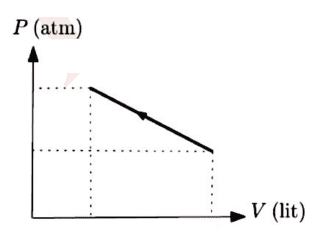
P-V graph with P (atm) on the vertical axis and V (lit) on the horizontal axis; a straight line segment slopes downward from upper left to lower right, with an arrow on the line pointing toward the upper left, and dotted guide lines drawn from its endpoints to the axes.

Can someone tell me if I am wrong ?

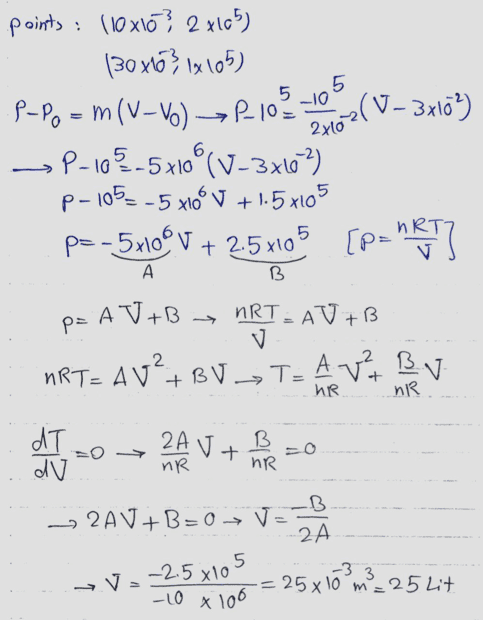
Handwritten working on a pressure-volume relation: points (10x10^-3, 2x10^5) and (30x10^-3, 1x10^5), a linear p-V fit p = -5x10^6 V + 2.5x10^5, then T = (A/nR)V^2 + (B/nR)V, dT/dV = 0 giving V = -B/2A = 25 x 10^-3 m^3 = 25 L.
 
Looks ok, except that you did not check that it is a maximum. Could be a local minimum, in which case either the starting or finishing temperature would be the max.
 
MatinSAR said:
Homework Statement:: We condense some ideal gas
Presumably you mean 'compress'. 'Condense' means something different!

In addition to what @haruspex already said...

It's not necessary to use SI units here. You can work in 'atm' and 'lit' (though 'lit' is not a common abbreviation for litres) and you will get the same answer. It's less messy.

For example, the gradient of the line can immediately be written as ##\frac {-1}{20}## (corresponding to units of atm/lit).

Try it – and check you understand why it works here.
 
haruspex said:
Looks ok, except that you did not check that it is a maximum. Could be a local minimum, in which case either the starting or finishing temperature would be the max.
I will use derivative test to prove it.
Thanks a lot for your help.
Steve4Physics said:
Presumably you mean 'compress'. 'Condense' means something different!
Sorry! I haven't spoken English for a long time and I didn't remember the correct word so I used google translate ...
Steve4Physics said:
It's not necessary to use SI units here. You can work in 'atm' and 'lit' (though 'lit' is not a common abbreviation for litres) and you will get the same answer. It's less messy.
Yes, thanks, I use SI units when I'm not sure if it's correct to use non-SI units.
Steve4Physics said:
For example, the gradient of the line can immediately be written as −120 (corresponding to units of atm/lit).

Try it – and check you understand why it works here.
Thanks a lot for your help ...
I will try this and I hope I will get similar result.
 
  • Like
Likes   Reactions: Steve4Physics