Questions Regarding the Inertia Tensor

Click For Summary
The discussion focuses on clarifying concepts related to the Inertia Tensor from the book "Classical Dynamics of Particles and Systems." The authors state that the velocity (V) and angular velocity (ω) are not unique to any specific particle, allowing them to be factored out of summations. The second term in Equation (11.9) does not require the Kronecker delta function because it arises from a double sum over the components of ω and position vectors. Diagonal terms in the Inertia Tensor represent moments of inertia aligned with coordinate axes, while off-diagonal terms are products of inertia, indicating how mass is distributed relative to the axes. Understanding these distinctions is crucial for analyzing rotational dynamics effectively.
sams
Gold Member
Messages
84
Reaction score
2
In Chapter 11: Dynamics of Rigid Bodies, in the Classical Dynamics of Particles and Systems book by Thornton and Marion, Fifth Edition, pages 415-418, Section 11.3 - Inertia Tensor, I have three questions regarding the Inertia Tensor:

1.The authors made the following statement: "neither V nor ω is characteristic of the αth particle."

1.PNG

What do the authors mean by the above statement and how did they take V.ω outside the relation?

2. Kronecker delta function

2.PNG

3.PNG


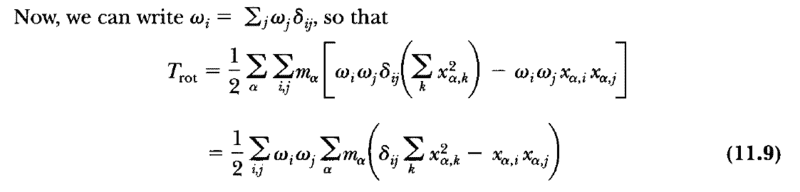
Shouldn't the second term in the square brackets or in the parenthesis of Equation (11.9) also contain the Kronecker delta function?

3. Physical Interpretation of the diagonals and off-diagonals of the Inertia Tensor
4.PNG


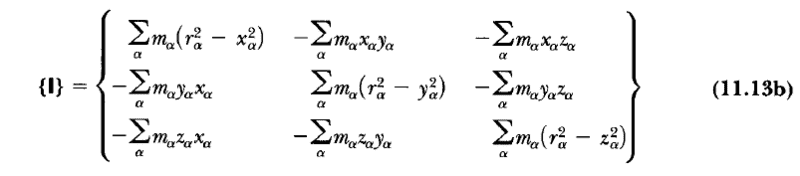
According to the authors, the diagonal terms are called the moments of inertia and the off-diagonal terms are called the products of inertia. What are the physical interpretations of the diagonal and the off-diagonal terms? What is the difference between them?

Thank you so much for your help.
 

Attachments

  • 1.PNG
    1.PNG
    13.6 KB · Views: 524
  • 2.PNG
    2.PNG
    6.2 KB · Views: 482
  • 3.PNG
    3.PNG
    8 KB · Views: 566
  • 4.PNG
    4.PNG
    7.6 KB · Views: 399
  • 4.PNG
    4.PNG
    7.6 KB · Views: 489
Last edited:
Physics news on Phys.org
sams said:
What do the authors mean by the above statement and how did they take V.ω outside the relation?
They mean that all particles have the same V and the same ω, so they can be taken out of the summation, due to the distributive property of the cross product.

sams said:
Shouldn't the second term in the square brackets or in the parenthesis of Equation (11.9) also contain the Kronecker delta function?
No, since the second term comes from a double sum over the components of ω and x. The Kronecker delta is introduced to transform the single sum into a double sum, so that both terms can be written together as a double sum.

sams said:
According to the authors, the diagonal terms are called the moments of inertia and the off-diagonal terms are called the products of inertia. What are the physical interpretations of the diagonal and the off-diagonal terms? What is the difference between them?
There is an orthogonal system of coordinates in which the tensor of inertia is diagonal. In that case, the moments of inertia obtained are aligned with the coordinate axes and they are called the principal moments of inertia. They represent the "natural" way in which the body can rotate. Any rotation can be written as a superposition of rotations around the principal moments of inertia.
 
  • Like
Likes sams
DrClaude said:
No, since the second term comes from a double sum over the components of ω and x. The Kronecker delta is introduced to transform the single sum into a double sum, so that both terms can be written together as a double sum.
5.PNG

Equation (11.8) is obtained from Equation (11.7). How did the second term come with a double sum and not the first term as well?
 

Attachments

  • 5.PNG
    5.PNG
    1.4 KB · Views: 438
sams said:
How did the second term come with a double sum and not the first term as well?
Because you are squaring a dot product. The dot product will give you a sum of three terms, and when you square it you get a product of two sums.

I suggest you write it out. It takes only a couple of lines, and it is just simple vector algebra. All will then become clear.
 
For simple comparison, I think the same thought process can be followed as a block slides down a hill, - for block down hill, simple starting PE of mgh to final max KE 0.5mv^2 - comparing PE1 to max KE2 would result in finding the work friction did through the process. efficiency is just 100*KE2/PE1. If a mousetrap car travels along a flat surface, a starting PE of 0.5 k th^2 can be measured and maximum velocity of the car can also be measured. If energy efficiency is defined by...

Similar threads

Replies
5
Views
1K
Replies
8
Views
3K
  • · Replies 4 ·
Replies
4
Views
2K
  • · Replies 11 ·
Replies
11
Views
11K
  • · Replies 30 ·
2
Replies
30
Views
3K
  • · Replies 1 ·
Replies
1
Views
4K
Replies
5
Views
2K
Replies
1
Views
3K
  • · Replies 3 ·
Replies
3
Views
4K
  • · Replies 6 ·
Replies
6
Views
2K