Quick Method of Calculating the 2nd Moment Of Area Of an I Beam

Click For Summary
SUMMARY

The discussion focuses on calculating the Second Moment of Area about the Z axis for an I Beam. Participants highlight that while the Y axis calculation is straightforward, the Z axis requires more effort due to the application of the parallel axis theorem. A suggested method involves using the moment of inertia about the centroid of each shape, emphasizing the importance of accurately determining the base and height for each component of the I Beam.

PREREQUISITES
  • Understanding of the Second Moment of Area
  • Familiarity with the parallel axis theorem
  • Knowledge of moment of inertia concepts
  • Basic geometry of I Beam shapes
NEXT STEPS
  • Research methods for calculating the Second Moment of Area for complex shapes
  • Study the application of the parallel axis theorem in structural engineering
  • Learn about moment of inertia calculations for various geometric shapes
  • Explore software tools for structural analysis, such as AutoCAD or SolidWorks
USEFUL FOR

Structural engineers, civil engineering students, and professionals involved in beam design and analysis will benefit from this discussion.

tomtomtom1
Messages
160
Reaction score
8
TL;DR
Quick Method of Calculating 2nd Moment Of Area Of I Beam
Hi All

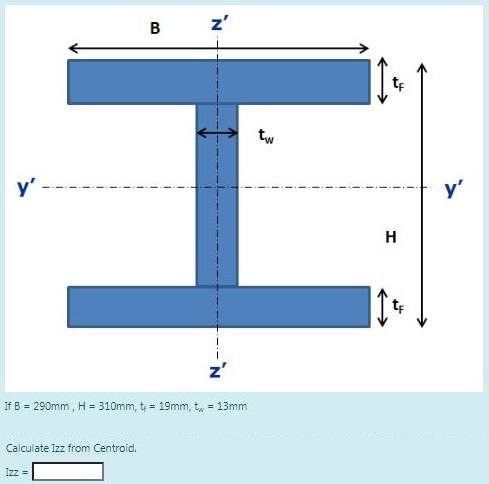
I was wondering if there was a quick method of calculating the Second Moment Of Area about the Z axis shown below?

I can quickly work out the Second Moment Of Area about the Y axis but the Z axis is proving very difficult and time consuming as the parallel axis therom needs to be applied to each shape.

Any ideas?

Thank you.
Quick Way.JPG
 
Engineering news on Phys.org
tomtomtom1 said:
Summary:: Quick Method of Calculating 2nd Moment Of Area Of I Beam

Hi All

I was wondering if there was a quick method of calculating the Second Moment Of Area about the Z axis shown below?

I can quickly work out the Second Moment Of Area about the Y axis but the Z axis is proving very difficult and time consuming as the parallel axis therom needs to be applied to each shape.

Any ideas?

Thank you.

View attachment 255519
you don’t have to use the parallel axis theorem at all. Why not try using the moment of Inertia about the centroid of each of the three shapes, after first determining base and height correctly for each shape.
 

Similar threads

  • · Replies 7 ·
Replies
7
Views
3K
  • · Replies 1 ·
Replies
1
Views
4K
  • · Replies 1 ·
Replies
1
Views
2K
  • · Replies 11 ·
Replies
11
Views
3K
  • · Replies 30 ·
2
Replies
30
Views
7K
  • · Replies 2 ·
Replies
2
Views
2K
  • · Replies 12 ·
Replies
12
Views
12K
  • · Replies 2 ·
Replies
2
Views
8K
  • · Replies 5 ·
Replies
5
Views
4K
Replies
3
Views
3K