dougy
- 26
- 0
Hello everyone.
From what I've understood, the radiant intensity of a surface is defined as the number of photons emitted by the surface per unit solid angle (steradian) and per second, times a constant (that constant being the mean energy of a photon emitted by this surface). So radiant intensity is expressed in W·sr−1
The way I see it, the radiant intensity of a Lambertian surface (i.e. an isotropic source) is the same in every direction, so plotting the radiant intensity of such a surface for each direction should give in 3D a sphere (or a semisphere) with the source at the center, and in 2D a circle (or a semicircle) with the source at the center. Yet all the representations I find of the radiant intensity of an isotropic source are similar to this one :
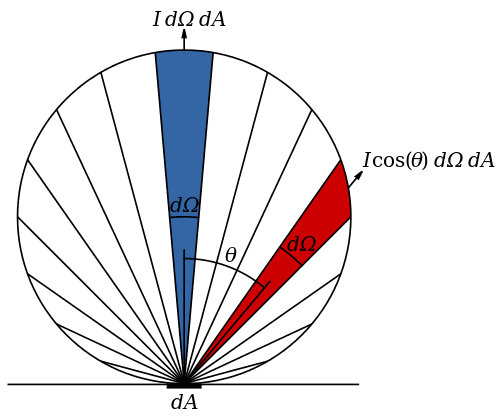
which, the way I see it, would mean that the radiant intensity is maximum in the direction normal to the emitting surface, and approach zero as the direction becomes parallel to the surface.
What am I not getting there?
From what I've understood, the radiant intensity of a surface is defined as the number of photons emitted by the surface per unit solid angle (steradian) and per second, times a constant (that constant being the mean energy of a photon emitted by this surface). So radiant intensity is expressed in W·sr−1
The way I see it, the radiant intensity of a Lambertian surface (i.e. an isotropic source) is the same in every direction, so plotting the radiant intensity of such a surface for each direction should give in 3D a sphere (or a semisphere) with the source at the center, and in 2D a circle (or a semicircle) with the source at the center. Yet all the representations I find of the radiant intensity of an isotropic source are similar to this one :
which, the way I see it, would mean that the radiant intensity is maximum in the direction normal to the emitting surface, and approach zero as the direction becomes parallel to the surface.
What am I not getting there?