Railgun: Significant magnetic field where projectile is?

Click For Summary

Discussion Overview

The discussion revolves around the magnetic field behavior in railguns, particularly focusing on the region where the projectile is located and the implications for Lorentz force calculations. Participants explore configurations of the projectile and their effects on the magnetic field and forces involved, addressing both theoretical and conceptual aspects of railgun operation.

Discussion Character

  • Exploratory
  • Technical explanation
  • Conceptual clarification
  • Debate/contested

Main Points Raised

  • Some participants express confusion about the presence of a significant magnetic field at the projectile's location, questioning whether it diminishes compared to the field between wires further away.
  • One participant proposes a design modification to the projectile to potentially enhance its interaction with the magnetic field.
  • There is a discussion about whether the opposing magnetic field created by parts of the projectile should be considered when calculating the Lorentz force acting on it.
  • Participants debate the implications of anti-parallel currents in the projectile and their effect on the net magnetic field and forces, with some suggesting that these currents cancel each other out.
  • One participant presents a thought experiment regarding the behavior of an isolated part of the projectile with an initial charge separation and its implications for motion.
  • Clarifications are made regarding the configuration of the projectile and its electrical contact with the rails, with some participants asserting that the net current in certain areas is zero, leading to no magnetic field being generated there.

Areas of Agreement / Disagreement

Participants do not reach a consensus on the role of the magnetic field created by the anti-parallel parts of the projectile in the Lorentz force calculations. There are competing views on whether these fields contribute to the net force experienced by the projectile.

Contextual Notes

Some assumptions regarding the configurations and interactions of currents and magnetic fields remain unresolved, particularly concerning the implications of charge separation and the behavior of the magnetic field in specific regions of the railgun setup.

greypilgrim
Messages
581
Reaction score
44
Hi.
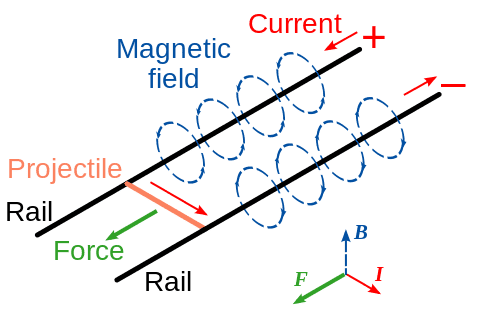
Very simplified schematics of railguns all look like this:
Railgun-1.svg.png

I have trouble properly understanding this. So apparently there is still a significant magnetic field where the projectile is, even though that's where the current stops flowing through the rails? Of course the magnetic field doesn't just stop there, there's a fringe field, but that has to be a lot weaker than the magnetic field between two wires far from the ends, doesn't it?

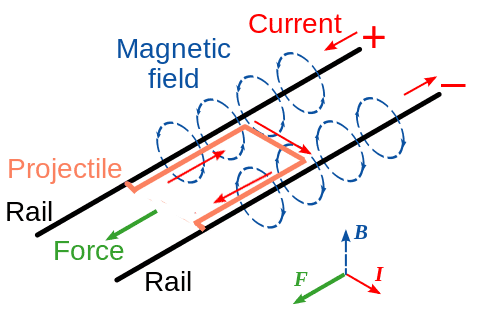
Would it make sense to build the projectile like this to move the crossing wire further inside the magnetic field:
Railgun-3.svg.png

Of course, the parts of the projectile (anti-)parallel to the rails would create an opposing magnetic field. But since this field is created by the projectile itself, it shouldn't be taken into account for the Lorentz force acting on the projectile. Or should it?
 
Last edited:
Physics news on Phys.org
Can you clarify the second configuration? Are the orange conductors that parallel the black rails insulated from those rails, or in electrical contact with them? If they're in contact, isn't this the same as the first configuration, just with slightly thicker rails ahead of the projectile?
 
They are part of the projectile and insulated from the rails, apart from the very front where there's contact (at the places where the projectile in the initial configuration was).

EDIT: I uploaded a clarified version.
 
Last edited:
But the orange current flowing anti-parallel to the black current will cancel, so no net increase in the field past the projectile.
 
That's what I was wondering, does the field created by the anti-parallel parts count when calculating the Lorentz force onto the projectile? Wouldn't that mean that the orange part would create a net force on itself, contradicting 3rd Newton?

Imagine we only have the isolated orange part at rest, but with a huge inital charge separation that leads to a current. That shouldn't start moving, should it?
Railgun-4.svg.png
 
greypilgrim said:
does the field created by the anti-parallel parts count when calculating the Lorentz force onto the projectile?
It cancels the force from the black wire next to it. You can say that they each create an opposite force, if you like. I prefer to say that there is no net current in that area so no field is created, but it is ultimately the same thing.
 
  • Like
Likes   Reactions: Bystander
greypilgrim said:
That's what I was wondering, does the field created by the anti-parallel parts count when calculating the Lorentz force onto the projectile? Wouldn't that mean that the orange part would create a net force on itself, contradicting 3rd Newton?
Yes, the "anti-parallel parts count". On your diagram, I've marked non-existent magnetic field loops with red Xs:
1699127582316.png

The field in that region is zero because the net current through those loops vanishes: the black and orange currents are antiparallel and exactly balance to zero. So the only region of magnetic field propelling the projectile is behind it. Your "alternative" is really just the standard railgun.
 
Okay, thanks. I think my question comes down to the thought experiment in #5. I refined it a bit and formulated it more clearly in this other thread.
 
greypilgrim said:
Okay, thanks. I think my question comes down to the thought experiment in #5. I refined it a bit and formulated it more clearly in this other thread.
This thread here is now closed. Please continue the discussion in that other thread. Thanks.
 

Similar threads

  • · Replies 4 ·
Replies
4
Views
1K
  • · Replies 61 ·
3
Replies
61
Views
6K
  • · Replies 1 ·
Replies
1
Views
1K
  • · Replies 2 ·
Replies
2
Views
2K
  • · Replies 5 ·
Replies
5
Views
1K
  • · Replies 12 ·
Replies
12
Views
2K
  • · Replies 8 ·
Replies
8
Views
2K
  • · Replies 0 ·
Replies
0
Views
1K
  • · Replies 42 ·
2
Replies
42
Views
3K
  • · Replies 7 ·
Replies
7
Views
2K