4,023 replies · 312K views · last reply
Science Advisor
Gold Member
- 2,413
- 5,295
We're having an interesting trip. I don't have a picture but my wife spotted Kurt Russell and Goldy Hawn walking on the sidewalk in the opposite direction a few blocks from our hotel.Borg said:
sbrothy
Gold Member
- 2,062
- 1,609
You gotta give this series a chance. It's incredibly funnny.

-- "Jeffrey, that man is a loser and will never amount to anything! I'm not gonna arrest him because a jail cell wont do anything to him he hasn't already done to himself. Let this be a teaching moment for you."
EDIT: I hope this is subtle enough to get through moderation!
-- "Jeffrey, that man is a loser and will never amount to anything! I'm not gonna arrest him because a jail cell wont do anything to him he hasn't already done to himself. Let this be a teaching moment for you."
EDIT: I hope this is subtle enough to get through moderation!
Last edited:
sbrothy
Gold Member
- 2,062
- 1,609
My first computer:jtbell said:Early electronic calculators and microcomputers:
View attachment 371645
View attachment 371649
View attachment 371648
Apple I computers in "original condition" are apparently scarce enough that they're identified by their owners.
View attachment 371646
View attachment 371647
https://www.msx.org/wiki/images/6/6a/Hx22ch1.jpg
My first computer. I still have a photo of the screen after the computer spent 48 hours "drawing" mandelbrot (calculating millions of pixels but only painting blocks as it was connected to an 80s TV.)jtbell said:Early electronic calculators and microcomputers:
View attachment 371645
View attachment 371649
View attachment 371648
Apple I computers in "original condition" are apparently scarce enough that they're identified by their owners.
View attachment 371646
View attachment 371647

sbrothy
Gold Member
- 2,062
- 1,609
Wow, I almost tihnk someone put something in my drink just looking at that thing!Borg said:The Vessel at the end of the High Line.
View attachment 371683
DennisN
Gold Member
- 2,199
- 10,367
A couple of spring shots from April:

Springtime in the park.

Common spikerush in a pond.

A lovely looking tulip, Tulipa 'Palmyra'.

A star magnolia tree in the city.

A common daisy (the photo was quite heavily edited to get a partly black background).
Lens used (all photos): Canon nFD 50mm f/1.4.
Springtime in the park.
Common spikerush in a pond.
A lovely looking tulip, Tulipa 'Palmyra'.
A star magnolia tree in the city.
A common daisy (the photo was quite heavily edited to get a partly black background).
Lens used (all photos): Canon nFD 50mm f/1.4.
DennisN
Gold Member
- 2,199
- 10,367
jtbell said:Early electronic calculators and microcomputers:
The post by @jtbell with old hardware, including an old Hewlett-Packard calculator, prompted me to pull out these two old devices I have at home for a photo shoot:
(HP = Hewlett-Packard)
1. Item #1: A HP 27 calculator, made by Hewlett-Packard between 1976 and 1978, so it is ca 49 years old
. I used this in upper secondary school and I really loved it, so I'm never going to get rid of it. This calculator, and the next one, originally belonged to my father who later gave them to me.HP 27 original case.
HP 27. More info here on Wikipedia and here on the Museum of HP Calculators.
HP 27, side view.
HP 27, back. Apparently it was made in Singapore.
2. Item #2: A HP 22 calculator, made between 1975 and 1978, so it is ca 49 years old too.
A quite dusty old HP 22.
HP 22, side view.
(all shot with Canon nFD 50mm f/3.5 Macro)
Last edited:
sbrothy
Gold Member
- 2,062
- 1,609
I remember my stepdad giving me a Texas-Instruments "brick" which could be "programmed" to play various games. That must have been before the MSX. The youth today have no idea what they've missed. Mainframes with 8-inch floppy disks, magnetic tape and whatnot!DennisN said:The post by @jtbell with old hardware, including an old Hewlett-Packard calculator, prompted me to pull out these two old devices I have at home for a photo shoot:
(HP = Hewlett-Packard)
1. Item #1: A HP 27 calculator, made by Hewlett-Packard between 1976 and 1978, so it
is ca 49 years old
so I'm never going to get rid of it. This calculator, and the next one, originally belonged
to my father who later gave them to me.
View attachment 371715
HP 27 Original case.
View attachment 371716
HP 27. More info here on Wikipedia and here on the Museum of HP Calculators.
View attachment 371717
HP 27, side view.
View attachment 371718
HP 27, back. Apparently it was made in Singapore.
2. Item #2: A HP 22 calculator, made between 1975 and 1978, so it is ca 49 years old too.
View attachment 371719
A quite dusty old HP 22.
View attachment 371720
HP 22, side view.
(all shot with Canon nFD 50mm f/3.5 Macro)
EDIT: And yeah, lets not forget punch cards.
sbrothy
Gold Member
- 2,062
- 1,609
So beautiful:
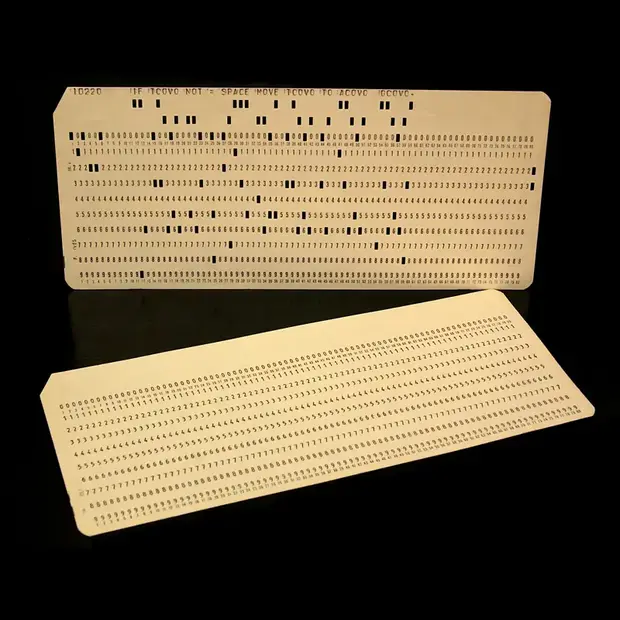
That's kinda where it all started. You heard the story of how the magnetic stripe on cards where created yeah? An IBM employee brought the problem of attaching the stripe to the card home to his wife who immediately ironed it on. Technique was subsequently used for years.
The Magnetic Stripe
That's kinda where it all started. You heard the story of how the magnetic stripe on cards where created yeah? An IBM employee brought the problem of attaching the stripe to the card home to his wife who immediately ironed it on. Technique was subsequently used for years.
The Magnetic Stripe
pinball1970
Gold Member
2025 Award
- 3,906
- 6,253
Some classics! Here are a few more.DennisN said:The post by @jtbell with old hardware, including an old Hewlett-Packard calculator, prompted me to pull out these two old devices I have at home for a photo shoot:
(HP = Hewlett-Packard)
1. Item #1: A HP 27 calculator, made by Hewlett-Packard between 1976 and 1978, so it
is ca 49 years old
so I'm never going to get rid of it. This calculator, and the next one, originally belonged
to my father who later gave them to me.
View attachment 371715
HP 27 Original case.
View attachment 371716
HP 27. More info here on Wikipedia and here on the Museum of HP Calculators.
View attachment 371717
HP 27, side view.
View attachment 371718
HP 27, back. Apparently it was made in Singapore.
2. Item #2: A HP 22 calculator, made between 1975 and 1978, so it is ca 49 years old too.
View attachment 371719
A quite dusty old HP 22.
View attachment 371720
HP 22, side view.
(all shot with Canon nFD 50mm f/3.5 Macro)
pinball1970
Gold Member
2025 Award
- 3,906
- 6,253
Racing green. He was actually driving off slowly as I took this, it sounded nowhere near as pretty as it looked!



Would have been nice to have seen one of the older Jags

Not bad for a Saturday afternoon in Hyde.

Would have been nice to have seen one of the older Jags
Not bad for a Saturday afternoon in Hyde.
DennisN
Gold Member
- 2,199
- 10,367
pinball1970 said:Racing green
pinball1970 said:Would have been nice to have seen one of the older Jags
My dad used to have racing green Jaguar, actually. I think it was a Jaguar XJ (possibly X300).
I remember it was the most comfortable car I had ever taken a ride in at that point.
And I drove it sometimes too, it was really wonderful to drive
.
Last edited:
sbrothy
Gold Member
- 2,062
- 1,609
pinball1970 said:Racing green. He was actually driving off slowly as I took this, it sounded nowhere near as pretty as it looked!
View attachment 371726
Quite a contrast with the BMW in the background!
Jonathan Scott
Gold Member
- 2,358
- 1,274
In my first job with IBM, as a vacation student in 1973, I had some free time and I worked out how to use overpunching on the IBM 029 card punch to create patterns, which could then be duplicated by copying the card. An unofficial version of the IBM logo one was popular (I still have a copy):
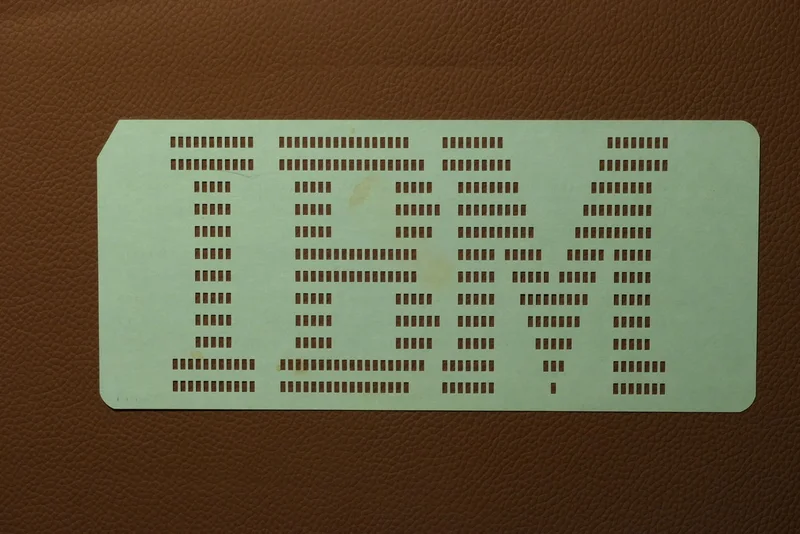
But management banned copying it because rows with all holes punched tended to jam the mechanism!
But management banned copying it because rows with all holes punched tended to jam the mechanism!
sbrothy
Gold Member
- 2,062
- 1,609
So true!DaveE said:Unless you actually had to use them. The 2nd worst way to program a computer.
EDIT: Wait, what's the worst? Actual machine code? Editing an already compiled binary using a hex-editor? Please don't say assembly. That would be a walk in the park compared!
sbrothy
Gold Member
- 2,062
- 1,609
Jonathan Scott said:In my first job with IBM, as a vacation student in 1973, I had some free time and I worked out how to use overpunching on the IBM 029 card punch to create patterns, which could then be duplicated by copying the card. An unofficial version of the IBM logo one was popular (I still have a copy):
View attachment 371735
But management banned copying it because rows with all holes punched tended to jam the mechanism!
Hah, "overpunching" Is it like "overclocking" but for old IBM mainframes?

sbrothy
Gold Member
- 2,062
- 1,609
sbrothy said:So true!
EDIT: Wait, what's the worst? Actual machine code? Editing an already compiled binary using a hex-editor? Please don't say assembly. That would be a walk in the park compared!
---- Assembly language (wiki):Thus, programmers are freed from tedious repetitive calculations and assembler programs are much more readable than machine code.
Well yeah, but "freed from repetitive calculations" seems to me a bit optimistic or over-advertized.
Jonathan Scott
Gold Member
- 2,358
- 1,274
I don't know what was intended, but in 1974 I was trying out things in IBM mainframe assembly language and didn't like having to wait for compile job turnaround so I started an interactive debug session on an existing dummy program and poked machine code into storage in hex to test it, saving a lot of time.sbrothy said:So true!
EDIT: Wait, what's the worst? Actual machine code? Editing an already compiled binary using a hex-editor? Please don't say assembly. That would be a walk in the park compared!
My last job was looking after IBM's High Level Assembler, compiling a more advanced version of the same language. The macro language made it ridiculously powerful, if one had the patience to learn how to write it. Unlike for most programming languages, the macro language has access to any definitions the assembler has already processed from the current pass, and it can even look ahead to a limited extent (ignoring macros for that purpose). Someone wrote some macro definitions around 1990 that meant you could compile an early version of Fortran simply by giving the source code to the assembler!
pinball1970
Gold Member
2025 Award
- 3,906
- 6,253
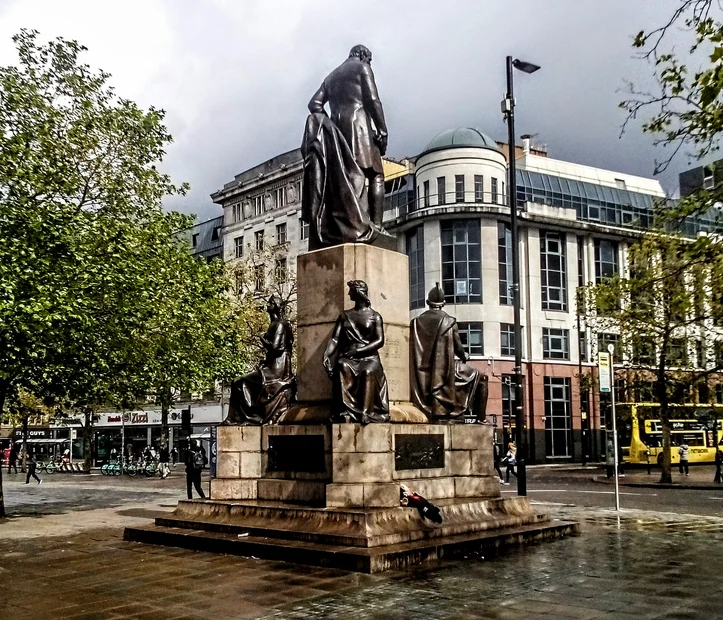
Manchester Piccadilly has two Victorian statues, This is one.
sbrothy
Gold Member
- 2,062
- 1,609
Obviously, you have experienced the whole tour, so to speak. I must've been younger, I really started expending energy learning C, then understanding that I needed to know assembly to really understand what was going on. Leading me to embedded code (Laser scanners, dictaphones), but also ultimately to C++. If you've known programming from that level you don't ask questions like "What's the best language to learn?".Jonathan Scott said:I don't know what was intended, but in 1974 I was trying out things in IBM mainframe assembly language and didn't like having to wait for compile job turnaround so I started an interactive debug session on an existing dummy program and poked machine code into storage in hex to test it, saving a lot of time.
My last job was looking after IBM's High Level Assembler, compiling a more advanced version of the same language. The macro language made it ridiculously powerful, if one had the patience to learn how to write it. Unlike for most programming languages, the macro language has access to any definitions the assembler has already processed from the current pass, and it can even look ahead to a limited extent (ignoring macros for that purpose). Someone wrote some macro definitions around 1990 that meant you could compile an early version of Fortran simply by giving the source code to the assembler!
Learn algorithms, basic functional analysis, perhaps Linear Algebra; and understand that there's more than one kind (or even several kinds) of language(s).
Staff Emeritus
Science Advisor
Homework Helper
2025 Award
- 16,110
- 8,631
Machine code, in binary, using a row of switches on the front panel.sbrothy said:Wait, what's the worst? Actual machine code?

I played with one of these as an undergraduate in the early 1970s. The main I/O device was a teletype terminal with a paper tape reader / puncher. I normally wrote assembly language using the keyboard. When I wanted to save something, either source code or an assembled program, I punched a paper tape.
The operating system was on a paper tape that I had to load after turning the power on. In order to load that paper tape, I first had to enter a short paper tape reading program via the front panel switches. About twenty 12-bit binary instructions, one at a time via the switch register, from a sheet of paper that we kept handy.
- 13,973
- 16,898
That is kind of awesome. Both that you had to do it and that you could fit a bootloader into thirty bytes.jtbell said:About twenty 12-bit binary instructions, one at a time via the switch register, from a sheet of paper that we kept handy.
sbrothy
Gold Member
- 2,062
- 1,609
Ouch! But cool!jtbell said:Machine code, in binary, using a row of switches on the front panel.
View attachment 371759
View attachment 371760
I played with one of these as an undergraduate in the early 1970s. The main I/O device was a teletype terminal with a paper tape reader / puncher. I normally wrote assembly language using the keyboard. When I wanted to save something, either source code or an assembled program, I punched a paper tape.
The operating system was on a paper tape that I had to load after turning the power on. In order to load that paper tape, I first had to enter a short paper tape reading program via the front panel switches. About twenty 12-bit binary instructions, one at a time via the switch register, from a sheet of paper that we kept handy.
sbrothy
Gold Member
- 2,062
- 1,609
You've all clearly been in the game for longer than me. Looking at that thing I must admit I'm a little grateful that that was before my time!DaveE said:
sbrothy
Gold Member
- 2,062
- 1,609
Although I have played Hanoi on an old IBM "PC" "running" CP/M.DaveE said:
Similar threads
- songoku
- · Replies 12 ·
- Introductory Physics Homework Help
- Replies
- 12
- Gezstarski
- · Replies 2 ·
- Optics
- Replies
- 2
- ashah99
- · Replies 1 ·
- Calculus and Beyond Homework Help
- Replies
- 1
- BadgerBadger92
- · Replies 73 ·
- Art, History, and Linguistics
- Replies
- 73
- berkeman
- · Replies 7 ·
- Mechanical Engineering
- Replies
- 7
- The_Baron
- · Replies 122 ·
- Other Physics Topics
- Replies
- 122
- kelly0303
- · Replies 19 ·
- Atomic and Condensed Matter
- Replies
- 19
- yungman
- · Replies 27 ·
- Computing and Technology
- Replies
- 27
Undergrad
Random variable vs Random Process
- fog37
- · Replies 2 ·
- Set Theory, Logic, Probability, Statistics
- Replies
- 2
- Graham 1956
- · Replies 5 ·
- Astronomy, Astrophysics, Cosmology
- Replies
- 5