RC Circuit Discharge Conceptual Question

Click For Summary
SUMMARY

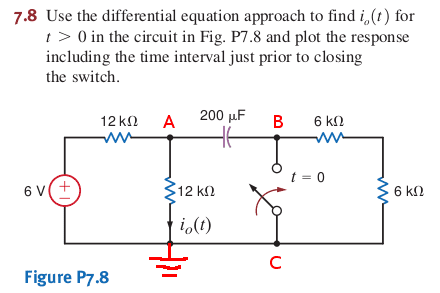
The discussion centers on the behavior of an RC circuit during the discharge phase when a switch is closed. Initially, the voltage at node A is 3V, while nodes B and C are at 0V, with a current of 0.25 mA. Upon closing the switch, the two 6kΩ resistors become irrelevant, leading to confusion about the flow of current from the capacitor between nodes B and C. The conclusion drawn is that the voltage across the capacitor remains constant at 3V, contradicting the solution manual's assertion that current would flow from B to C.

PREREQUISITES
  • Understanding of RC circuits and their components
  • Knowledge of voltage and current concepts in electrical engineering
  • Familiarity with Ohm's Law and Kirchhoff's Voltage Law
  • Basic principles of capacitor behavior during discharge
NEXT STEPS
  • Study the principles of capacitor discharge in RC circuits
  • Learn about the impact of closing switches on circuit behavior
  • Explore Kirchhoff's Laws in more complex circuit scenarios
  • Investigate the role of resistors in parallel and series configurations
USEFUL FOR

Electrical engineering students, circuit designers, and anyone seeking to deepen their understanding of RC circuit dynamics and capacitor behavior during discharge.

DaleSwanson
Messages
350
Reaction score
2
http://i.imgur.com/ZCcaZpq.png
ZCcaZpq.png


I have the solution manual, so this is more just a question of why, rather than what.

I understand that with the switch open:
vA = 3v
vB = vC = 0v
i0 = 0.25 mA

When the switch closes it creates a short that makes the two 6kΩ resistors irrelevant. What I don't understand is why anything should change then. The solution manual tells me that a current would flow from the capacitor from B to C, but why? It seems like nodes B and C should be at 0v both before and after the switch is closed.
 
Physics news on Phys.org
Yes, node B is at zero both before and after the switch is closed, but after the switch is closed, what is the voltage across the capacitor? Is it any different than before the switch is closed?
 
You are right--book is wrong.
 
As far as I can tell the voltage across the capacitor should always be 3v.
 

Similar threads

  • · Replies 2 ·
Replies
2
Views
2K
  • · Replies 10 ·
Replies
10
Views
3K
  • · Replies 8 ·
Replies
8
Views
4K
  • · Replies 2 ·
Replies
2
Views
2K
  • · Replies 3 ·
Replies
3
Views
3K
  • · Replies 3 ·
Replies
3
Views
3K
  • · Replies 10 ·
Replies
10
Views
3K
  • · Replies 1 ·
Replies
1
Views
6K
  • · Replies 4 ·
Replies
4
Views
2K
  • · Replies 46 ·
2
Replies
46
Views
11K