Solve 2 Loop RC Circuit: Find Q(topen)

Click For Summary

Discussion Overview

The discussion revolves around solving a problem related to a two-loop RC circuit, specifically focusing on finding the charge on a capacitor at a given time after the switch is opened. Participants explore the circuit's behavior during both the charging and discharging phases, utilizing Kirchhoff's laws and relevant equations.

Discussion Character

  • Technical explanation
  • Mathematical reasoning
  • Debate/contested

Main Points Raised

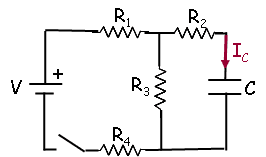
  • One participant describes the circuit configuration and provides values for resistors, capacitance, and battery voltage, stating the need to find Q(topen) after the switch is opened.
  • Another participant requests to see the calculations for the capacitor's charging voltage and asks about the discharging path when the switch is open.
  • A participant shares their calculation for the maximum charge on the capacitor, noting a value of approximately 243μC and expressing difficulty in determining the time constant τ.
  • One participant clarifies that the discharge path involves resistors R2 and R3 and suggests writing the exponential time equation for the capacitor voltage during discharge.
  • Another participant points out that the time constant τ should be calculated as the product of resistance and capacitance, emphasizing the need for proper units.
  • One participant acknowledges a mistake in their calculations and expresses gratitude for the assistance provided by others in the thread.

Areas of Agreement / Disagreement

Participants express varying levels of understanding regarding the calculation of the time constant and the discharge path of the circuit. There is no clear consensus on the correct approach to find Q(topen), and some participants indicate confusion or uncertainty about their calculations.

Contextual Notes

There are unresolved issues regarding the correct determination of the time constant τ and the appropriate resistors to use in calculations. Some participants have provided conflicting information about the discharge path and the calculations involved.

acrimius
Messages
6
Reaction score
0
1. Situation and Variables:
A circuit is constructed with four resistors, one capacitor, one battery and a switch as shown. The values for the resistors are: R1 = R2 = 30 Ω, R3 = 66 Ω and R4 = 113 Ω. The capacitance is C = 64 μF and the battery voltage is V = 12 V. The positive terminal of the battery is indicated with a + sign.
phpAv88Ty.png


2. Sub-question:
After the switch has been closed for a very long time, it is then opened. What is Q(topen), the charge on the capacitor at a time topen = 786 μs after the switch was opened?

3. Relevant Equations:
Kirchhoff's Loop Rule: \Sigma V_l = 0

Kirchhoff's Node Rule: I_i = I_o

V_C = \frac {q} {C}

For a discharging circuit:
q(t) = q_o e^\frac {-t} {\tau}

4. Attempt:
When the switch is closed initially and time goes to infinity, the capacitor charges up and reaches it's capacitance, which I found the max charge, qo to be about 243μC.
Then for a discharging circuit, we have the equation I gave above q(t). I believe my issue is finding tau, which is RC. I have been using R = R_1+R_2 but that hasn't been correct. I've tried different combinations of resistors but I'm not quite getting it.
 
Last edited by a moderator:
Physics news on Phys.org
Show your working for the capacitor charging voltage.

How to determine the capacitor's discharging path when the switch is an open circuit?
 
NascentOxygen said:
Show your working for the capacitor charging voltage.

How to determine the capacitor's discharging path when the switch is an open circuit?
Q(∞)?
IC = 0 ∴ I1 = I2
Knowing this:
Loop for right hand side (I):
\frac {q} {C} = I_2R_3

Loop for left hand side (II):
V_b = I_2(R_1+R_3+R_4)
Therefore,
I_2 = \frac {V_b} {R_1+R_3+R_4}

plugging this into (I):
\frac {q} {C} = \frac {V_bR_3} {R_1+R_3+R_4}

then solve for q, which is just multiplying both sides by C.
The exactly answer they have for Q is 242.526315789474μC, which is what I got, and I have this number stored so I used it for my text calculation of find Q(786μs) from the equation q(t) = q_oe^\frac{-t} {\tau}
 
Also I figured the current go across the switch, so I assumed it would only traverse the right hand side, which is why I use R=R_2+R_3 the equation I originally posted is not what I had written, it was a typo on my part.
 
acrimius said:
which is why I use R=R_2+R_3
That's the discharge path. So you need to be able to write by inspection the exponential time equation for the capacitor voltage as it discharges. I see you almost have.

Are you able to calculate τ and finish this now?
 
NascentOxygen said:
That's the discharge path. So can you write by inspection the exponential time equation for the capacitor voltage as it discharges?
Right. So I have this equation:
q(t) = q_oe^\frac {-t} {R_2+R_3}
but because R2+R3 is so large in comparison to t=786μs, the e part is approximately 1, and so my calculator outputs nearly the same answer as I had before, which the website counts as incorrect
 
The time constant is the product of R and C. It needs to have units of seconds, or it wouldn't be a time.
 
  • Like
Likes   Reactions: acrimius
NascentOxygen said:
The time constant is the producut of R and C.
Wow, that was a really dumb mistake on my part. Thanks for helping me though, I probably would have never realized that.
 
I thought you had it right in your first post ...
acrimius said:
I believe my issue is finding tau, which is RC.
 

Similar threads

  • · Replies 10 ·
Replies
10
Views
3K
  • · Replies 17 ·
Replies
17
Views
6K
  • · Replies 7 ·
Replies
7
Views
5K
  • · Replies 1 ·
Replies
1
Views
2K
  • · Replies 7 ·
Replies
7
Views
3K
Replies
36
Views
12K
  • · Replies 10 ·
Replies
10
Views
4K
  • · Replies 3 ·
Replies
3
Views
2K
  • · Replies 10 ·
Replies
10
Views
4K
  • · Replies 7 ·
Replies
7
Views
2K