RC DC Series and Parallel Circuit

Click For Summary

Homework Help Overview

The discussion revolves around an RC circuit in a DC context, focusing on the behavior of current and voltage in series and parallel configurations. Participants are exploring the application of Kirchhoff's laws and Ohm's law in analyzing the circuit.

Discussion Character

  • Exploratory, Conceptual clarification, Mathematical reasoning, Assumption checking

Approaches and Questions Raised

  • Participants discuss initial attempts to calculate total current and voltage across components. Questions arise regarding the flow of current through capacitors after reaching equilibrium and the relationship between current and voltage in the circuit.

Discussion Status

Some participants have provided insights into the behavior of current in the circuit, particularly regarding the charging of capacitors and the conditions under which current ceases to flow. There is an ongoing exploration of the implications of these observations.

Contextual Notes

Participants express confusion over the application of formulas and the interpretation of circuit behavior, particularly in mixed series and parallel arrangements. There is a noted reliance on provided answers to guide understanding.

DeadFlower
Messages
3
Reaction score
0
Hi!

Homework Statement


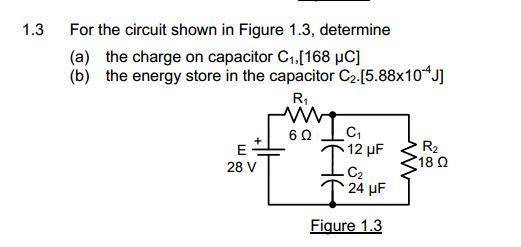
attachment.php?attachmentid=61046&stc=1&d=1377062905.jpg

Homework Equations


V = IR
Kirchhoff Current and Voltage Law.

The Attempt at a Solution


I am facing difficulty with this RC circuit.
I tried looking up solutions but all I could find were either exclusively series or parallel.

My first guess was to take Total Current = 28/(6+18). However, that ended up being wrong.
I worked backwards from the answer provided and realized that Current through R2 = 28/(6+18) instead of what I thought earlier. However, I am unable to relate this to any of the formula I can find.I would be a great help if someone were able to explain to me how to arrive and the solutions to the question.
Thanks.
 

Attachments

  • RC DC.JPG
    RC DC.JPG
    14.3 KB · Views: 624
Last edited:
Physics news on Phys.org
DeadFlower said:
Hi!

Homework Statement


attachment.php?attachmentid=61046&stc=1&d=1377062905.jpg


Homework Equations


V = IR
Kirchhoff Current and Voltage Law.


The Attempt at a Solution


I am facing difficulty with this RC circuit.
I tried looking up solutions but all I could find were either exclusively series or parallel.

My first guess was to take Total Current = 28/(6+18). However, that ended up being wrong.

How did you proceed from here?

DeadFlower said:
I worked backwards from the answer provided and realized that Current through R2 = 28/(6+18) instead of what I thought earlier. However, I am unable to relate this to any of the formula I can find.


I would be a great help if someone were able to explain to me how to arrive and the solutions to the question.
Thanks.

Does any current flow through the capacitors after reaching the equilibrium voltage?
The "total current" is the same as the current through either R2 and R1.

ehild
 
Can you calculate the voltages across the capacitors?
 
ehild said:
How did you proceed from here?


Does any current flow through the capacitors after reaching the equilibrium voltage?
The "total current" is the same as the current through either R2 and R1.

ehild

Oh my. It was a mathematical error on my part. I deeply apologise.

After taking Total Current = V/R= 28/(6+18) = 1r1r6 A
Voltage across R1 = IR = 1r1r6 * 6 = 7 V
Therefore voltage across C1 + C2 = 28 - 7 = 21 V
Capacitance total = (1/12 + 1/24)^-1 = 8 μF
Therefore Charge across C1 and C2 = CV = (8*10^-6)(21) = 168 μC (FOUND)

However there is one thing I would like to ask.
So, this means that no current flows through the capacitors?
 
DeadFlower said:
However there is one thing I would like to ask.
So, this means that no current flows through the capacitors?

It flows at the beginning when the circuit is connected. After a while, the capacitors are charged, till the voltage gets the same across them as the voltage across R2. After that, no more potential difference to drive charges to the capacitor plates, so no current flows after the steady state is settled.


ehild
 
ehild said:
It flows at the beginning when the circuit is connected. After a while, the capacitors are charged, till the voltage gets the same across them as the voltage across R2. After that, no more potential difference to drive charges to the capacitor plates, so no current flows after the steady state is settled.


ehild

Ahhh, I understand now. Thanks!

Thread closed then :)
 

Similar threads

  • · Replies 14 ·
Replies
14
Views
2K
  • · Replies 13 ·
Replies
13
Views
1K
Replies
20
Views
2K
  • · Replies 4 ·
Replies
4
Views
2K
Replies
3
Views
2K
  • · Replies 14 ·
Replies
14
Views
5K
  • · Replies 5 ·
Replies
5
Views
2K
  • · Replies 1 ·
Replies
1
Views
928
  • · Replies 13 ·
Replies
13
Views
2K
  • · Replies 6 ·
Replies
6
Views
3K