[rcl circuits] is this a contradiction?

4 replies · 2K views · last reply
Vishera
Messages
72
Reaction score
1
Problem:
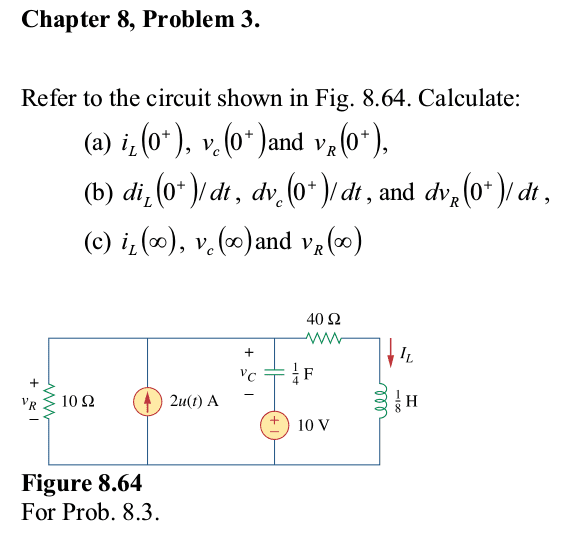
Circuit schematic for Fig. 8.64 with a 10 Ω resistor V_R on the left, a 2u(t) A current source in parallel, a capacitor with voltage v_c and 1/4 F, a 10 V source, a 40 Ω resistor, and an inductor I_L of 1/8 H.


Attempt:
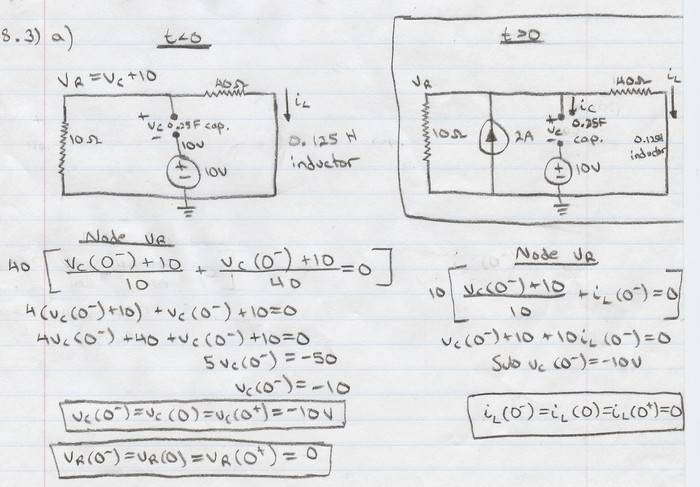
Handwritten circuit analysis for t<0 and t>0: two circuit schematics with a 10 ohm resistor, 0.25 F capacitor, 0.125 H inductor, 40 ohm resistor and 10 V source, followed by nodal equations solving vc(0-) = -10 V and vR(0-) = vR(0+) = 0.

But here is what happens when I apply nodal analysis to the same node at t>0:
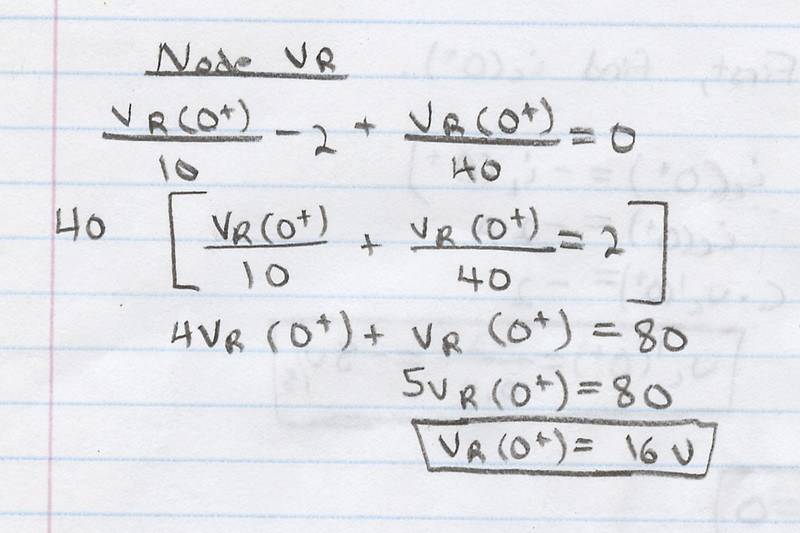
Handwritten nodal analysis labeled Node VR: VR(0+)/10 - 2 + VR(0+)/40 = 0, multiplied by 40 to give 4VR(0+) + VR(0+) = 80, so 5VR(0+) = 80 and VR(0+) = 16 V.


Is this a contradiction? Is the voltage of the resistor at t=0+ equal to 16V or 0V?
 
I think I figured it out. At ##t=0^-##, the capacitors are replaced with open circuits and the inductors are replaced with wires but this does not apply at ##t=0^+##.
 
When t<0, an inductor acts as a short circuit and a capacitor acts as an open circuit. At the instant t=0+, the circuit goes through a transient phase. Once t>>0, the circuit becomes steady state and once again the inductor acts as a short and the capacitor as an open.
 
  • Like
Likes   Reactions: Vishera
iRaid said:
When t<0, an inductor acts as a short circuit and a capacitor acts as an open circuit. At the instant t=0+, the circuit goes through a transient phase. Once t>>0, the circuit becomes steady state and once again the inductor acts as a short and the capacitor as an open.

Thank you for this. Argh, I wish my textbook explained this to me. Why does the inductor and capacitor act as closed/open circuits in the steady state but not in the transient phase?
 
Vishera said:
Thank you for this. Argh, I wish my textbook explained this to me. Why does the inductor and capacitor act as closed/open circuits in the steady state but not in the transient phase?

Basically an inductor goes from some high voltage to 0, which would cause all the current to flow through it (which is a short) when time goes to infinity. I'm not sure if you've seen the graphs of these, but that should help you, so I'd say look it up.