Discussion Overview
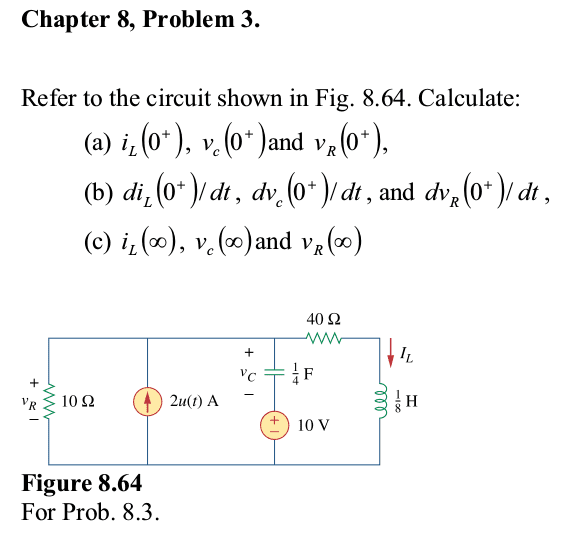
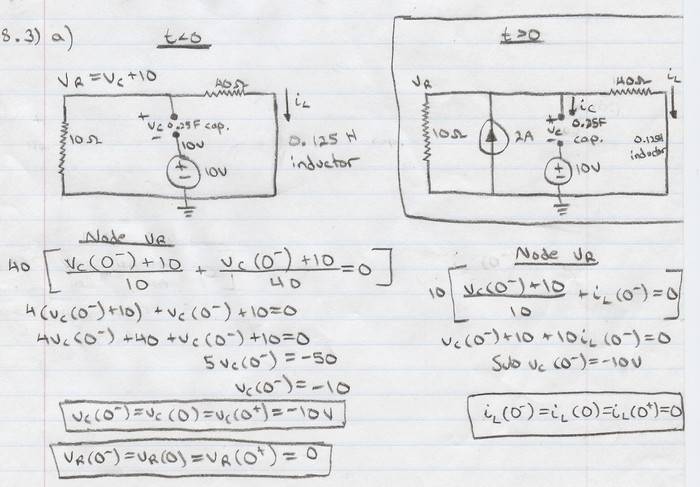
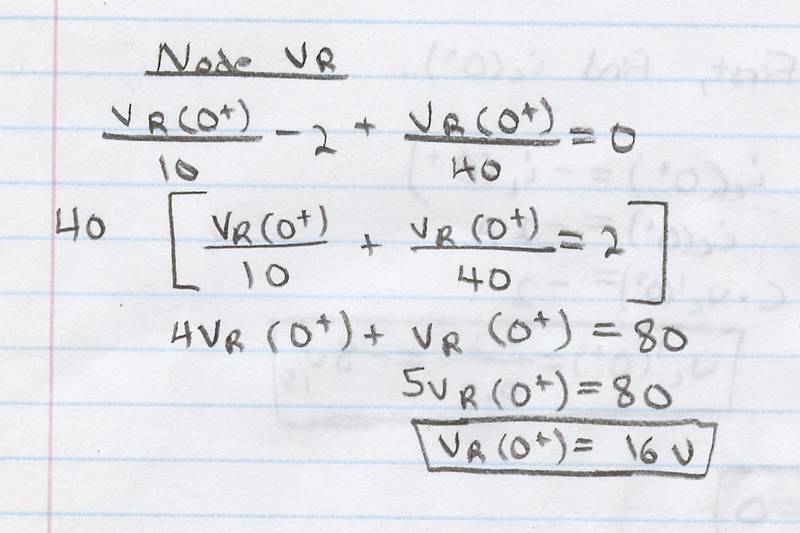
The discussion revolves around the behavior of RCL circuits at the moment of switching, specifically addressing the voltage across a resistor at the transition from t=0- to t=0+. Participants explore the implications of nodal analysis and the roles of inductors and capacitors during transient and steady-state conditions.
Discussion Character
- Technical explanation
- Conceptual clarification
- Debate/contested
Main Points Raised
- One participant questions whether the voltage of the resistor at t=0+ is equal to 16V or 0V, suggesting a potential contradiction.
- Another participant proposes that at t=0-, capacitors behave as open circuits and inductors as short circuits, but this changes at t=0+.
- It is noted that during the transient phase at t=0+, the circuit behaves differently compared to the steady state, where inductors act as shorts and capacitors as opens again after a long time.
- One participant expresses confusion about why inductors and capacitors behave as closed/open circuits in steady state but not during the transient phase.
- Another participant elaborates that an inductor transitions from high voltage to 0, indicating that current flows through it as a short in the steady state.
Areas of Agreement / Disagreement
Participants express differing views on the behavior of the circuit elements at the transition point, indicating that the discussion remains unresolved regarding the exact voltage across the resistor at t=0+.
Contextual Notes
There are limitations in the discussion regarding the assumptions made about circuit behavior at the transition points and the definitions of steady state versus transient conditions, which remain unresolved.