Reflection from double glazed window

  • Context: High School 
  • Thread starter Thread starter franchester
  • Start date Start date
  • Tags Tags
    Reflection Window
Click For Summary
SUMMARY

The discussion centers on the phenomenon of unusual reflections observed on an outside wall due to sunlight hitting a triple-glazed window. The glass's deformation, caused by thermal expansion and wind pressure, results in a slightly concave shape, which alters the reflection patterns. This deformation leads to overlapping light reflections, creating areas of increased brightness, described as a bright "X" shape. The conversation also touches on the properties of hermetically sealed double glazing (DVH), which enhances thermal and acoustic insulation, and the potential effects of air pressure differences within the glass layers.

PREREQUISITES
  • Understanding of optical principles, specifically caustics and light reflection.
  • Familiarity with the properties of triple-glazed windows and hermetic sealing.
  • Knowledge of thermal expansion effects on glass materials.
  • Basic concepts of air pressure and its impact on glass deformation.
NEXT STEPS
  • Research the optical properties of caustics and their applications in architecture.
  • Explore the design and benefits of triple-glazed windows in energy efficiency.
  • Investigate methods for measuring light transmission using mid-IR spectrometers.
  • Learn about the effects of thermal expansion on different types of glass used in construction.
USEFUL FOR

Homeowners, architects, and builders interested in understanding window reflections, energy efficiency, and the optical effects of glass in building design.

franchester
Messages
1
Reaction score
0
TL;DR
Sorry not technical minded
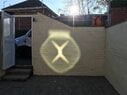
Can anyone explain why we are having this strange reflection on our outside wall, from the sun hitting our bedroom window?
 

Attachments

  • IMG_3364.jpeg
    IMG_3364.jpeg
    52.3 KB · Views: 78
Science news on Phys.org
franchester said:
Can anyone explain why we are having this strange reflection on our outside wall, from the sun hitting our bedroom window?
The glass is not perfectly flat. It deforms within the frame, due to thermal expansion, windpressure, etc.
 
As A.T. says, the glass isn't quite flat. From the pattern, I'd think it's slightly concave and taller than it is wide.

Imagine dividing the window up like this:
1730549160672.png

If the glass is slightly curved inwards, the triangle at the top is slightly tilted down, the one at the bottom is slightly tilted up, and the side ones are slightly tilted towards each other.

If you think what the slightly tilted down bit does with reflected light, it slightly displaces the reflection downwards - so the triangle of light reflected by the top triangle slightly overlaps the very top of the reflections from the side pieces. Similarly, light reflected from the bottom triangle is slightly displaced upwards and overlaps the reflections from the very bottom of the side pieces. And the reflections from the side pieces are slightly displaced inwards and overlap each other in the middle. The overlapped areas get double the light of other areas, so are double-brightness compared to the rest of it. That's the origin of the bright X.

The reality is a bit messier than my description because the glass is (slightly) curved rather than folded sharply along neat lines, which is probably how come you have the sort of distorted circular reflection from what I expect is a rectangular window.
 
  • Like
Likes   Reactions: sophiecentaur
I think that is hermetically sealed glass pocket. Air between double glass has a different pressure to the ambient air producing glass sheet deformation. I observe similar effect in my house, the light reflected from window is focused on the wall of nearby house. Tree windows in a row with the same effect.
Hermetic Double glazing (DVH) or insulated, are panels composed of two glass sheets, hermetically sealed by thermoplastic tape, existing between both layers a chamber of dehydrated air that provides greater acoustic and thermal insulation compared to a monolithic glass.
 
  • Like
Likes   Reactions: Ibix and A.T.
Reflection from the windows that I observe daily
20241103_095629.jpg
 
  • Like
Likes   Reactions: davenn and Ibix
Try pushing against the glass (from inside or outside) and note any change in that pattern.
 
  • Like
Likes   Reactions: Gleb1964 and davenn
sophiecentaur said:
Try pushing against the glass (from inside or outside) and note any change in that pattern.
windows refrection-2a.jpg


Catching a nice sunny day when reflection structure is visible in a greater details, I took a new photo. The window is a triple-glazed window, it gives three reflections. Pushing by finger the inside glass gives visible effect on the outside ring in reflection. That suggests that the air pressure inside pocket is below ambient and windows have a slight sag inside and the middle glass is about flat.
The reflection from inside glass have a slightly different colour, there should be some sort of coating, probably preserving the near infrared radiation(?). Potentially, I can measure the transmission curve with an mid-IR spectrometer (not at high priority those).
 
  • Like
Likes   Reactions: johnbbahm, sophiecentaur, A.T. and 1 other person
Happy New Year!
I've wondered about these shapes for ages and only just got round to thinking about it properly. I agreed with the flexing glass due to a pressure difference between the cavity and the atmosphere explanation so I tried to model it in python.
Analytical model
Each pane can be roughly modelled by a thin plate of glass of dimensions ##a \times b## with a uniform applied pressure ##p_0## with pinned boundaries. In reality it would be better modelled by clamped boundaries, but that's a lot harder to solve analytically. As it is, each pane can be modelled as following the Levy Solution:
$$ w_{Levy}(x,y) = \frac{16p_0}{\pi^6D}\sum_{m=1}^{\infty}\sum_{n=1}^{\infty} \frac{\sin{\frac{m\pi x}{a}}\sin{\frac{n\pi y}{b}}}{mn\left(\frac{m^2}{a^2}+\frac{n^2}{b^2}\right)^2}$$
Where ##D## is the plate bending stiffness per unit length, given a Young's Modulus ##E## and Poisson ratio ##\nu##.
$$ D = \frac{Et^3}{12(1-\nu^2)}$$
The Levy Solution contains a Fourier series that originates from the Fourier series of a square wave of amplitude ##p_0##, the uniform pressure acting on the pane, where ##m,n \in [1,3,5,..]##. Using a higher number of harmonics (i.e. letting ##m,n \rightarrow \infty##) provides a higher accuracy but at the expense of run time, as I couldn't be bothered to find a closed form to this converging Fourier series.
Using this solution for the displacement of the pane it's possible to model how a light ray incident normal to the each pane would be reflected. The "inner" pane will bulge toward the sun, so the ##w## is positive, but the "outer" pane bulges in the opposite direction, so its displacement will be negative.
At a given point on the surface of a pane the gradient will define how an incoming ray reflects. For simplicity the rays can be modelled as parallel and in the negative ##z## direction, i.e. directly at the undeformed pane. Hence at a given point on the surface, the surface normal vector will be at an angle ##\phi## to the ##z## axis (ray direction) and it will be oriented at an angle ##\theta## anticlockwise from the ##x## axis.
1767323614597.webp

Figure above shows a given point on the pane surface with a surface normal ##\hat{\underline{\mathbf{n}}}## with a set of axes ##xyz## parallel to the undeformed global axes.
The surface normal vector can be defined as:
$$\hat{\underline{\mathbf{n}}}=\frac{1}{\sqrt{(\frac{\partial w}{\partial x})^2+(\frac{\partial w}{\partial y})^2 +1}}
\begin{bmatrix}
-\frac{\partial w}{\partial x}\\
-\frac{\partial w}{\partial y} \\
1
\end{bmatrix}
$$
Hence ##\theta## and ##\phi## can be defined as
$$\theta= \arctan{\left(\frac{\frac{\partial w}{\partial y}}{\frac{\partial w}{\partial x}}\right)}$$
and
$$\phi = \arccos{\left(\frac{1}{\sqrt{(\frac{\partial w}{\partial x})^2+(\frac{\partial w}{\partial y})^2 +1}}\right)}$$
The reflected ray will be at the same angle ##theta## from the ##x## axis, but tilted ##2\phi## from the ##z## axis, i.e. one ##\phi## from the ##z## axis to the surface normal, then another ##\phi## to the reflected ray. This new ray can be projected onto a plane at a distance ##L## from the pane, producing a spot. Repeating this for a many incident rays across the pane and recording where they are projected to on the plane at ##z=L## will reveal a rough image of the phenomenon.
Python modelling
The janky python implementation only requires numpy and matplotlib:
Python:
import matplotlib.pyplot as plt
import numpy as np

# physical parameters
a = 1     # length of window
b = 1.2   # height of window
L = 8     # distance from the window to the wall
p0 = 1e3  # pressure difference from atmospheric, 0.01 bar, approx 1% of an atmosphere
E = 70e9  # youngs modulus of soda lime silicate glass
v = 0.23  # poisson ratio of soda lime silicate glass
t = 0.004 # thickness of a single pane, 4mm
D = (E*t**3)/(12*(1-v**2)) # plate bending stiffness per unit length

# modelling parameters
h = 20    # number of harmonics to sum up to
plot_type = "reflected_image"

if plot_type == "pane_displacement":
    N = 5   # number of points to sample in each direction x and y
elif plot_type == "reflected_image":
    N = 100   # number of points to sample in each direction x and y


x,y = np.meshgrid(np.linspace(0,a,N),np.linspace(0,b,N)) # make grid of points across x y domain

@np.vectorize
def w_harmonic(x,y,a,b,m,n): # function returns one harmonic term (m,n) of the Levy solution
    return (np.sin(m*np.pi*x/a)*np.sin(n*np.pi*y/b))/(m*n*(m**2/a**2+n**2/b**2)**2)

# functions returns one harmonic term (m,n) of the spatial derivates of the Levy solution
def dw_dx_harmonic(x,y,a,b,m,n,inner):
    return (inner*np.pi*np.cos(m*np.pi*x/a)*np.sin(n*np.pi*y/b))/(a*n*(m**2/a**2+n**2/b**2)**2)
def dw_dy_harmonic(x,y,a,b,m,n,inner):
    return (inner*np.pi*np.sin(m*np.pi*x/a)*np.cos(n*np.pi*y/b))/(b*m*(m**2/a**2+n**2/b**2)**2)

# initialise surface displacement and spatial derivatives arrays
w_levy = np.zeros([N,N])
dw_dx_inner = np.zeros([N,N]) # inner pane
dw_dy_inner = np.zeros([N,N]) # inner pane

# loop over range h harmonics for m and n
for i in range(h):
    n = 2*i+1
    for j in range(h):
        m = 2*j+1

        # add harmonic terms to displacement and spatial derivatives
        w_levy += 16*p0/(np.pi**6*D)*w_harmonic(x,y,a,b,m,n)

        dw_dx_inner += 16*p0/(np.pi**6*D)*dw_dx_harmonic(x,y,a,b,m,n, 1)
        dw_dy_inner += 16*p0/(np.pi**6*D)*dw_dy_harmonic(x,y,a,b,m,n, 1)

## for the inner pane
# calculate the components of the surface normal
n_w_inner = (np.ones([N,N])+dw_dx_inner**2 + dw_dy_inner**2)**(-0.5)
n_u_inner = -n_w_inner*dw_dx_inner
n_v_inner = -n_w_inner*dw_dy_inner

# calculate the orientation angles theta and phi
theta_inner = np.atan2(n_v_inner,n_u_inner)
phi_inner = np.acos(n_w_inner)

# calculate where the array of points get projected to on the wall
x_inner = x + L*np.sin(phi_inner)*n_w_inner*np.cos(theta_inner)
y_inner = y + L*np.sin(phi_inner)*n_w_inner*np.sin(theta_inner)

## for the outer pane, lots can be reused due to symmetry but theta will be oriented the other way around
x_outer = x + L*np.sin(phi_inner)*n_w_inner*np.cos(theta_inner-np.pi)
y_outer = y + L*np.sin(phi_inner)*n_w_inner*np.sin(theta_inner-np.pi)

# plot the results
if plot_type == "pane_displacement":
    fig = plt.figure(figsize =(14, 9))
    ax = plt.axes(projection ='3d')
    ax.quiver(x, y, w_levy, np.sin(2*phi_inner)*np.cos(theta_inner), np.sin(2*phi_inner)*np.sin(theta_inner), np.cos(2*phi_inner),color='green',length = 1,label = "reflected rays")
    ax.quiver(x, y, w_levy, n_u_inner, n_v_inner, n_w_inner,color='red',length = 1,label="surface normals")
    ax.plot_surface(x, y, w_levy)
    plt.legend()
    ax.axis('equal')
elif plot_type == "reflected_image":
    plt.scatter(x,y,s=0.1,c="r", label= "flat") # plot the window pane red
    plt.scatter(x_inner,y_inner,s=0.1,c="g", label= "inner") # plot the reflection of the inner pane green
    plt.scatter(x_outer,y_outer,s=0.1,c="b", label= "outer") # plot the reflection of the outer pane blue
    plt.legend()
    plt.axis('equal')
else:
    raise Exception("set plot type to pane_displacement or reflected_image")
plt.show()
1767323635313.webp

Not too bad in my opinion, looks pretty much like Franchester's photo.
Additional notes
The Levy solution uses pinned edges, not clamped, i.e. the boundary conditions are ##w(x=0,y) = 0## and ## \frac{\partial^2 w}{\partial x^2}_{x=0} = 0##, rather than what is more likely, ##w(x=0,y) = 0## and ## \frac{\partial w}{\partial x}_{x=0} = 0##. It should be possible to solve analytically by solving the bi-harmonic equation ##D\nabla^4 w = p(x,y)## with these boundary conditions but that's a lot of effort compared to the known Levy solution.
In the code I've assumed a 1mx1.2m window with 4mm thick panes and a wall 8m away, just to make the pattern look nicer. The distance at which the pattern looks most similar is highly sensitive to the pane thickness and pressure, so the 8m distance is a fudge factor to get a nice figure, but it's not that outlandish.
I've assumed the rays are all being reflected off in their myriad directions from the plane z=0, the discrepancy between this assumption and setting off each ray exactly from the pane's distorted surface will be so small compared to the 8m distance to the wall.
 

Similar threads

  • · Replies 25 ·
Replies
25
Views
7K
  • · Replies 1 ·
Replies
1
Views
2K
  • · Replies 6 ·
Replies
6
Views
1K
  • · Replies 5 ·
Replies
5
Views
2K
  • · Replies 3 ·
Replies
3
Views
3K
  • · Replies 4 ·
Replies
4
Views
5K
  • · Replies 22 ·
Replies
22
Views
3K
  • · Replies 4 ·
Replies
4
Views
1K
  • · Replies 5 ·
Replies
5
Views
2K
  • · Replies 1 ·
Replies
1
Views
2K