Discussion Overview
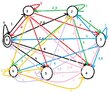
The discussion revolves around the question of whether the language L, defined as the set of strings over the alphabet $\Sigma=\{1,2,4,5,7,9\}$ that represent decimal numbers divisible by 7, is regular. Participants explore various methods to analyze the regularity of this language, including the construction of a deterministic finite automaton (DFA) and regular expressions.
Discussion Character
- Exploratory
- Technical explanation
- Debate/contested
- Mathematical reasoning
Main Points Raised
- Some participants propose constructing a DFA where states represent possible remainders when divided by 7.
- Others suggest that creating a regular expression might be possible but acknowledge it could be more complicated.
- One participant expresses uncertainty about the transitions in the DFA and seeks clarification on how to construct a regular expression.
- Another participant notes the challenge of finding a finite regular expression for divisibility by 7, contrasting it with simpler cases like divisibility by 5.
- Some participants discuss the interpretation of the language as decimal numbers, despite the limited alphabet.
- A later reply introduces a transition function for the DFA, suggesting a mathematical approach to understanding the automaton's behavior.
Areas of Agreement / Disagreement
Participants do not reach a consensus on whether the language is regular. There are competing views on the feasibility of constructing a regular expression and the effectiveness of the DFA approach.
Contextual Notes
Participants express uncertainty regarding the completeness of their DFA and regular expression constructions. There are also discussions about the implications of the decimal representation of the strings in the language.
Who May Find This Useful
Readers interested in formal language theory, automata theory, and the properties of regular languages may find this discussion relevant.