MHB How Do You Solve Related Rates Problems Involving Melting Ice?

Click For Summary
SUMMARY

The discussion focuses on solving related rates problems involving melting ice, specifically using the volume formula for a sphere, V = (4/3)πr³. The participants confirm the correct differentiation leading to dr/dt = -k, where k is a constant. For part b, they derive the time it takes for the sphere to completely melt, concluding that t = r₀/k, where r₀ is the initial radius. The integration process and application of initial conditions are emphasized as critical steps in the solution.

PREREQUISITES
  • Understanding of calculus, specifically differentiation and integration.
  • Familiarity with related rates problems in physics and mathematics.
  • Knowledge of the volume formula for a sphere, V = (4/3)πr³.
  • Basic understanding of initial value problems (IVPs) in differential equations.
NEXT STEPS
  • Study the application of the Fundamental Theorem of Calculus (FTOC) in solving differential equations.
  • Explore more complex related rates problems involving different shapes and volumes.
  • Learn about the implications of initial conditions in differential equations.
  • Investigate the physical significance of constants in related rates problems, such as k in melting scenarios.
USEFUL FOR

Students and educators in mathematics and physics, particularly those focusing on calculus and differential equations, as well as anyone interested in applying mathematical concepts to real-world problems like melting ice.
tomc612
Messages
17
Reaction score
0
Hi,
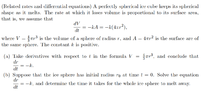
need some help on the following question.

Just want to check on part a on the followingv=4/3\pi.r^3

dv = 4\pi.r^2 dr

dv/dt = 4\pi.r^2 dr/dt

dr/dt = (dv/dt)/ 4\pi.r^2

dr/dt = (-KA)/4\pi.r^2

dr/dt= -K

part B need some help

Thanks

TomView attachment 6214
 

Attachments

  • Screen Shot 2016-11-22 at 4.37.09 pm.png
    Screen Shot 2016-11-22 at 4.37.09 pm.png
    31.3 KB · Views: 125
Last edited:
Physics news on Phys.org
tomc612 said:
Hi,
need some help on the following question.

Just want to check on part a on the followingv=4/3\pi.r^3

dv = 4\pi.r^2 dr

dv/dt = 4\pi.r^2 dr/dt

dr/dt = (dv/dt)/ 4\pi.r^2

dr/dt = (-KA)/4\pi.r^2

dr/dt= -K

part B need some help

Thanks

Tom

You've done part a) correctly.

As for part b, you want to know how long it takes for the sphere to melt entirely, in other words, for r to become 0.

So integrate $\displaystyle \begin{align*} \frac{\mathrm{d}r}{\mathrm{d}t} = -k \end{align*}$ with respect to t to get r in terms of t, and then solve for t where $\displaystyle \begin{align*} r = 0 \end{align*}$.
 
So,
dr/dt = -k

dr = -k.dt

intergral dr = integral -k.dt

r = -kt + c

0 = -kt +c

Still not sure that's it, or should it be that the integral of -k.dt is -1/2k^2t

Thanks
 
tomc612 said:
So,
dr/dt = -k

dr = -k.dt

intergral dr = integral -k.dt

r = -kt + c

0 = -kt +c

Still not sure that's it, or should it be that the integral of -k.dt is -1/2k^2t

Thanks
You have not yet answered the question! What is t when r= 0? Of course, that will depend upon what "c" is. You were given "k" as part of the problem when you were given \frac{dV}{dt}= -kA. To determine "c" use the fact that "the ice sphere has initial radius r_0 when t= 0".
 
so do we need to bring the Volume formula back into represent V and R
if V =4/3pi.r^3

then r = (3V/4pi)^1/3r0=-kt +c

(3V/4Pi)^1/3 =-kt+c

is that the right path?

Thanks
 
For part (b), we are to solve the IVP:

$$\d{r}{t}=-k$$ where $$r(0)=r_0$$

Integrate w.r.t $t$, using the given boundaries and switch dummy variables of integration:

$$\int_{r_0}^{r(t)}\,da=-k\int_0^t\,db$$

Apply the FTOC:

$$r(t)-r_0=-kt$$

Solve for $t$:

$$t=\frac{r_0-r(t)}{k}$$

To determine how long it takes the ice to melt away, we set $r(t)=0$:

$$t=\frac{r_0}{k}$$
 
Relativistic Momentum, Mass, and Energy Momentum and mass (...), the classic equations for conserving momentum and energy are not adequate for the analysis of high-speed collisions. (...) The momentum of a particle moving with velocity ##v## is given by $$p=\cfrac{mv}{\sqrt{1-(v^2/c^2)}}\qquad{R-10}$$ ENERGY In relativistic mechanics, as in classic mechanics, the net force on a particle is equal to the time rate of change of the momentum of the particle. Considering one-dimensional...

Similar threads

  • · Replies 2 ·
Replies
2
Views
2K
  • · Replies 7 ·
Replies
7
Views
3K
  • · Replies 3 ·
Replies
3
Views
5K
Replies
4
Views
3K
Replies
2
Views
1K
  • · Replies 8 ·
Replies
8
Views
4K
  • · Replies 2 ·
Replies
2
Views
4K
  • · Replies 4 ·
Replies
4
Views
2K
  • · Replies 10 ·
Replies
10
Views
1K
  • · Replies 10 ·
Replies
10
Views
6K