SUMMARY
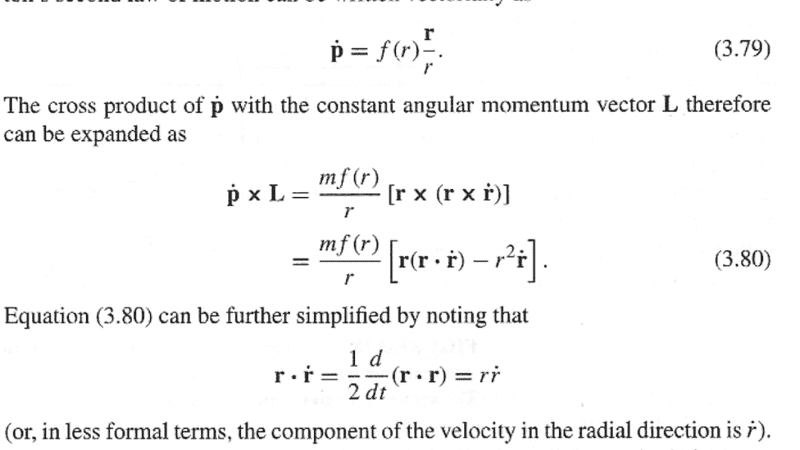
The discussion clarifies the relationship between the position vector ##\vec{r}## and the velocity vector ##\vec{\dot{r}}## in the context of central forces. It establishes that while the acceleration vector for a central force is directed along the position vector, the velocity vector can point in any direction, indicating that ##\vec{\dot{r}}## is not necessarily parallel to ##\vec{r}##. The distinction between the magnitude of the velocity, ##\dot{r}##, and the velocity vector itself, ##|\vec{\dot{r}}|##, is emphasized as crucial for understanding motion in a central force field.
PREREQUISITES
- Understanding of vector calculus
- Familiarity with central force dynamics
- Knowledge of acceleration and velocity vectors
- Basic concepts of angular motion
NEXT STEPS
- Study the properties of central force motion in classical mechanics
- Learn about vector decomposition in physics
- Explore the relationship between angular and radial components of motion
- Investigate the implications of non-parallel vectors in kinematics
USEFUL FOR
Students of physics, particularly those studying mechanics, as well as educators and anyone interested in the dynamics of motion under central forces.