Relation between torque and magnetic moment

Click For Summary
SUMMARY

The discussion centers on the relationship between torque and magnetic moment in charged particles, specifically defined as ##\vec{M}=\frac{1}{2}q\,(\,\vec{r}\times\vec{v})##. A contradiction arises when analyzing torque ##\vec{N}=\vec{M}\times\vec{B}## for a charged particle moving in a circular path under a magnetic field ##\vec{B}##. The key issue identified is that the magnetic moment represents a current loop, necessitating a uniform charge distribution around the ring, which leads to varying torque experienced at different points. The double cross product identity is also highlighted as crucial for resolving the contradiction.

PREREQUISITES
  • Understanding of magnetic moment and its formula
  • Familiarity with torque and its vector representation
  • Knowledge of the double cross product identity
  • Basic concepts of charged particle motion in magnetic fields
NEXT STEPS
  • Study the implications of magnetic moment in current loops
  • Explore the dynamics of charged particles in magnetic fields
  • Learn about the double cross product and its applications in physics
  • Investigate the effects of non-uniform charge distributions on torque
USEFUL FOR

Physicists, electrical engineers, and students studying electromagnetism, particularly those interested in the behavior of charged particles in magnetic fields and the mathematical foundations of torque and magnetic moments.

Happiness
Messages
686
Reaction score
30
The magnetic moment ##\vec{M}## of a charged particle is defined as ##\vec{M}=\frac{1}{2}q\,(\,\vec{r}\times\vec{v})##.

Starting with torque ##\vec{N}=\vec{M}\times\vec{B}##, I arrive at a contradiction.

Consider a charge particle moving at a constant speed ##v## anticlockwise in a circle of radius ##r##. A magnetic field ##\vec{B}## is applied parallel to the plane of this circle. Consider the instant when ##\vec{B}## is in the same direction as ##\vec{r}##, the position vector of the particle, taking the center of the circle as the origin. Thus, ##\vec{r}\times\vec{B}=0##.

Then, ##\vec{N}=\frac{1}{2}q(\vec{r}\times\vec{v})\times\vec{B}##
##=\frac{1}{2}q[\vec{r}\times(\vec{v}\times\vec{B})-\vec{v}\times(\vec{r}\times\vec{B})]##
##=\frac{1}{2}\vec{r}\times\vec{F}-0##
##=\frac{1}{2}\vec{N}##, a contradiction.

What's wrong?
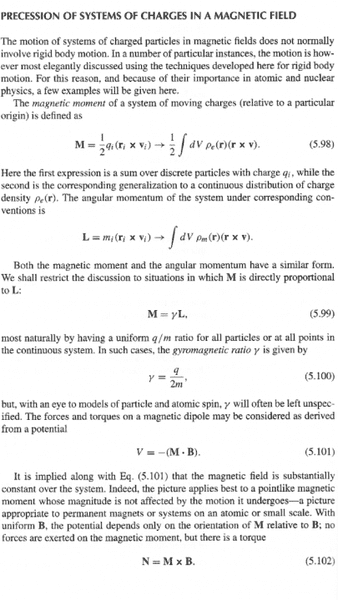
image.png
 
Physics news on Phys.org
The magnetic moment is a current loop and the particle needs to travel in a circle with the charge distribution spread out over the complete ring. The different locations on the ring do not all experience the same torque. Meanwhile, please check your double cross product: I think ## a \times (b \times c)=(a \cdot c)b-(a \cdot b)c ## . The definition of the magnetic moment that you have with the 1/2 factor is correct.
 

Similar threads

  • · Replies 8 ·
Replies
8
Views
1K
  • · Replies 0 ·
Replies
0
Views
1K
Replies
4
Views
2K
  • · Replies 14 ·
Replies
14
Views
2K
  • · Replies 6 ·
Replies
6
Views
2K
  • · Replies 1 ·
Replies
1
Views
2K
  • · Replies 66 ·
3
Replies
66
Views
27K
  • · Replies 14 ·
Replies
14
Views
1K
  • · Replies 3 ·
Replies
3
Views
2K
  • · Replies 23 ·
Replies
23
Views
5K