Relative rotational motion on a disc

Click For Summary
SUMMARY

The discussion focuses on the complexities of calculating acceleration in relative rotational motion on a disc. The problem involves a mass A oscillating with an amplitude of 5 cm at a frequency of 2 Hz, while an angular acceleration of 20 rad at 4 Hz is applied to the disc. Key equations include the acceleration formula: ##\vec a=\vec a_B + \vec{\dot \omega} X \vec r + \vec \omega X \vec \omega X \vec r + 2. \vec \omega . \vec v_{rel} + \vec a_{rel}##. Participants emphasize the necessity of defining variables and context for accurate calculations.

PREREQUISITES
  • Understanding of relative rotational motion concepts
  • Familiarity with angular acceleration and oscillatory motion
  • Proficiency in vector calculus, particularly cross products
  • Knowledge of trigonometric functions and their applications in physics
NEXT STEPS
  • Study the principles of relative rotational motion in detail
  • Learn how to apply angular acceleration in dynamic systems
  • Practice vector calculus, focusing on cross products and triple cross products
  • Explore the implications of oscillatory motion in physical systems
USEFUL FOR

Students and educators in physics, particularly those focusing on dynamics and rotational motion, as well as anyone involved in solving complex motion problems in engineering contexts.

Like Tony Stark
Messages
182
Reaction score
6
Homework Statement
##A## oscillates along the central position ##O## with amplitude ##5 cm## at a frecuency ##2 hz## such that its displacement measured in ##cm## in function of time is governed by ##x=5sin(4 \pi t)##, where ##t## is measured in seconds. An angular acceleration around ##O## is applied to the disc with an amplitude ##20 rad## at a frequency ##4 hz## such that ##\theta =0.20sin(8 \pi t)##. Determine the acceleration of A for ##x=0 cm## and ##x= 5 cm##.
Relevant Equations
##\vec a=\vec a_B + \vec{\dot \omega} X \vec r + \vec \omega X \vec \omega X \vec r + 2. \vec \omega . \vec v_{rel} + \vec a_{rel}##
The first doubt that comes to my mind is "I have to determine the acceleration with respect to what?", because the problem doesn't tell. Then, I have some problems when having to plug the data in the formula of acceleration. ##\vec a_B=0## because the origin isn't accelerated, ##\vec{\dot \omega} X \vec r## would be ##x=5sin(4 \pi .5)## (in the second case), and then what numbers should I plug in ##\vec \omega X \vec \omega X \vec r##, ##2. \vec \omega . \vec v_{rel}## and ##\vec a_{rel}##?
I don't understand relative rotational motion very well. I mean, I just have to plug the data in the formula, but I don't know what's the data that I have.
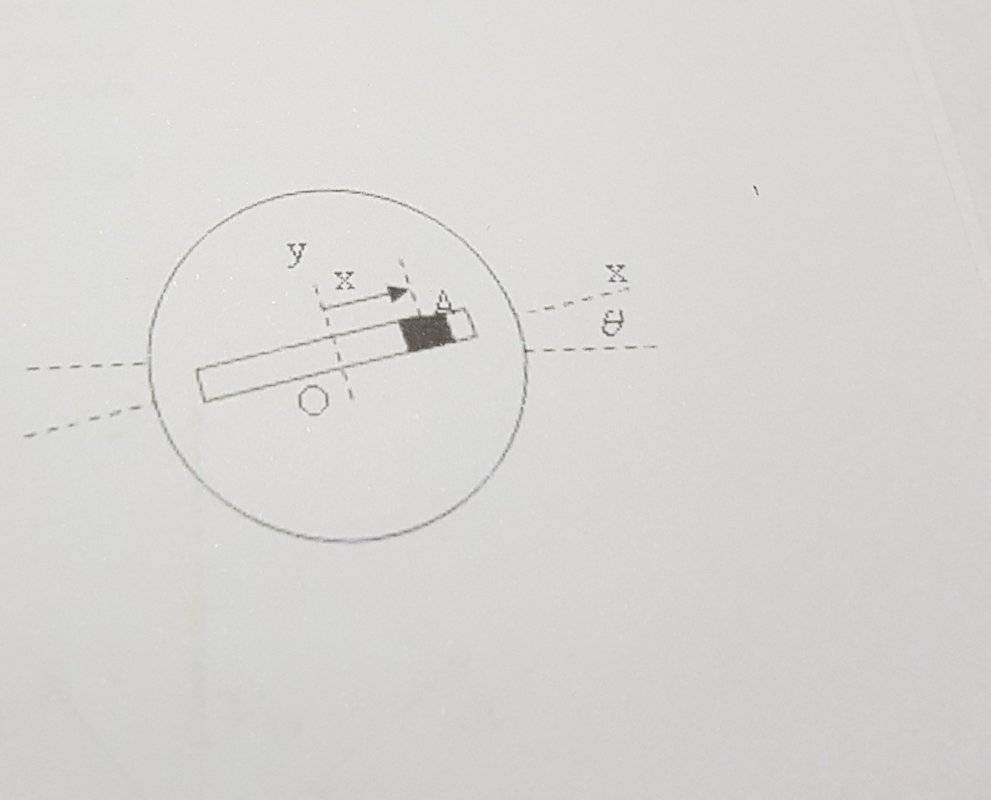
20190906_20202777.jpg
 
  • Like
Likes   Reactions: Delta2
Physics news on Phys.org
Like Tony Stark said:
Homework Statement: ##A## oscillates along the central position ##O## with amplitude ##5 cm## at a frecuency ##2 hz## such that its displacement measured in ##cm## in function of time is governed by ##x=5sin(4 \pi t)##, where ##t## is measured in seconds. An angular acceleration around ##O## is applied to the disc with an amplitude ##20 rad## at a frequency ##4 hz## such that ##\theta =0.20sin(8 \pi t)##. Determine the acceleration of A for ##x=0 cm## and ##x= 5 cm##.
Homework Equations: ##\vec a=\vec a_B + \vec{\dot \omega} X \vec r + \vec \omega X \vec \omega X \vec r + 2. \vec \omega . \vec v_{rel} + \vec a_{rel}##

The first doubt that comes to my mind is "I have to determine the acceleration with respect to what?", because the problem doesn't tell. Then, I have some problems when having to plug the data in the formula of acceleration. ##\vec a_B=0## because the origin isn't accelerated, ##\vec{\dot \omega} X \vec r## would be ##x=5sin(4 \pi .5)## (in the second case), and then what numbers should I plug in ##\vec \omega X \vec \omega X \vec r##, ##2. \vec \omega . \vec v_{rel}## and ##\vec a_{rel}##?
I don't understand relative rotational motion very well. I mean, I just have to plug the data in the formula, but I don't know what's the data that I have.View attachment 249344
There's something wrong with your equation. ##2. \vec \omega . \vec v_{rel}## would be a scalar.
For the cross products, use \times; and the triple cross product needs parentheses.

No equation is meaningful without a statement of the context and definitions of the variables. Please state these for your relevant equation.
 

Similar threads

  • · Replies 5 ·
Replies
5
Views
2K
Replies
25
Views
2K
  • · Replies 4 ·
Replies
4
Views
1K
Replies
2
Views
801
Replies
9
Views
2K
Replies
15
Views
2K
  • · Replies 20 ·
Replies
20
Views
2K
  • · Replies 3 ·
Replies
3
Views
1K
  • · Replies 10 ·
Replies
10
Views
2K
  • · Replies 10 ·
Replies
10
Views
1K