Relativity of Simultaneity - Missing Event

Click For Summary

Discussion Overview

The discussion revolves around the ladder paradox in the context of relativity, specifically focusing on the introduction of a third simultaneous event involving rods attached to garage doors. Participants explore the implications of this addition on the concept of simultaneity from different frames of reference.

Discussion Character

  • Debate/contested
  • Technical explanation
  • Conceptual clarification

Main Points Raised

  • One participant proposes that the touching of the rods verifies simultaneity between two frames of reference, suggesting that this event should be observable in both frames.
  • Another participant argues that the rods cannot be treated as rigid, emphasizing the need for mathematical proof and suggesting that the diagrams presented are incorrect.
  • A different participant references the bug rivet paradox as a simpler analogy to illustrate the issues being discussed, implying that the original scenario is overly complicated.
  • One participant challenges the understanding of the timing of events, stating that the sequence of events leaves no time for the rods to touch, thus questioning the validity of the proposed simultaneity.
  • There is a contention regarding the representation of the rods in diagrams, with some participants insisting on the importance of accounting for the finite speed of sound in the rods and the implications of their movement.

Areas of Agreement / Disagreement

Participants express multiple competing views regarding the treatment of the rods and the implications for simultaneity. The discussion remains unresolved, with no consensus on the correctness of the proposed models or the interpretations of the paradox.

Contextual Notes

Limitations include assumptions about the rigidity of the rods, the treatment of simultaneity across different frames, and the potential misunderstanding of the physical implications of the proposed scenario. The discussion also highlights the dependence on the accuracy of diagrams and the mathematical modeling of the events.

Sisoeff
Messages
29
Reaction score
0
Obviously I have to learn how to start a topic, but I believed that in a scientific forum, what matters is the idea, not the presentation.
I'll try harder this time.
Since every scientist knows very well the ladder paradox, I believe I won't be wrong, by missing something in the set.
---

A third simultaneous event is introduced in the ladder paradox, by attaching a rod to each door, which are welded perpendicularly on the inside of the doors, in a way that both rods touch when the doors are simultaneously closed (the small added red lines on the graphics)
(The rods are not on the way of the ladder, and can be placed in a way not to touch the floor.)
The single event "touching of the rods" verifies that both doors are closed simultaneously.
touch - simultaneity
no_touch - no_simultaneity
In the same time as a single event it must be present in both frames of reference.

As seen on the left graphic (garage frame of reference with shorter ladder), the rods touch in the frame of the garage, when the doors are closed.
As an event, it should be present in the ladder frame of reference, but it is not.

Here is the process of the long ladder passing through the garage as presented in Wikipedia:
The first event is the front of the ladder approaching the exit door of the garage.
The door closes, and then opens again to let the front of the ladder pass through. At a later time, the back of the ladder passes through the entrance door, which closes and then opens.


See the images bellow for reference.
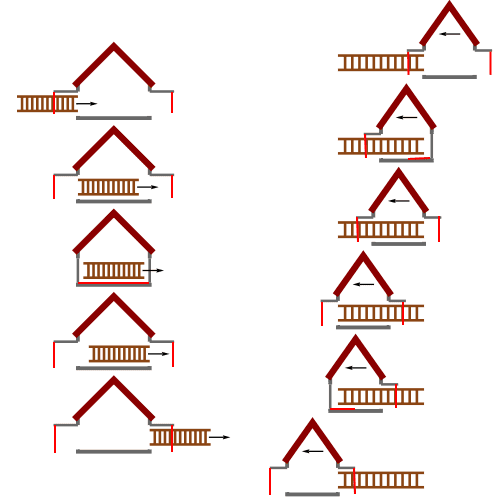
ladder_garage.png
 
Physics news on Phys.org
Again! You are treating the rods as rigid which they cannot be. How many times do we have to repeat this?

Your diagrams are wrong because you continue to ignore the above. You either have to learn the maths and prove this for yourself (I recommend this) or take our word for it.
 
Sisoeff said:
Obviously I have to learn how to start a topic, but I believed that in a scientific forum, what matters is the idea, not the presentation.
I'll try harder this time.
Since every scientist knows very well the ladder paradox, I believe I won't be wrong, by missing something in the set.
When it seems people are quibbling about your presentation, most likely it means you have failed to get your idea across at all due to presentation issues. In may also mean (as in the series of thread you've started on the same general idea) that things you misunderstand as being inconsequential are very important to modeling the situation.
 
  • Like
Likes   Reactions: Sisoeff
A.T. said:
The bug rivet paradox deals with this in a simpler manner, without rotation and the other complications the OP introduces here.
http://hyperphysics.phy-astr.gsu.edu/hbase/relativ/bugrivet.html
It's just Einstein's train, isn't it? Except instead of light pulses coming from front and rear he's got mechanical waves propagating through the rods.
 
Ibix said:
Again! You are treating the rods as rigid
No, I'm not.
I repeat my answer from the locked topic:
note that while the end of the back door rod departs later from the point of the touch, the left rode will arrive later too, thus missing the touch, for the single fact, that the front door need to give time for the ladder to pass through.
Also, as stated in the OP "the first event is the front of the ladder approaching the exit door of the garage.
The door closes, and then opens again to let the front of the ladder pass through.
At a later time, the back of the ladder passes through the entrance door, which closes and then opens."

The above leaves no time for the touching event.

Ibix said:
Your diagrams are wrong because you continue to ignore the above.
The diagrams are not mine except for the added rods. They are widely accepted and published in Wikipedia.
Please let us know at which point the touching event will happen.
 
Sisoeff said:
The diagrams are not mine except for the added rods. They are widely accepted and published in Wikipedia.
Yes. You added the bit that's wrong... Try adding in the delay in the rods' movement due to the finite speed of sound in the rods.
 
A.T. said:
The bug rivet paradox deals with this in a simpler manner, without rotation and the other complications the OP introduces here.
There is no rotation here.
For your reference, here is how the rods look from closer view:
ladder_rods.jpg
 
The rods are pointing to 3 o'clock and 9 o'clock in your first picture and to 6 o'clock in your second picture. There is rotation...
 
  • #10
You again display the same fundamental misunderstanding as before and refuse to accept correction. This thread is therefore closed. I suggest you read and try to understand the implications of the replies you have received.

Also note that the "A" tag implies that you have a physics graduate student level understanding of the subject and expect an answer geared to that audience. It is pretty clear that you do not. Please select tags according to your level of understanding.
 

Similar threads

  • · Replies 17 ·
Replies
17
Views
2K
  • · Replies 6 ·
Replies
6
Views
2K
  • · Replies 17 ·
Replies
17
Views
2K
  • · Replies 36 ·
2
Replies
36
Views
4K
  • · Replies 66 ·
3
Replies
66
Views
6K
  • · Replies 20 ·
Replies
20
Views
3K
  • · Replies 9 ·
Replies
9
Views
826
  • · Replies 12 ·
Replies
12
Views
2K
  • · Replies 17 ·
Replies
17
Views
2K
  • · Replies 54 ·
2
Replies
54
Views
5K