Residual magnetism in shunt generator reverse F1F2

Click For Summary
SUMMARY

The discussion centers on the impact of reversing field terminals (F1 and F2) in a DC shunt generator to address issues related to residual magnetism. When field connections are incorrect, the generated voltage becomes zero due to opposing flux. By reversing the field connections relative to the armature terminals, the small voltage from residual magnetism aids the existing flux, allowing the generator to produce voltage. The technique is crucial for ensuring that the field current circulates in a direction that supports the residual flux, thus maintaining generator functionality.

PREREQUISITES
  • Understanding of DC shunt generator operation
  • Knowledge of magnetic flux and its effects on voltage generation
  • Familiarity with field coil connections and their implications
  • Basic principles of electromagnetism and the right-hand rule
NEXT STEPS
  • Research the principles of residual magnetism in DC generators
  • Study the effects of field coil connections on generator performance
  • Learn about the right-hand rule in electromagnetism
  • Explore techniques for troubleshooting DC shunt generators
USEFUL FOR

Electrical engineers, technicians working with DC generators, and students studying electromagnetism will benefit from this discussion, particularly those focused on troubleshooting and optimizing generator performance.

jaus tail
Messages
613
Reaction score
48
Hi,
I'm not able to understand how reversing Field terminals will help build magnetic flux in dc shunt generator
Have drawn diagrams below.
In 1st case machine doesn't generate as the flux opposes residual flux, so I reverse F1, F2 and draw below diagram...
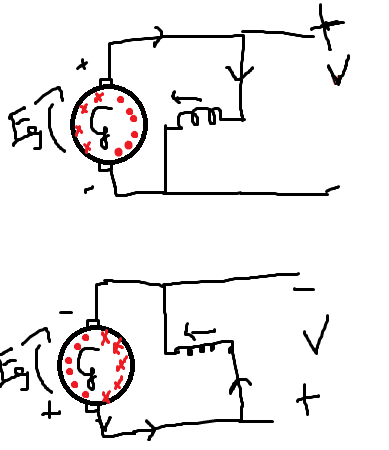
upload_2018-1-12_12-19-8.png

But in second case the direction of current will also change as the flux has changed its direction. So by right hand rule, emf also changes sign. So again the field flux is same as right to left. How does this work? Do I change the direction of rotation of prime mover?
 

Attachments

  • upload_2018-1-12_12-19-8.png
    upload_2018-1-12_12-19-8.png
    5.9 KB · Views: 1,693
Engineering news on Phys.org
Can you provide the page where you have seen this technique described? It might give a clue to what is going on.

What are F1,F2?
 
  • Like
Likes   Reactions: jaus tail
The description is:
The small voltage due to residual magnetism should circulate current in field coils in a direction to produce flux aiding the residual flux. If the field connections are incorrect, the flux produced by small field current opposes residual flux and generated voltage becomes zero. This trouble can be remedied by reversing field connections w.r.t armature terminals.

There isn't any diagram or more. I drew the diagram myself.
 
Okay got it. At first field current is zero. Residual flux is there. This causes Eg and also Ia. This also gives field current. Now if field flux opposes residual flux then generator goes to zero voltage as flux has fallen.
But if I reverse field. Again at first field current is zero. Residual flux is there. This causes Eg and Ia. This gives field current. But now it's opposite so it aids residual flux.
 
  • Like
Likes   Reactions: NascentOxygen
jaus tail said:
The description is:
The small voltage due to residual magnetism should circulate current in field coils in a direction to produce flux aiding the residual flux. If the field connections are incorrect, the flux produced by small field current opposes residual flux and generated voltage becomes zero. This trouble can be remedied by reversing field connections w.r.t armature terminals.

There isn't any diagram or more. I drew the diagram myself.
It's saying if you connect the field the wrong way it won't work. To fix this, connect it the right way and it will work.

Imagine a permanent magnet generator. You decide to add an electromagnet to strengthen the field. There are two ways to merge the fields: additively and subtractively. The prime mover's rotation remains unchanged.
 
Last edited:
  • Like
Likes   Reactions: jaus tail

Similar threads

  • · Replies 37 ·
2
Replies
37
Views
7K
  • · Replies 9 ·
Replies
9
Views
3K
  • · Replies 4 ·
Replies
4
Views
2K
Replies
64
Views
8K
Replies
4
Views
4K
Replies
1
Views
3K
  • · Replies 7 ·
Replies
7
Views
2K
  • · Replies 5 ·
Replies
5
Views
654
  • · Replies 5 ·
Replies
5
Views
5K
  • · Replies 6 ·
Replies
6
Views
2K