Resistance and DC circuit question

Join the discussion
Registration is free. Start your own thread to ask a follow-up.
7 replies · 3K views · last reply
SmokeyMTNJim
Messages
18
Reaction score
0
Here is the problem: I have already lost the ability to get the correct answer for AI
Homework Statement


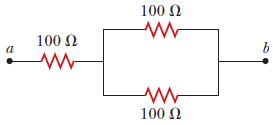
Circuit schematic: a 100 Ω resistor in series from terminal a, then two parallel branches of 100 Ω resistors on the top and bottom wires, ending at terminal b.

(a) What is the maximum potential difference that can be applied to the terminals a and b?
33.541

Resistance and DC circuit question

Which resistor will have the largest current? V

(b) For the voltage determined in part (a), what is the power delivered to each resistor?
resistor on the left W
resistor at the top of the loop W
resistor at the bottom of the loop W

(c) What is the total power delivered to the combination of resistors?
W

Homework Equations

:
V=IR, P=IV, P=I^2R
Resistors in series = R+R+R...
Resistors in parallel (1/R)+(1/R)+(1/R)...[/B]

The Attempt at a Solution


My thought process was: If the max power to anyone resistor could be 22.5 watts then use P=IV, substitute the V for V=IR.
My equation is now P=I^2R or 22.5W = I^2 (100Ω) => I = .4743 A for current at the resistor on side A. V=IR => V=.4743(100) => V=47.43

I tried a similar method for the other side after consolidating the Resistors 1/100 + 1/100 = .2 => 1/.2 = 50. Basically a------100Ω--------50Ω--------b

No dang just thought to add these to together and get a Reqiv. for the whole thing. So i just used the same method of P=I^2R to get a I = .3873.
V=IR => 150Ω(.3873) = 58.095 V << Is this what you would get for part a? I don't really want to plug in answers yet for the problem if its wrong
 
Physics news on Phys.org
SmokeyMTNJim said:
Here is the problem: I have already lost the ability to get the correct answer for AI

Homework Statement


Circuit schematic: a 100 Ω resistor in series from terminal a, then two 100 Ω resistors in parallel branches, then terminal b.

(a) What is the maximum potential difference that can be applied to the terminals a and b?
33.541
Row of small forum status icons: green check marks, red crosses, speech bubbles, and gray question and warning symbols.

Which resistor will have the largest current? V

(b) For the voltage determined in part (a), what is the power delivered to each resistor?
resistor on the left W
resistor at the top of the loop W
resistor at the bottom of the loop W

(c) What is the total power delivered to the combination of resistors?
W

Homework Equations

:
V=IR, P=IV, P=I^2R
Resistors in series = R+R+R...
Resistors in parallel (1/R)+(1/R)+(1/R)...[/B]

The Attempt at a Solution


My thought process was: If the max power to anyone resistor could be 22.5 watts then use P=IV, substitute the V for V=IR.
My equation is now P=I^2R or 22.5W = I^2 (100Ω) => I = .4743 A for current at the resistor on side A. V=IR => V=.4743(100) => V=47.43

I tried a similar method for the other side after consolidating the Resistors 1/100 + 1/100 = .2 => 1/.2 = 50. Basically a------100Ω--------50Ω--------b

No **** just thought to add these to together and get a Reqiv. for the whole thing. So i just used the same method of P=I^2R to get a I = .3873.
V=IR => 150Ω(.3873) = 58.095 V << Is this what you would get for part a? I don't really want to plug in answers yet for the problem if its wrong
Please state the complete problem.
 
Three 100 Ω resistors are connected as shown in the figure. The maximum power that can safely be delivered to anyone resistor is 22.5W.
Circuit schematic of three 100 Ω resistors: one in series on the left between terminal a and a parallel pair, with a 100 Ω resistor in each of the two parallel branches, ending at terminal b on the right.

(a) What is the maximum potential difference that can be applied to the terminals a and b?
33.541
Row of small forum status and reaction icons, including green checkmarks, red crosses, question marks and thumbs-up symbols.

Which resistor will have the largest current? V

(b) For the voltage determined in part (a), what is the power delivered to each resistor?
resistor on the left
Row of small forum status icons: green check marks, red X marks, speech bubbles and gray question-style icons.
W
resistor at the top of the loop W
resistor at the bottom of the loop W

(c) What is the total power delivered to the combination of resistors?
W
 
SmokeyMTNJim said:
Three 100 Ω resistors are connected as shown in the figure. The maximum power that can safely be delivered to anyone resistor is 22.5W.
Circuit schematic: terminal a connects through a 100 Ω resistor to a junction, then two 100 Ω resistors in parallel, one on top and one on bottom, rejoin to terminal b.

(a) What is the maximum potential difference that can be applied to the terminals a and b?
33.541
Row of small forum status icons: green checkmarks, red crosses, speech bubbles and gray user avatars, some marked with asterisks.

Which resistor will have the largest current? V

(b) For the voltage determined in part (a), what is the power delivered to each resistor?
resistor on the left
Strip of small forum status icons, including green checkmarks, red crosses, speech bubbles and smiley faces.
W
resistor at the top of the loop W
resistor at the bottom of the loop W

(c) What is the total power delivered to the combination of resistors?
W
SammyS said:
Please state the complete problem.

I apologize for not including that top part.
 
SmokeyMTNJim said:

The Attempt at a Solution


My thought process was: If the max power to anyone resistor could be 22.5 watts then use P=IV, substitute the V for V=IR.
My equation is now P=I^2R or 22.5W = I^2 (100Ω) => I = .4743 A for current at the resistor on side A. V=IR => V=.4743(100) => V=47.43

I tried a similar method for the other side after consolidating the Resistors 1/100 + 1/100 = .2 => 1/.2 = 50. Basically a------100Ω--------50Ω--------b

No **** just thought to add these to together and get a Reqiv. for the whole thing. So i just used the same method of P=I^2R to get a I = .3873.
V=IR => 150Ω(.3873) = 58.095 V << Is this what you would get for part a? I don't really want to plug in answers yet for the problem if its wrong
The resistor closest to point a can have a maximum current of approx. 0.4743 A.

If the equivalent resistance is 150 Ω, what voltage is required to have a current of 0.4743 A ?
 
SammyS said:
The resistor closest to point a can have a maximum current of approx. 0.4743 A.

If the equivalent resistance is 150 Ω, what voltage is required to have a current of 0.4743 A ?


Why do we use the equivalent resistance, but not the equivalent current that I found, was that an erroneous calculation?
 
SmokeyMTNJim said:
Why do we use the equivalent resistance, but not the equivalent current that I found, was that an erroneous calculation?
Look at it another way.

You can have at most 0.4743 A through the resistor on the left. Then how much current will flow through each of the two resistors that are in parallel?

Assuming you get that right, what is the voltage drop across a & b ?
 
It helps to write down the certain rules for parallel and series circuits. When Voltage (potential difference) is the same, when does it change, when does the current change, when it is the same. When I did these questions back in high school, what helped was working the problems out with easier numbers and figuring out V,I,R, at different points in circuits.