Resistive heating power AC vs rectified AC/DC

Click For Summary

Discussion Overview

The discussion revolves around the differences in resistive heating power when using alternating current (AC) versus rectified and filtered direct current (DC). Participants explore the effects of rectification on current draw and heating efficiency in resistive loads, examining both theoretical and experimental perspectives.

Discussion Character

  • Exploratory
  • Technical explanation
  • Debate/contested
  • Mathematical reasoning

Main Points Raised

  • One participant describes an experiment with a soldering iron and a resistive heating element, noting differences in current draw between AC and rectified/filtered DC.
  • Another participant suggests that the capacitor in the rectified circuit stores energy and releases it at a different rate, affecting the average current and power.
  • A participant questions why the peak AC voltage does not result in higher current through the resistor when connected to AC, suggesting that the capacitor may extend the peak voltage over time.
  • Discussion includes the idea that the resistor's current draw is proportional to the voltage across it, with AC producing a sinewave current and rectified DC resulting in a mainly DC component with ripple voltage.
  • One participant emphasizes the importance of understanding RMS values and how they relate to power calculations in AC circuits.
  • Another participant notes that AC current meters may not provide accurate readings due to the non-linear nature of the load.
  • There is a mention of the relationship between AC and DC, suggesting that under certain conditions, the two can be treated similarly.

Areas of Agreement / Disagreement

Participants express differing views on the behavior of current and voltage in AC versus rectified DC circuits. There is no consensus on the underlying reasons for the observed differences in heating power and current draw.

Contextual Notes

Participants discuss the implications of RMS values, the behavior of capacitors in rectified circuits, and the limitations of AC current meters, but these points remain unresolved and depend on specific circuit conditions.

artis
Messages
1,479
Reaction score
977
I thought about this for some time but I can't seem to really understand the cause.
Now I remember some time ago using a transformer for my self made soldering iron, I wound it to have the right temperature at about 45 VAC input but I guess I missed a bit , so that when I connected it to the 45 v output of my transformer it was hot but not hot enough for some higher temp. tin.
What came to mind was to rectify and smooth the AC output to DC, I did this and indeed the soldering iron was now just hot enough to melt all kinds of tin.
Clearly rectifying AC doesn't increase it's voltage or maximum power , by adding a filter capacitor I can just simply "catch" the AC peak voltage which is the AC RMS voltage times 1.414, so for 45 VAC the peak DC rectified voltage is then about 63 volts.So just out of curiosity I did a second experiment , this time deliberately. I took a resistive heating element (an old heater essentially) and one of my test transformers. It has both an AC output as well as a full bridge rectifier with filter caps, so I can also use the rectified but unfiltered DC or the rectified and filtered DC.
So my results are as follows.

1) Secondary AC output with no load (RMS value measured by multimeter) = 100 VAC which implies the AC peak should be 140 VAC.
2) Rectified but unfiltered DC output after the bridge rectifier with no load = about 95/97 volts , some drop due to diode forwards voltage drop (older model diodes)
3) And finally the no load filtered DC output = 140 VDCHere is the part I don't quite understand. As I connect the heating element as my load I now measure the amps flowing to the heater.
1) Heater on AC draws about 1.03A at 98 VAC (about 2-3 volts drop due to load)
2)Heater on unfiltered rectified DC draws about 0.903 A at about 93/94 volts , again few volts drop in the transformer and in the diodes.
3) Heater on rectified and filtered DC draws 1.3A at about 130 VDC. (10 volt drop from maximum 140 VDC due to load)
So here is my dilemma, clearly I can push more amperes through a resistor by rectifying and filtering my AC instead of just using the AC as is. But what I don't understand is this, the bridge rectifier nor the capacitor doesn't add any power to the circuit, all the power comes from the transformer secondary as is. The capacitor simply charges to the peak of the sine wave during each half period.
The question is why isn't this sine wave peak manifesting as current/heat in the resistor on AC but only after rectification to DC and filtering?

A resistor is said to be 100% efficient as it turns current into heat, the current through a fixed resistance is proportional to voltage, so taking the AC RMS voltage one can see it's lower than the rectified and filtered DC but the DC maximum voltage is then again just the AC peak, so why isn't this AC peak heating the resistor when it's connected to AC ?
 
Engineering news on Phys.org
3) Heater on rectified and filtered DC draws 1.3A at about 130 VDC. (10 volt drop from maximum 140 VDC due to load)

If you meter the primary you will see a increase (non-sinusoidal peak pulses) in average current and power over the AC powered resistor case. The capacitor stores energy in high current pulses and releases (ripple) it at the filter load time constant rate.

https://diyaudioheaven.wordpress.com/tutorials/power-supplies/rectifiers/
 
  • Like
Likes   Reactions: DaveE and sysprog
@nsaspook I do realize that. The capacitor discharges somewhat after each cycle's peak, how much depends on the load, so it sort of functions like a thyristor that gets switched on each cycle shortly before the peak and switched off at the peak.
My problem is a bit different, I don't understand why this AC peak doesn't manifest itself through the resistor when it's connected to AC and is only adding it's value when the AC is rectified and filtered?

Because the filter capacitor only charges up to the maximum AC voltage during each half period, yet when I connect the resistor to AC only versus rectified/filtered DC the current draw is different.

Does it have to do with the fact that the capacitor stores the AC half period that it got charged with and so the peak AC voltage get sort of "stretched out" longer over the resistive load than it would under pure AC ?
 
You could halve the capacitance if rather than a single diode, you used a full wave rectifier such as a bridge. Then both half cycles would charge the capacitor.
 
  • Like
Likes   Reactions: sophiecentaur
artis said:
@nsaspook
...
My problem is a bit different, I don't understand why this AC peak doesn't manifest itself through the resistor when it's connected to AC and is only adding it's value when the AC is rectified and filtered?
...

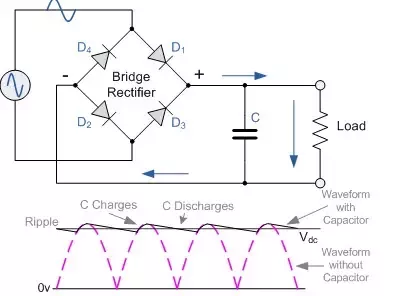
The resistor is purely a dissipative element in the circuit with a current draw that's proportional to the voltage across it. (ohms law) The current change in the resistor is a function of applied voltage. With a pure AC voltage sinewave applied, the resistor current waveform is also a sinewave. In the rectified and filtered circuit there is the mainly DC component and a ripple voltage across the resistor so we still don't have a large peak current pulses through the resistor, only variations in current from changes in the ripple voltage.

main-qimg-47968bcc4d7b47c9ab378eead57075f5.gif


During the https://www.electronics-tutorials.ws/filter/filter_1.html pulse current peak(s), the capacitor current path and the resistor current path are different because the capacitor is a much lower impedance (higher current in this path) than the load (mainly steady current) during the peak charging time period.

main-qimg-d81025ad4ab4d379638018b6203d42bc.webp
 
Last edited:
So I guess it is because of what I thought, the DC voltage is the same AC peak voltage just that in AC only case voltage and current waveforms are in phase through the resistor so the peak voltage through the resistor is only at the moment during sine half period peak, meanwhile in the rectified and filtered DC case this peak voltage is extended for a longer time period if the load is not large enough as to completely drain the capacitor during each half period charge.
So the capacitor extends the peak AC voltage and even as it discharges the voltage that it drops to is still higher than the voltage the AC sine is falling down towards the zero crossing point.

In other words if I were to integrate under the rectified half periods verus integrate under the rectified and filtered line in this second case there would be more area, so more power available through the resistor.
 
  • Like
Likes   Reactions: Tom.G
Several things:
-
1) Take a moment and realize what RMS actually is. Chop up an AC cycle into tiny slices and take the product of the instantaneous voltage and instantaneous current for each slice and average the products over the complete cycle. This is the same amount of watts you would get from a DC source into the same resistive load at the all familiar peak AC volts / (2^.5). (RMS is peak / 1.414).
-
2) Your AC current meter is likely lying to you. It is probably not accurately able to give you a true reading because of the fact that you are driving a non-linear load. You only draw current during about 25% or less of the full wave rectified cycle.
 
  • Like
  • Informative
Likes   Reactions: nsaspook and anorlunda
Averagesupernova said:
1) Take a moment and realize what RMS actually is. Chop up an AC cycle into tiny slices and take the product of the instantaneous voltage and instantaneous current for each slice and average the products over the complete cycle. This is the same amount of watts you would get from a DC source into the same resistive load at the all familiar peak AC volts / (2^.5). (RMS is peak / 1.414).
That's exactly right. What a lot of people don't realize is that method works for non-sinusoidal and non-periodic waveforms as well. When you work with sufficiently brief samples, there is no difference between AC and DC.
 
  • Like
Likes   Reactions: Averagesupernova and nsaspook
anorlunda said:
When you work with sufficiently brief samples, there is no difference between AC and DC.
In school we were told early on that AC is just changing DC. Good way to think about it, but as with most things, it only goes so far.
 
  • #10
@Averagesupernova I was actually aware of what you said in your post so when I did my measurements I used a meter that has both AC and DC current reading options, while on AC I simply used the ammeter in series with the heater, then when I measured DC current I used the meter on the DC side after the filter capacitor so that I don't measure as you said "the capacitor charging current" but instead measure the full load current that goes into the resistor constantly, and that came out to be the 1.3A as said in post #1.

But I think I got the reason why as I already said in my post #6, that for loads that don't completely drain the capacitor to zero after each half period peak , the capacitor charge only drops say by 1/3 or so , so even though the AC half period has dropped to zero by that time the capacitor is still supplying current to the load , so from the perspective of the load , it gets more current on average than it would get with AC only and this I think is the reason why I'm getting more heat from my soldering iron when I use DC , even though that DC has the same maximum voltage and power available as the AC that created it.
 
  • #11
artis said:
so from the perspective of the load , it gets more current on average than it would get with AC only
There is another factor at work and that is the series resistance of the transformer which can limit the rate that the capacitor can charge during the top up period. The effective DC will always be a bit below the AC waveform peak. No prob if the transformer is a good one, tho'.
 

Similar threads

  • · Replies 14 ·
Replies
14
Views
2K
  • · Replies 5 ·
Replies
5
Views
2K
  • · Replies 15 ·
Replies
15
Views
2K
  • · Replies 8 ·
Replies
8
Views
3K
  • · Replies 7 ·
Replies
7
Views
4K
  • · Replies 63 ·
3
Replies
63
Views
8K
  • · Replies 39 ·
2
Replies
39
Views
5K
Replies
21
Views
2K
Replies
6
Views
4K
Replies
1
Views
2K