decentfellow
- 130
- 2
I have been having some problem resolving the velocity component along the rope. My question will be clear if you read an illustration that I encountered which is very helpful in showing my doubt very clearly.
In the Fig. given below the block ##'A'## and ##'B'## are connected with an in-extensible string. The block ##'A'## can slide on a smooth horizontal surface.
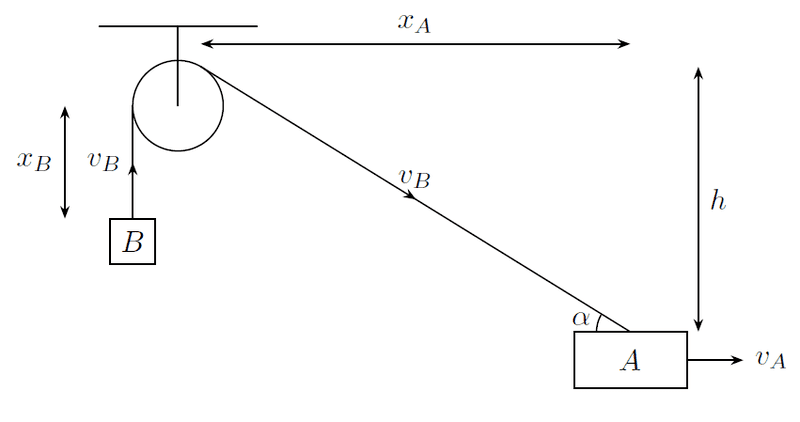
My approaches to form the kinematics constraint equations:-
Approach 1:-
The length ##\ell## of the string connecting the two blocks ##A## and ##B## can be written as follows
$$\sqrt{{x_A}^2+h^2}+x_B+R\theta=\ell$$
On differentiating the above equation we get
$$\dfrac{x_A}{\sqrt{{x_A}^2+h^2}}\cdot\dfrac{dx_A}{dt}+\dfrac{dx_B}{dt}=0\implies \dfrac{x_A}{\sqrt{{x_A}^2+h^2}}\cdot\dfrac{dx_A}{dt}=-\dfrac{dx_B}{dt}$$
As the block ##A## moves rightward ##x_A## increases while ##x_B## decreases. So, ##\dfrac{dx_A}{dt}=v_A## and ##\dfrac{dx_B}{dt}=-v_B##. So, the kinematic constraint equation for velocity is as follows
$$\dfrac{x_A}{\sqrt{{x_A}^2+h^2}}\cdot v_A=v_B\implies v_A\cos\alpha=v_B\ \qquad\qquad\left(\because \cos\alpha=\dfrac{x_A}{\sqrt{{x_A}^2+h^2}}\right)$$
Approach 2:-
The velocity of block ##B##, ##v_B## is along the string hence there could be two possible constraints according to me as follows:-
$$v_B\sec\alpha=v_A$$
or
$$v_B\cos\alpha=v_A$$
Please do tell me as why ##v_B\sec\alpha=v_A## is correct and the other one is wrong.
I had considered that what would have happened if the velocities in both the cases (the cases being the projection of the velocity along the rope in the direction of the movement of block ##A##, and the other one being the projection of the velocity of the block ##A## along the direction of the rope) if resolved into components would affect the movement of the one, in the direction of which the velocities have been resolved.
Case 1:-
So, what I had considered in the case of the velocity along the rope being projected in the direction of the notion of the block ##A## is as follows:-
If the velocity of the rope is resolved as stated above then, in the direction of the motion of the block ##A## the projected velocity will be ##v_B\cos\alpha## and in the perpendicular direction it will be ##v_B\sin\alpha##, as the block is not allowed to move in that direction, so the ground does something(yeah, the ground does something, I am not at all sure if the ground does something in this case, so some clarification on this too) which doesn't let it move in the perpendicular direction. So, according to me this is a probable case too.
Case 2:-
In this case what I had considered was that if we resolve the velocity of the block ##A## along the rope and perpendicular to the rope we get that the velocity component along the rope comes out to be ##v_A\cos\alpha## and perpendicular to it comes out to be ##v_A\sin\alpha##. Now, the perpendicular component changes the direction of the rope and the component along the rope produces the needed velocity along the rope to make the block ##B## move upwards. So, this case is also possible.
So, what is wrong in the 1st case such that it is not the answer, but the case-2 is.
In the Fig. given below the block ##'A'## and ##'B'## are connected with an in-extensible string. The block ##'A'## can slide on a smooth horizontal surface.
My approaches to form the kinematics constraint equations:-
Approach 1:-
The length ##\ell## of the string connecting the two blocks ##A## and ##B## can be written as follows
$$\sqrt{{x_A}^2+h^2}+x_B+R\theta=\ell$$
On differentiating the above equation we get
$$\dfrac{x_A}{\sqrt{{x_A}^2+h^2}}\cdot\dfrac{dx_A}{dt}+\dfrac{dx_B}{dt}=0\implies \dfrac{x_A}{\sqrt{{x_A}^2+h^2}}\cdot\dfrac{dx_A}{dt}=-\dfrac{dx_B}{dt}$$
As the block ##A## moves rightward ##x_A## increases while ##x_B## decreases. So, ##\dfrac{dx_A}{dt}=v_A## and ##\dfrac{dx_B}{dt}=-v_B##. So, the kinematic constraint equation for velocity is as follows
$$\dfrac{x_A}{\sqrt{{x_A}^2+h^2}}\cdot v_A=v_B\implies v_A\cos\alpha=v_B\ \qquad\qquad\left(\because \cos\alpha=\dfrac{x_A}{\sqrt{{x_A}^2+h^2}}\right)$$
Approach 2:-
The velocity of block ##B##, ##v_B## is along the string hence there could be two possible constraints according to me as follows:-
$$v_B\sec\alpha=v_A$$
or
$$v_B\cos\alpha=v_A$$
Please do tell me as why ##v_B\sec\alpha=v_A## is correct and the other one is wrong.
I had considered that what would have happened if the velocities in both the cases (the cases being the projection of the velocity along the rope in the direction of the movement of block ##A##, and the other one being the projection of the velocity of the block ##A## along the direction of the rope) if resolved into components would affect the movement of the one, in the direction of which the velocities have been resolved.
Case 1:-
So, what I had considered in the case of the velocity along the rope being projected in the direction of the notion of the block ##A## is as follows:-
If the velocity of the rope is resolved as stated above then, in the direction of the motion of the block ##A## the projected velocity will be ##v_B\cos\alpha## and in the perpendicular direction it will be ##v_B\sin\alpha##, as the block is not allowed to move in that direction, so the ground does something(yeah, the ground does something, I am not at all sure if the ground does something in this case, so some clarification on this too) which doesn't let it move in the perpendicular direction. So, according to me this is a probable case too.
Case 2:-
In this case what I had considered was that if we resolve the velocity of the block ##A## along the rope and perpendicular to the rope we get that the velocity component along the rope comes out to be ##v_A\cos\alpha## and perpendicular to it comes out to be ##v_A\sin\alpha##. Now, the perpendicular component changes the direction of the rope and the component along the rope produces the needed velocity along the rope to make the block ##B## move upwards. So, this case is also possible.
So, what is wrong in the 1st case such that it is not the answer, but the case-2 is.
