Resource explaining circuit design (for newbies)

Click For Summary
The discussion centers on finding resources that explain simple circuit designs in a relatable way, particularly for beginners. Participants emphasize the importance of understanding how components like resistors and capacitors function within a circuit, especially in practical applications like audio effects. A detailed breakdown of a specific circuit illustrates how transistors operate and how feedback mechanisms stabilize performance. The conversation highlights a desire for tutorials that bridge theoretical knowledge with practical circuit examples. Overall, the community seeks accessible resources that demystify circuit design for hobbyists.
Joakim
Messages
7
Reaction score
0
I've been looking for quite some time for some tutorial/video online explaining a working circuit. I mean, consider some simple analoge circuit, with resistors and voltage dividers, caps, maybe even transistors etc etc... If this circuit performs some understandable task, then what do these "helper components" do? I gather a lot is to do with ensuring the proper voltage and/or current "at" the various legs of the "more important" (active) components (transistors, mosfets, IC's etc). But while I understand there's a lot more to take into consideration than simply "powering on" transistors to make them do useful work, but what -- then -- do the resistors do for instance in the audio circuit ("fuzz") below?
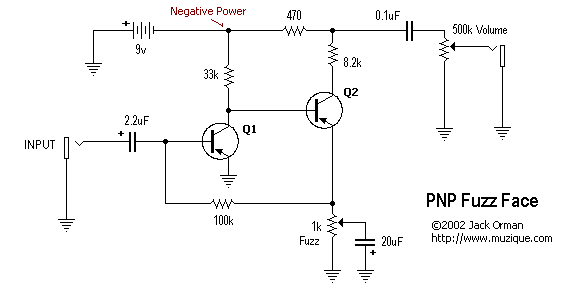
fuzzface6.gif


The caps are there to prevent the DC powering the transistors "inside" the effect circuit from going along with the audio signal (which is AC) at the input and output. This could possibly damage the guitar and/or amp :-)

In summary, does anyone know of a resource which takes "simple" circuits one can relate to, and breaks them down discussing the design? I know there are tons of stuff going the opposite direction (explaining the basic theory), but it would be so much more motivating to see something like this after struggling with the theory (as a hobby) for years.Joakim
 
Last edited:
Engineering news on Phys.org
What is your main question? To be informed about a resource for explaining "simple circuits" - or do you want explanations for the shown circuit?
Nevertheless, I will provide some explanations:
1.) Starting with Q2: After supply voltage switched-on Q2 will open (pnp base negativ with respect to grounded emitter) allowing a collector current Ic2.
2.) The emitter current Ie2~Ic2 causes a negative voltage drop across the 1k resistor, which gives a bias voltage (through the 100k resistor) to the base of Q1.
3.) Hence, Q1 also opens and the current Ic1 produces a voltage drop across the 33k resistor - thereby reducing the base voltage of Q2 to a suitable fixed value.
4.) As a result, both transistors have a fixed operating point, which is temperature stabilized due to the 100k feedback resistor.
5.) Feedback works as follows: A temperature caused rising voltage across 1k increases Ic1 (more open) and increases the voltage drop across 33k. Hence, Q2 reduces Ic2 and works against the initial increase.
6.) The 2,2µF capacitor is for decoupling the dc gate potential (Q1) from the signal source; and the 0.1µF capacitor transfers a part of the ac output (amplified signal) to the load (This ac portion is determined by the output voltage divider 8.2k/470 Ohms).
7.) There is another capacitor: 20µF. It is the task of this capacitor to bridge a certain part of the 1k feedback resistor. As a result, we have the full 1k resistance for DC feedback (bias point stabilization) but only a part of this resistance for ac feedback. This is very convenient be cause we can tune the amount of ac feedback. Strong ac feedback is good for linearity (THD) but reduces the gain to a value that is (perhaps) too small. Thus, we can find a good trade-off between signal quality and gain.
_______________
Does this help?
 
Have to re-read this a couple of times, but thanks! Very interesting breakdown :)
This is the sort of thing I'm looking for, yes, although not necessarily for this particular circuit. That was just an example.

So, now that we're on the subject; are there any websites/videos maybe books which deal with this?
While I do appreciate tips on basic theory, this is easy to find and typically handles single component behavior in isolation.
 
I am trying to understand how transferring electric from the powerplant to my house is more effective using high voltage. The suggested explanation that the current is equal to the power supply divided by the voltage, and hence higher voltage leads to lower current and as a result to a lower power loss on the conductives is very confusing me. I know that the current is determined by the voltage and the resistance, and not by a power capability - which defines a limit to the allowable...

Similar threads

Replies
11
Views
3K
Replies
12
Views
2K
  • · Replies 3 ·
Replies
3
Views
3K
Replies
4
Views
2K
  • · Replies 7 ·
Replies
7
Views
2K
Replies
13
Views
3K
Replies
68
Views
7K
  • · Replies 28 ·
Replies
28
Views
5K
  • · Replies 1 ·
Replies
1
Views
2K
  • · Replies 6 ·
Replies
6
Views
2K