Discussion Overview
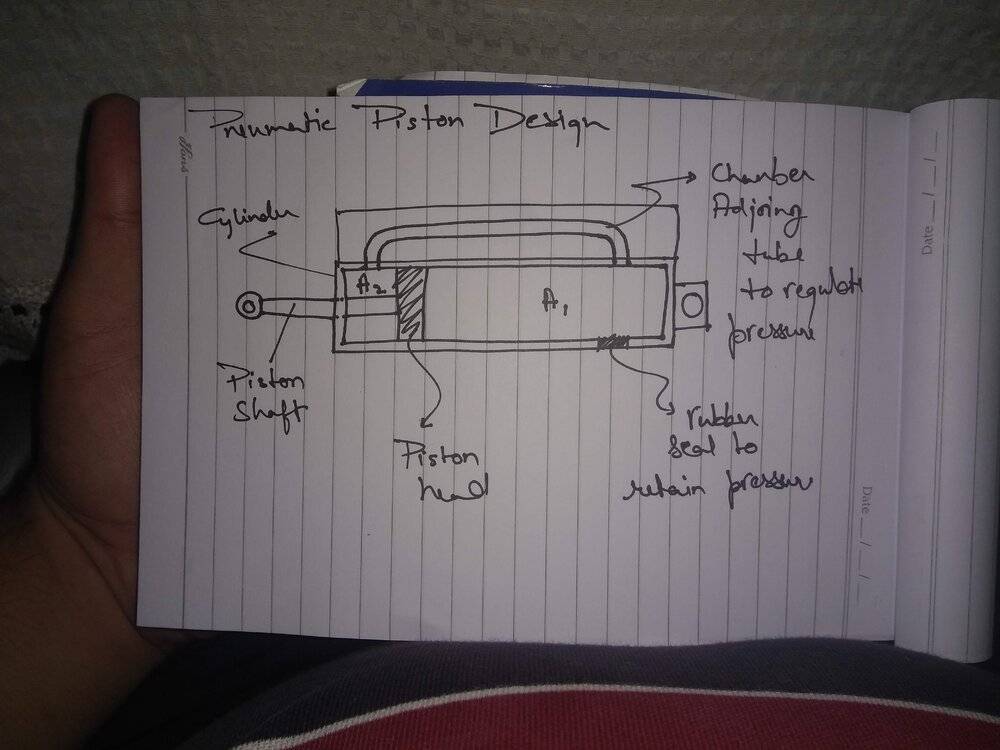
The discussion revolves around the functionality of a pneumatic piston designed by a freshman design student. The focus is on whether the piston can maintain its position under certain conditions, specifically when both chambers of the piston are pressurized and connected. The scope includes conceptual understanding and technical reasoning related to pneumatics.
Discussion Character
- Exploratory
- Technical explanation
- Conceptual clarification
Main Points Raised
- The original poster questions if a pressurized pneumatic piston can sustain its position when both chambers are joined.
- One participant suggests that if the pressures in the chambers are initially different and then equalized, the piston will move according to the Ideal Gas Law, prompting a question about the original poster's familiarity with this concept.
- Another participant challenges the original poster to elaborate on their reasoning for believing the piston will sustain its position.
- A further contribution compares the behavior of the piston to that of a spring, noting that the enclosed volume changes as the piston moves, and mentions a similarity to a regenerative hydraulic circuit.
Areas of Agreement / Disagreement
Participants have not reached a consensus. There are differing viewpoints on the mechanics of the pneumatic piston and its ability to maintain position under the described conditions.
Contextual Notes
There are limitations regarding the assumptions made about pressure differences and the specific design of the piston that have not been fully explored or defined.
Who May Find This Useful
This discussion may be useful for design students, engineers interested in pneumatics, and individuals exploring concepts related to pressure systems and mechanical design.