Rigidly Constantly Accelerating Frame

Click For Summary
A rigid frame, such as a rocket, undergoing constant proper acceleration has a hyperbolic worldline described by the equation x^2 - c^2t^2 = (c^2/a_0)^2. The discussion focuses on the implications of the orthogonality condition X · U = 0, which indicates that the line from the origin to the particle represents a surface of simultaneity in the instantaneous rest frame. It clarifies that lines of simultaneity do not simply follow the x = ± ct formula, as these represent light-like paths rather than surfaces of simultaneity. The conversation also emphasizes that different worldlines correspond to different hyperbolas, while all instantaneous rest frames share a common time coordinate at t=0. The Rindler horizon is noted as a boundary beyond which no information can reach observers in certain regions.
unscientific
Messages
1,728
Reaction score
13
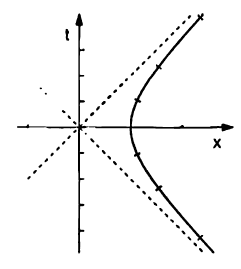
We know that when a rigid frame, say a rocket undergoes constant proper acceleration, its worldline is hyperbolic. The equation is given by:

x^2 - c^2t^2 = \left( \frac{c^2}{a_0} \right)^2
zlapdy.png


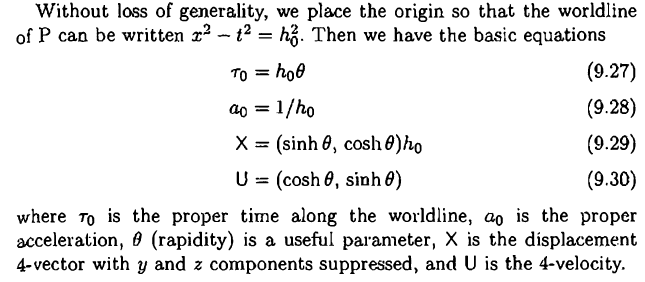
Suppose P is such a worldline and worldine can also be written as:
10er9qq.png


I understand how these are derived up to this point. But it is the reasoning presented below that confuses me.

Things I don't understand:
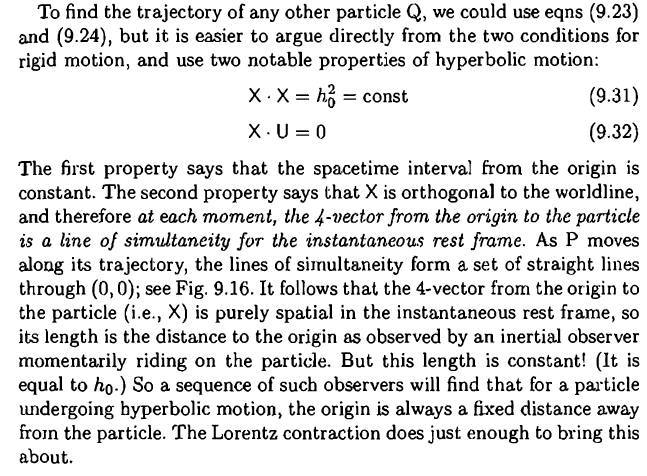
  • Why does ## X \cdot U = 0 ## imply that "4-vector from origin to particle is a line of simultaneity for the instantaneous rest frame" ?
  • Why do these lines of simultaneity pass through (0,0)? Shouldn't they simply be ##x = \pm ct## based on the first picture?

2dhgvnr.png


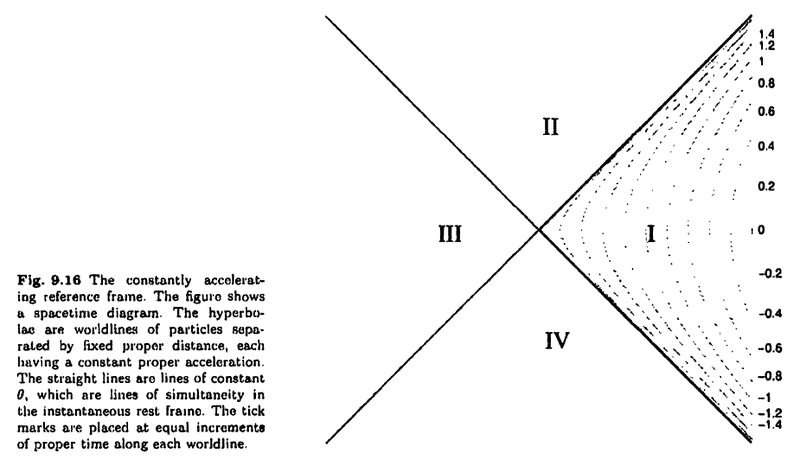
For completeness, Fig. 9.16 showing the worldlines and lines of simultaneity are shown below:
292mja1.png
 
Physics news on Phys.org
In the instantaneous rest frame, ##U## is pointing in the time direction, i.e., its components are (1,0,0,0). Anything orthogonal to this has time component zero and thus a line from the origin has zero change of dt in the instantaneous rest frame, i.e., it is a surface of simultaneity in that frame.
 
Orodruin said:
In the instantaneous rest frame, ##U## is pointing in the time direction, i.e., its components are (1,0,0,0). Anything orthogonal to this has time component zero and thus a line from the origin has zero change of dt in the instantaneous rest frame, i.e., it is a surface of simultaneity in that frame.
That makes sense. What about point 2? I thought based on the formula of the hyperbola these lines of simultaneity should simply be ##x = \pm ct##?
 
##x = \pm ct## is not a surface of simultaneity in any frame. A surface of simultaneity is simply a set of events with the same time coordinate in a given inertial frame, which means they are by definition space-like. The light cone is by definition ... well ... light-like. :)
 
Orodruin said:
##x = \pm ct## is not a surface of simultaneity in any frame. A surface of simultaneity is simply a set of events with the same time coordinate in a given inertial frame, which means they are by definition space-like. The light cone is by definition ... well ... light-like. :)
So in fig 9.16, is there only one surface of simultaneity for different values of ##a_0##? How do I find an expression for that surface?
 
unscientific said:
So in fig 9.16, is there only one surface of simultaneity for different values of ##a_0##? How do I find an expression for that surface?
No surfaces of simultaneity are drawn in 9.16 (at least not visible in that image, the original might have shown it clearer - by the way, you should also cite the original when quoting images and text). You have the light cone related to the origin and different hyperbola corresponding to different world lines with different constant proper acceleration. However, for each instantaneous rest frame for each of the world lines, they are all moving with velocity zero at the same time, i.e., time t=0 in that frame and they are equidistant at that time as well.

In addition, the light-like world line separating I and II is the Rindler horizon - no information can reach any of the observers from events contained in II or III.
 
In an inertial frame of reference (IFR), there are two fixed points, A and B, which share an entangled state $$ \frac{1}{\sqrt{2}}(|0>_A|1>_B+|1>_A|0>_B) $$ At point A, a measurement is made. The state then collapses to $$ |a>_A|b>_B, \{a,b\}=\{0,1\} $$ We assume that A has the state ##|a>_A## and B has ##|b>_B## simultaneously, i.e., when their synchronized clocks both read time T However, in other inertial frames, due to the relativity of simultaneity, the moment when B has ##|b>_B##...

Similar threads

  • · Replies 11 ·
Replies
11
Views
2K
  • · Replies 33 ·
2
Replies
33
Views
1K
  • · Replies 14 ·
Replies
14
Views
2K
  • · Replies 8 ·
Replies
8
Views
522
  • · Replies 144 ·
5
Replies
144
Views
9K
  • · Replies 38 ·
2
Replies
38
Views
4K
  • · Replies 1 ·
Replies
1
Views
1K
  • · Replies 30 ·
2
Replies
30
Views
3K
  • · Replies 75 ·
3
Replies
75
Views
7K
  • · Replies 4 ·
Replies
4
Views
2K