Rod resting on a cylinder, find mu

  • Thread starter Thread starter resurgance2001
  • Start date Start date
  • Tags Tags
    Cylinder Rod
Click For Summary
SUMMARY

The discussion focuses on solving a mechanics problem involving a rod resting on a cylinder, specifically addressing the forces and moments at points A and C. Participants emphasize the importance of considering additional forces, such as horizontal and vertical components at the contact points, and the necessity of writing three equations to balance horizontal forces, vertical forces, and torques. The conversation critiques an existing solution that lacks justification for certain equations and highlights the need for a detailed free body diagram to accurately analyze the forces involved.

PREREQUISITES
  • Understanding of static equilibrium in mechanics
  • Familiarity with free body diagrams
  • Knowledge of forces and moments in physics
  • Ability to solve equations involving friction and normal forces
NEXT STEPS
  • Study the principles of static equilibrium in mechanics
  • Learn how to construct and analyze free body diagrams
  • Research the equations of motion for rigid bodies
  • Explore the concept of limiting friction and its applications
USEFUL FOR

Students and professionals in physics and engineering, particularly those studying mechanics and dynamics, as well as anyone involved in solving problems related to forces and equilibrium in rigid bodies.

resurgance2001
Messages
197
Reaction score
9
Homework Statement
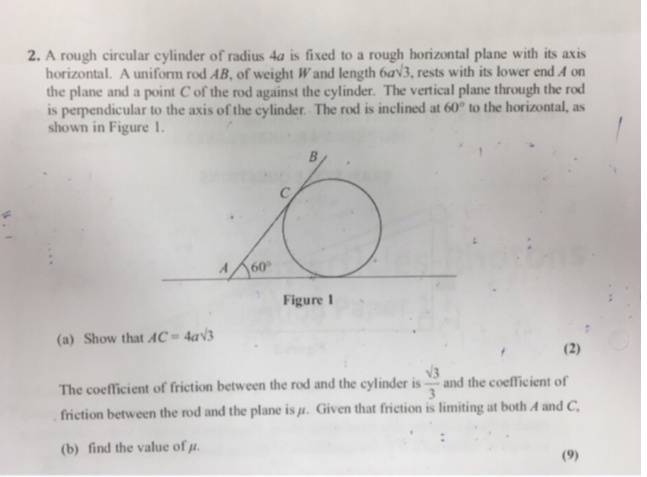
Please see the photo of the question below with the diagram. We have to find the coefficient of friction between the rod and plane
Relevant Equations
Moments, Components of forces, and friction = mu x reaction force.
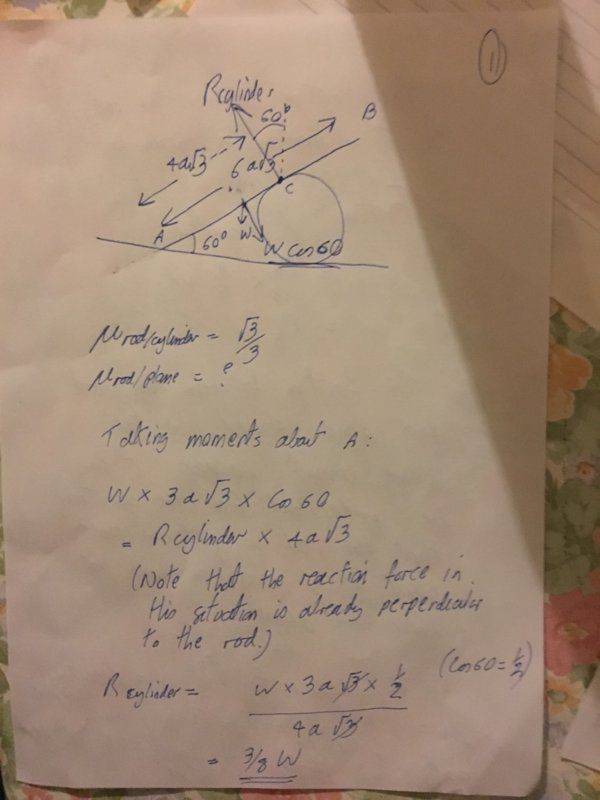
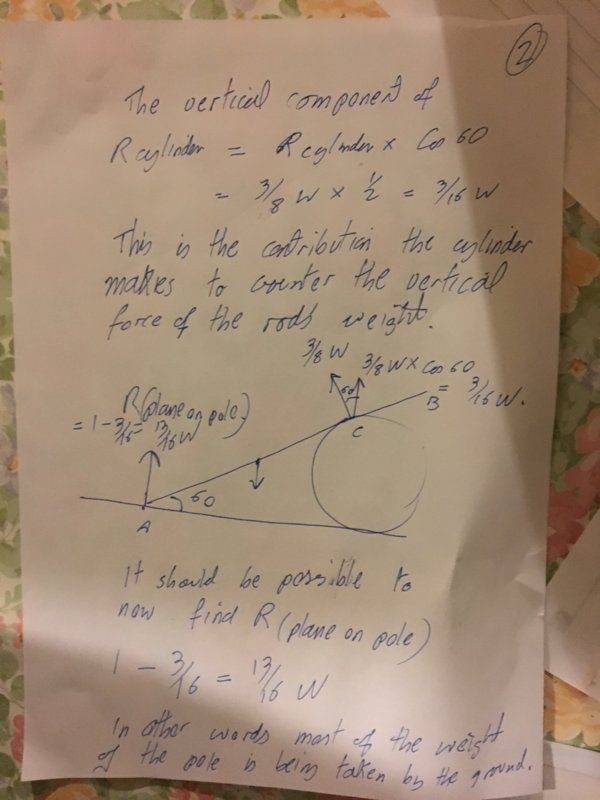
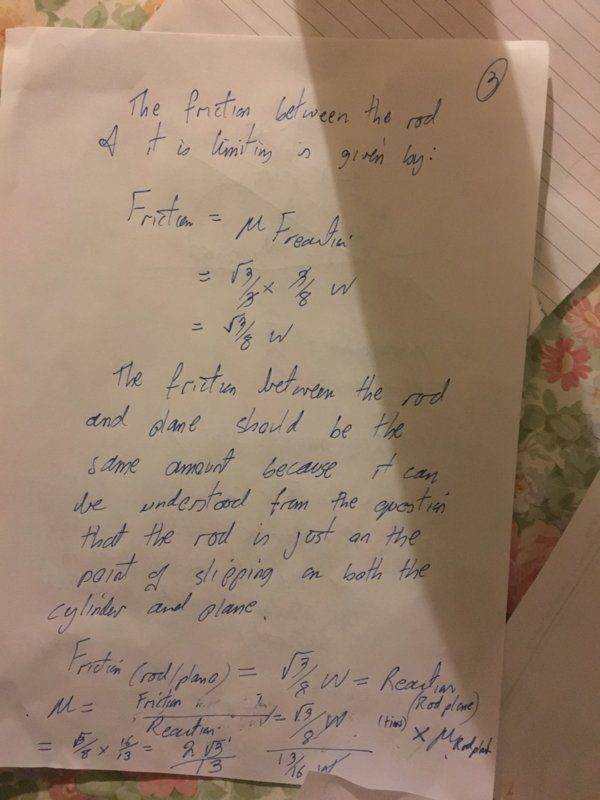
My solution is on the files.

The basic approac was the take moments about A. Then find the reaction at C.

Use the reaction at C to find the friction between rod and cylinder.

I take it to mean from the question that the friction between the rod and plane is equal to the friction between the rod and cylinder.

So find reaction at A.

And then divide the friction by the reaction at A.

So my real question is do you agree with the approach or can you suggest a more elegant way of solving the problem. ?

Thanks
6050E1C0-A69B-4992-AAB7-2151A341CA94.jpeg
513B2131-49B6-44D6-AC26-06F4D13687A7.jpeg
437C7F12-DDF0-46A2-BFAD-3191BF37E143.jpeg
AD0D8F8F-DD69-48B5-AD9B-635263A25142.jpeg
6050E1C0-A69B-4992-AAB7-2151A341CA94.jpeg
 
Physics news on Phys.org
I do not agree with your method. There are additional forces ##F_x## and ##F_y## at the point where the rod touches the ground. You need to take these into account and write three equations balancing the horizontal forces, the vertical forces and the torques.
resurgance2001 said:
I take it to mean from the question that the friction between the rod and plane is equal to the friction between the rod and cylinder.
The statement "Given that friction is limiting at both A and C" does not mean that the forces of friction are equal; it means that at both A and C the rod is at the threshold of slipping.

I would use a coordinate system with vertical and horizontal axes otherwise you will go crazy trying to sort out the force of static friction where the rod meets the ground.
 
kuruman said:
I do not agree with your method. There are additional forces ##F_x## and ##F_y## at the point where the rod touches the ground. You need to take these into account and write three equations balancing the horizontal forces, the vertical forces and the torques.

The statement "Given that friction is limiting at both A and C" does not mean that the forces of friction are equal; it means that at both A and C the rod is at the threshold of slipping.

I would use a coordinate system with vertical and horizontal axes otherwise you will go crazy trying to sort out the force of static friction where the rod meets the ground.
Thanks. I have another answer that someone else has done. It looks like they are doing the right thing with what looks like possibly a good free body diagram. However, at the start of their answer they just seem to pull out of nowhere 1/2 NRC - I can’t see what the justification is for that equation. Are they balancing moments. The diagram looks convincing but I am not convinced it is the correct answer.
 
Sorry I forgot to add the file.
 

Attachments

  • 4885FF52-86A3-48C8-92F0-B0710B42E7C5.jpeg
    4885FF52-86A3-48C8-92F0-B0710B42E7C5.jpeg
    39.8 KB · Views: 426
It looks like ##NR_C## represents the "normal reaction force at point C" which is perpendicular to the length of the rod. It has a vertical component equal to ##NR_C\cos60^o=NR_C×\frac{1}{2}##. It is needed not to balance torques but to balance the vertical forces. I have not done the problem in detail. When I do, I will let you know whether I agree with the solution you posted in #4.

On edit: My answer disagrees with the one posted in #4. I found one error and there may be more. The third equation from the bottom is supposed to be the balance equation for thr vertical forces. It reads ##NR_A+NR_C=\frac{8}{3}NR_C##. It has already been established that the weight ##W=83NR_C##. It is also correct that ##NR_A## is the vertical force at A. However ##NR_C## on the left side should be the vertical component of ##NR_C## not its magnitude. I suggest that you derive your own solution and then we can compare with mine.
 
Last edited:

Similar threads

  • · Replies 19 ·
Replies
19
Views
2K
  • · Replies 15 ·
Replies
15
Views
4K
  • · Replies 2 ·
Replies
2
Views
2K
  • · Replies 3 ·
Replies
3
Views
1K
  • · Replies 8 ·
Replies
8
Views
3K
  • · Replies 32 ·
2
Replies
32
Views
4K
  • · Replies 5 ·
Replies
5
Views
2K
  • · Replies 4 ·
Replies
4
Views
2K
Replies
4
Views
2K
  • · Replies 5 ·
Replies
5
Views
3K