Root Locus Sketching: Why Is -0.435 the Breakaway Point?

  • Thread starter Thread starter FFX
  • Start date Start date
  • Tags Tags
    Root Root locus
Click For Summary
SUMMARY

The breakaway point of -0.435 on the root locus is determined by the rule that two poles can never intersect. In the context of the discussion, the two real roots identified are -0.435 and -1.61, with -0.435 being the only point on the root locus. The characteristic equation for the system is essential for determining values of ##K##, where negative values correspond to points not on the root locus. Understanding these concepts is crucial for analyzing system stability and behavior in control theory.

PREREQUISITES
  • Root locus analysis in control systems
  • Characteristic equations in system dynamics
  • Understanding of poles and zeros in transfer functions
  • Knowledge of stability criteria in control theory
NEXT STEPS
  • Study the implications of pole-zero placement on system stability
  • Learn about the Routh-Hurwitz criterion for stability analysis
  • Explore the concept of gain margin and phase margin in control systems
  • Investigate the effects of varying gain (K) on the root locus
USEFUL FOR

Control engineers, system analysts, and students studying control theory who are interested in understanding root locus techniques and system stability analysis.

FFX
Messages
8
Reaction score
0
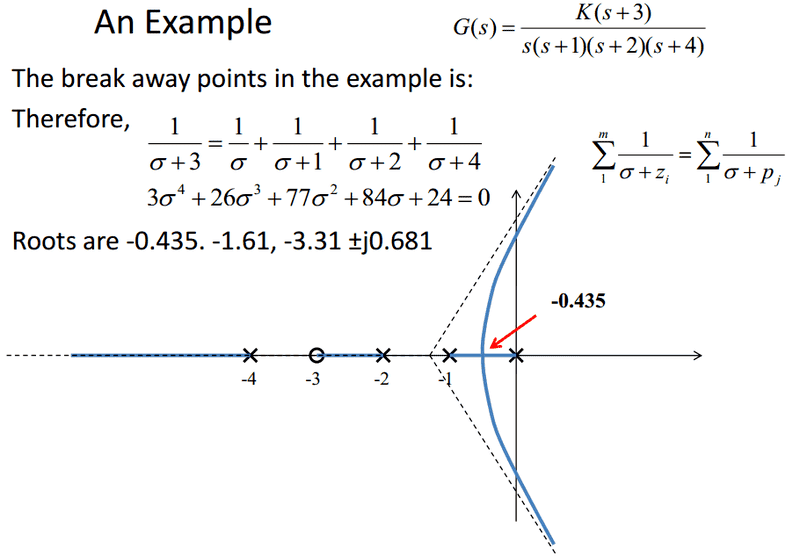
Hi guys. Firstly the answer to the requirement of the post is all in the picture (problem statement, relevant equations etc.). I'm just wondering if someone could tell me why they use the root -0.435 as the breakaway point? Like I know there's two real roots; -0.435 and -1.61, so obviously one of those two are the breakaway. Is it simply -0.435 because the rule is that two poles can never intersect? Or is it for an additional reason? Like I could apply the two poles never intersection rule to this scenario, but I'm wondering if there's another reason. Such as what were to happen if the roots were -0.435 and -0.675, or is such a thing not possible?
avhj05.png
 
Physics news on Phys.org
FFX said:
I'm just wondering if someone could tell me why they use the root -0.435 as the breakaway point?
That's the only point that's actually on the root locus.

When you solve for ##\sigma##, you're going to get solutions that correspond to negative values of ##K##, i.e. points that aren't on the root locus. You can figure out what values of ##\sigma## correspond to positive values of ##K## by inserting them into the characteristic equation for your system:
$$
K\frac{(s - z_1)(s - z_2)\dots(s - z_m)}{(s - p_1)(s - p_2)\dots(s - p_n)} = -1 \Leftrightarrow K = -\frac{(s - p_1)(s - p_2)\dots(s - p_n)}{(s - z_1)(s - z_2)\dots(s - z_m)}
$$
 
Ah that makes sense, thank you!
 

Similar threads

  • · Replies 1 ·
Replies
1
Views
2K
  • · Replies 3 ·
Replies
3
Views
3K
  • · Replies 4 ·
Replies
4
Views
2K
Replies
36
Views
8K
  • · Replies 14 ·
Replies
14
Views
2K
  • · Replies 3 ·
Replies
3
Views
2K
  • · Replies 2 ·
Replies
2
Views
4K
  • · Replies 1 ·
Replies
1
Views
8K
  • · Replies 14 ·
Replies
14
Views
2K
  • · Replies 5 ·
Replies
5
Views
3K