Rotation around fixed axis (robot arm), dynamics

Click For Summary
SUMMARY

The discussion focuses on the dynamics of a robot arm driven by two hydraulic cylinders, specifically analyzing the velocity and acceleration of point C in relation to point D, which has an angular velocity of 5 rad/s. The participants clarify that the distance from point D to C must be perpendicular to the axis of rotation for accurate calculations. A link to HyperPhysics is provided for further understanding of rotational dynamics, and the final solution is confirmed by community members.

PREREQUISITES
  • Understanding of rotational dynamics and angular velocity
  • Familiarity with hydraulic systems and their applications in robotics
  • Knowledge of vector representation in physics
  • Basic proficiency in using online physics resources like HyperPhysics
NEXT STEPS
  • Study the principles of rotational dynamics in depth
  • Learn about the kinematics of hydraulic systems in robotics
  • Explore vector analysis in physics, focusing on velocity and acceleration
  • Review case studies on robot arm dynamics and their applications
USEFUL FOR

Mechanical engineers, robotics enthusiasts, and students studying dynamics and kinematics in engineering contexts will benefit from this discussion.

Mech_LS24
Messages
148
Reaction score
16
Homework Statement
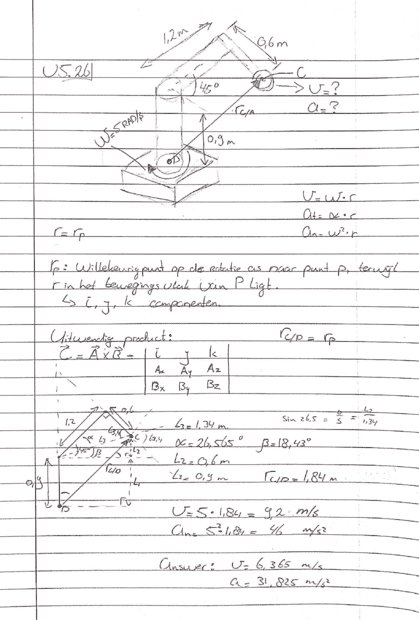
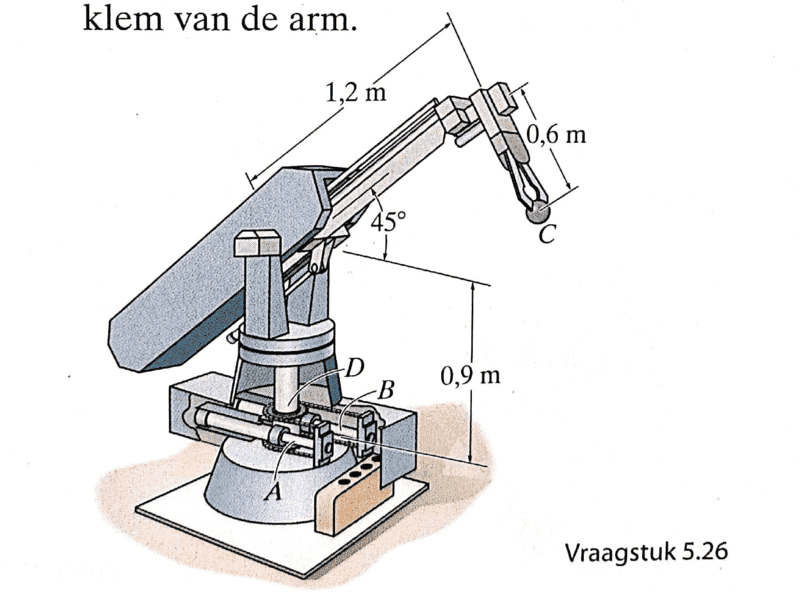
The robot arm is driven by two hydraulic cilinders A and B which brings point D rotates CW. The gear in point D has a angular velocity of 5 rad/s. Calculate the velocity and acceleration of the part in point C.
Relevant Equations
Velocity = angular velocity * radius
Acceleration = angular velocity^2 * radius
Hello,

Given the figure below, and the following statement:
"The robot arm is driven by two hydraulic cilinders A and B which brings point D rotates CW. The gear in point D has a angular velocity of 5 rad/s. Calculate the velocity and acceleration of the part in point C."

First I determined the distance from point D to C as rc/d, this distance is used for the formula's. The answer doesn't correspond, what am I missing here??

Like to here! :)
1625339667159.png

1625339678814.png
 
Physics news on Phys.org
Last edited:
  • Like
Likes   Reactions: Mech_LS24
Thanks @Lnewqban . Found the solution :)

1625390627567.png
 
  • Like
Likes   Reactions: Lnewqban
@Lnewqban , just to be sure, could you verify the sketch below? I draw the velocity and acceleration vectors acting on point C, where V actually goes 'into' the paper.

1625397938237.png
 
If I understand it correctly, I believe that vector V should be pointing out of the paper, as the rotation of the gear has been said to be clockwise.
The rest of the diagram seems to be correct.
 
  • Like
Likes   Reactions: Mech_LS24
You are right, thanks! :biggrin:
 
  • Like
Likes   Reactions: Lnewqban

Similar threads

  • · Replies 9 ·
Replies
9
Views
2K
  • · Replies 5 ·
Replies
5
Views
2K
  • · Replies 1 ·
Replies
1
Views
1K
  • · Replies 60 ·
3
Replies
60
Views
4K
  • · Replies 3 ·
Replies
3
Views
5K
  • · Replies 5 ·
Replies
5
Views
1K
  • · Replies 5 ·
Replies
5
Views
3K
Replies
5
Views
4K
  • · Replies 2 ·
Replies
2
Views
1K
Replies
7
Views
2K