syang9
- 61
- 0
consider a yo-yo consisting of two cylinders of radius R1, (combined) mass M1, glued to another smaller cylinder of radius R2, mass M2. find the final velocity after falling a height h using Newton's second law. assume the string is vertical.
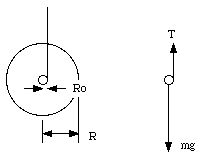
the inner radius R2 is R0, the outer radius R1 is R in this picture
so, i started off by applying f = ma to M2..
Fnet, y = (M1 + M2) - T = (M1 + M2)(a)cm
tnet, ext = T(R1) = I(alpha), alpha = (a)cm/R1
i calculated the moment of inertial to be the sum of the moments of inertia of the cylinders..
I = 1/2*(M1*R1^2 + M2*R2^2)
solving for (a)cm, i get a very nasty formula..
a = (M1 + M2)g / ( ( I/(2R1^2)) + (M1 + M2))
my original plan was to integrate this wrt time to get a velocity.
but this formula doesn't involve anything that changes with time.. so how do i obtain the final velocity? am i even on the right track?
the inner radius R2 is R0, the outer radius R1 is R in this picture
so, i started off by applying f = ma to M2..
Fnet, y = (M1 + M2) - T = (M1 + M2)(a)cm
tnet, ext = T(R1) = I(alpha), alpha = (a)cm/R1
i calculated the moment of inertial to be the sum of the moments of inertia of the cylinders..
I = 1/2*(M1*R1^2 + M2*R2^2)
solving for (a)cm, i get a very nasty formula..
a = (M1 + M2)g / ( ( I/(2R1^2)) + (M1 + M2))
my original plan was to integrate this wrt time to get a velocity.
but this formula doesn't involve anything that changes with time.. so how do i obtain the final velocity? am i even on the right track?
Last edited: