Rotation problem - AP Physics 1

Click For Summary

Discussion Overview

The discussion revolves around a rotation problem from an AP Physics 1 sample question, focusing on concepts of torque, acceleration, internal forces, and centripetal force in a system of two connected masses. Participants explore the implications of gravity on the motion of the masses and the nature of forces acting within the system.

Discussion Character

  • Exploratory
  • Technical explanation
  • Conceptual clarification
  • Debate/contested

Main Points Raised

  • One participant mentions that the net torque on the assembly is zero, suggesting this is due to the torque being applied at an earlier time and the masses not accelerating.
  • Another participant clarifies that while the rotation remains the same, the masses are changing their velocities and therefore accelerating.
  • There is a discussion about the curves in the graph, with one participant asserting that they are due to internal forces between the masses rather than gravity.
  • Participants discuss the concept of internal forces, with one explaining that these are the forces acting between different parts of the system, specifically between the two masses connected by a bar.
  • One participant asks for clarification on internal forces and requests a diagram for better understanding.
  • Another participant states that tension in the connecting bar is an internal force and contributes to the acceleration of the masses, which in turn affects the graph's curvature.
  • There is a question about whether the tension force acts as centripetal force towards the center of mass, with a later reply affirming that it does.
  • A more detailed explanation is provided regarding internal forces and their relationship to Newton's third law, emphasizing the distinction between internal and external forces in the context of the system.

Areas of Agreement / Disagreement

Participants express differing views on the nature of forces at play, particularly regarding the role of gravity and the characterization of internal versus external forces. The discussion remains unresolved as participants explore these concepts without reaching a consensus.

Contextual Notes

There are limitations in the discussion regarding the assumptions made about the system's behavior, the definitions of forces involved, and the mathematical implications of the forces acting on the masses.

blueblast
Hey guys,

I'm having trouble understanding this problem that was on an AP Physics 1 sample questions page:
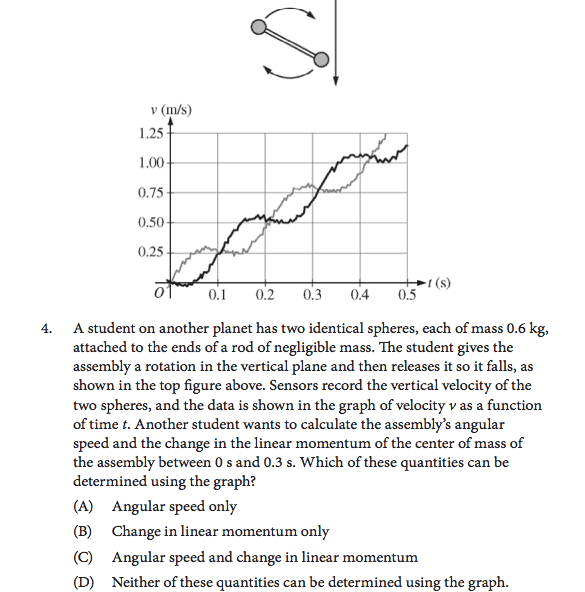
Screen Shot 2017-08-13 at 8.09.54 PM.png
So a couple of questions here:
(By the way, I know the answer is C)

1. My teacher explained that the net torque here on the assembly would be zero(will ask him again later). Is this because the torque was already applied at one point in time, and now the two masses are not accelerating?

2. Why does the graph have curves? Does it have to do with gravity changing the speed of the masses?

What I do know is the acceleration of the COM straight down, due to gravity. This can be found by the points on the graph that meet:
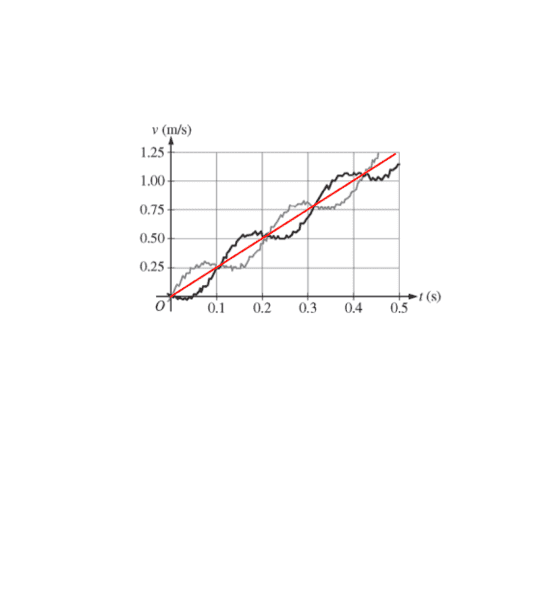
Screen Shot 2017-08-13 at 7.46.23 PM.png

It would be awesome if you guys could help me out :)
 

Attachments

  • Screen Shot 2017-08-13 at 7.46.23 PM.png
    Screen Shot 2017-08-13 at 7.46.23 PM.png
    6.1 KB · Views: 624
  • Screen Shot 2017-08-13 at 7.46.23 PM.png
    Screen Shot 2017-08-13 at 7.46.23 PM.png
    6.1 KB · Views: 594
  • Screen Shot 2017-08-13 at 7.46.23 PM.png
    Screen Shot 2017-08-13 at 7.46.23 PM.png
    5.2 KB · Views: 568
Physics news on Phys.org
blueblast said:
Is this because the torque was already applied at one point in time,
The rotation was initiated at the beginning. Gravity itself will give no torque relative to the centre of mass by definition of the centre of mass.

blueblast said:
and now the two masses are not accelerating?

Clearly, the masses are changing their velocities and therefore accelerating. However, the rotation remains the same.

2. Why does the graph have curves? Does it have to do with gravity changing the speed of the masses?

No. There is an internal force due to the connection between the masses.
 
Orodruin said:
The rotation was initiated at the beginning. Gravity itself will give no torque relative to the centre of mass by definition of the centre of mass.
Clearly, the masses are changing their velocities and therefore accelerating. However, the rotation remains the same.
No. There is an internal force due to the connection between the masses.

What do you mean by internal forces?
 
blueblast said:
What do you mean by internal forces?
Forces that act between different parts of the system, in this case between the two masses.
 
Orodruin said:
Forces that act between different parts of the system, in this case between the two masses.

I don't think I understand what you are talking about. Could you elaborate on the internal forces, and perhaps draw a diagram?

Thanks :)
 
There is tension in the bar connecting the masses. The internal forces are the forces mediated by this bar.
 
So this force causes acceleration, which in turn causes the graph to curve(change velocity), correct?
 
Right.
 
Also, would the tension force count as centripetal force, towards the COM, since the COM is the axis?
 
  • #10
blueblast said:
Also, would the tension force count as centripetal force, towards the COM, since the COM is the axis?
Yes, this force is in the centripetal direction. So it is a centripetal force.

Edit: Some additional explanation may be appropriate here... [hopefully your eyes will not glaze over]

If we consider the two masses and the rod all together as a single closed system then the forces where the masses connect to the rod are "internal" forces. As has been mentioned, a force between two objects is "internal" if both objects are part of the system. Newton's third law then assures us that the force of the one object on the other is equal to the force of the other on the one. The net effect of this third law force pair on the center of mass of the system totals to zero.

A third law force pair has a line of action, but it does not really have a direction. It acts on two objects and acts in the opposite direction on each.

If we are to talk about a particular force as being "centripetal", we are no longer talking about a third law force pair. Instead, we must be talking about only one half of the pair. In this case we are considering the force of rod on mass. In effect, we have focused in on the motion of a single mass and we are no longer considering the entire system. Instead, we are considering a new system consisting of a single mass alone. That single mass is moving in a circle around the center of mass of the "2 mass plus rod" assembly. In this context, the force of rod on mass is an "external" force. It has an unambiguous direction: in toward the center about which this single mass is circling.
 
Last edited:

Similar threads

  • · Replies 2 ·
Replies
2
Views
2K
  • · Replies 10 ·
Replies
10
Views
2K
  • · Replies 60 ·
3
Replies
60
Views
7K
  • · Replies 3 ·
Replies
3
Views
2K
  • · Replies 2 ·
Replies
2
Views
2K
  • · Replies 6 ·
Replies
6
Views
1K
  • · Replies 5 ·
Replies
5
Views
3K
  • · Replies 37 ·
2
Replies
37
Views
3K
  • · Replies 19 ·
Replies
19
Views
3K
Replies
2
Views
2K