Rotational Inertia Gas vs Liquid

Click For Summary
SUMMARY

This discussion focuses on the differences in rotational inertia between gases and liquids, specifically examining the effects of air and water within a rotating sealed cylinder. The experiment reveals that air, with a kinematic viscosity of 15.11 cSt, exhibits negligible inertial flow compared to water, which has a kinematic viscosity of 1.004 cSt. The key conclusion is that the higher density and viscosity of water require more force to stop its flow, leading to longer-lasting inertial effects. The discussion emphasizes the importance of dynamic viscosity and momentum diffusion in understanding these phenomena.

PREREQUISITES
  • Understanding of kinematic and dynamic viscosity
  • Basic principles of fluid dynamics
  • Knowledge of rotational motion and inertia
  • Familiarity with density and mass concepts in fluids
NEXT STEPS
  • Research the effects of viscosity on fluid dynamics in rotating systems
  • Explore the properties of various fluids, including acetone, for inertial momentum preservation
  • Study the principles of momentum diffusion in different phases of matter
  • Investigate advanced fluid dynamics simulations to model rotational inertia effects
USEFUL FOR

Researchers, engineers, and students in fluid dynamics, mechanical engineering, and physics who are interested in the behavior of fluids under rotational motion and the implications of viscosity on inertial flow.

Tom79Tom
Messages
45
Reaction score
3
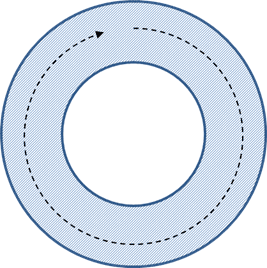
I am conducting an experiment that rotates a sealed donut cylinder to investigate amongst other things the inertia of the contained fluid.
upload_2016-4-7_18-31-56.png


Process
I rotate the cylinder to a set speed (assuming that the viscosity of the internal fluid will end up rotating the fluid to solid body rotation) then rapidly stop the vessel.

I have noticed little effect when I have filled the vessel is filled just with Air in fact no discernable effect
much akin to when you turn a fan off the flow seems to stop immediately with water the inertial flow is much greater and lasts longer

My question

Is this only because of the differences between air and water Kinematic viscosities
Air 15.11 cSt
Water 1.004 cst

meaning that viscous effects stop the dynamic pressure of air very quickly or is there other effects at play ?
Some come to mind
Gas vs Liquid - rate of diffusion ?
I would think that a gas would diffuse energy throughout the sealed vessel at a much greater rate due to the low interaction of particles where as a liquid which would have to displace molecules that contain there own dynamic pressure .

Total Mass
Could the net mass of the flow - (where as air has a mass of 1.35 kg/m3 water has a a mass of 1000kg/m3 be a factor ) for the equivalent volume and flow rate (from solid body rotation) the developed inertia contained in this volume is less to begin with
 
Physics news on Phys.org
Kinematic viscosity is not the right property to use here. Use dynamic viscosity. Water is much more viscous than air (about 100 times more viscous). This would imply that water should stop faster based on viscosity alone.

Viscosity is not alone, however. Water is also about 1000 times as dense, as air, so it requires more force (or a longer time) to stop it. That is where your observations come from.

Also, when it comes to diffusion, it's not diffusion of energy you should think about here. The important parameter is diffusion of momentum. The diffusion coefficient for momentum in a fluid is, you may have guessed, viscosity.
 
Thanks for the reply
If I can restate your answer to confirm I understand

The only difference in flow degredation is to due to the kinematic viscosity difference - differences in mass and phase are accounted for in the kinematic viscosity

If the density/volumemass of air and water were equivalent then the flow (dynamic pressure) would be equivalent between air and water
##m_{air}=m_{water} ##
##Dp=\frac{1}{2}m v^2##
##Dp=\frac{1}{2}m_{water} v^2##
##Dp=\frac{1}{2}m_{air} v^2##
##Dp_{air} =DP_{water} ##

If this was the case then water having a higher absolute viscosity by a factor of 50 would experience a quicker degradation as viscosity acts independent of the flow density

##μ_{water} =1.004pas##
##μ_{air} =0.01983pas##

##\frac{μ_{water} }{ μ_{air} }##

##\frac{μ_{water} 1.004pas}{ μ_{air} 0.01983pas} =50##

The reason I see air flow degrade quicker is that it is acting at a rate only ~ 50 times less on a dynamic pressure related to density of a ~ 1000 times less leading to our ratio of kinematic viscosities of ~ 16

In short the inertial flow of air should degrade 16times the rate the water does

If I wish to achieve the highest level of inertial momentum preservation (for my given volume) I should use the lowest kinematic viscosity fluid available - such as acetone ?
 
Last edited:

Similar threads

  • · Replies 8 ·
Replies
8
Views
3K
  • · Replies 1 ·
Replies
1
Views
2K
  • · Replies 1 ·
Replies
1
Views
3K
  • · Replies 1 ·
Replies
1
Views
6K
  • · Replies 2 ·
Replies
2
Views
2K
  • · Replies 9 ·
Replies
9
Views
17K
  • · Replies 7 ·
Replies
7
Views
2K
  • · Replies 3 ·
Replies
3
Views
2K
Replies
0
Views
2K
  • · Replies 8 ·
Replies
8
Views
2K