Rutherford scattering with Coulomb cutoff

Click For Summary
SUMMARY

The discussion focuses on classical Rutherford scattering with a Coulomb cutoff to model electric screening, as described in Jackson's text. The setup involves charges ##ze## and ##Ze##, where the Coulomb force interaction is modified to drop off at a radius ##r=a##, leading to a finite differential scattering cross section. The participants analyze the implications of this cutoff on momentum transfer and scattering angles, particularly how it affects the resulting differential cross section compared to the no-cutoff scenario. The conversation highlights the importance of understanding the functional form of the scattering equations and their physical interpretations.

PREREQUISITES
  • Classical mechanics principles, particularly in scattering theory
  • Understanding of Coulomb's law and electric forces
  • Familiarity with differential cross sections in particle physics
  • Basic knowledge of mathematical approximations and functional forms
NEXT STEPS
  • Study the derivation of differential cross sections in classical scattering scenarios
  • Explore the implications of electric screening in particle interactions
  • Review Jackson's "Classical Electrodynamics" for detailed explanations of Coulomb interactions
  • Investigate the mathematical techniques for approximating functional forms in physics
USEFUL FOR

Physicists, students of classical mechanics, and researchers interested in particle scattering and electric interactions will benefit from this discussion.

Reverend Shabazz
Messages
19
Reaction score
1
Hello, I am reading a section in Jackson discussing classical Rutherford scattering, and he mentions incorporating a cutoff in the Coulomb interaction in order to model electric screening. I am trying to understand how he applies this, as described below.

The set up is basically the classic Rutherford scattering set up with charges ##ze## and ##Ze## interacting with a small angle of deflection (i.e ##sin(\theta/2) \approx \theta/2##), leading to a differential scattering cross section of:

upload_2018-7-5_9-59-13.png


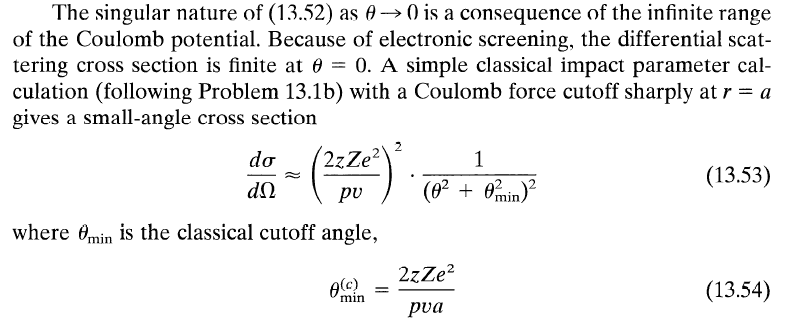
Now at ##\theta=0## of course the cross section is infinite, so he suggests modifying the Coulomb force interaction so as to drop off suddenly at ##r=a##:
upload_2018-7-5_10-7-12.png


So I am trying to understand how he obtains eq. 13.53...or at the very least what the set up is.

My guess is that he starts with a massive incident particle approaching a less massive target particle located at the origin. The massive incident particle is assumed to remain in a straight line, while the target particle deflects. But unlike the typical straight line approximation for this scenario, the typical Coulomb interaction remains the same only within a sphere of radius ##r=a## centered either on the origin or on the particle, beyond which the force is 0. Does this sound right?

Unfortunately, I couldn't find much on the internet pertaining to this question except for an article that I don't have access to: https://aapt.scitation.org/doi/10.1119/1.1987568
 

Attachments

  • upload_2018-7-5_9-59-13.png
    upload_2018-7-5_9-59-13.png
    2 KB · Views: 771
  • upload_2018-7-5_10-7-12.png
    upload_2018-7-5_10-7-12.png
    16.9 KB · Views: 1,166
Physics news on Phys.org
I don't think he's doing anything more sophisticated than picking a functional form that behaves the way he wants: \theta^4 \rightarrow (\theta^2 + \theta_0^2)^2 has the right large-angle and small-angle behavior.
 
Vanadium 50 said:
I don't think he's doing anything more sophisticated than picking a functional form that behaves the way he wants: \theta^4 \rightarrow (\theta^2 + \theta_0^2)^2 has the right large-angle and small-angle behavior.
I thought so too, but I have doubt since he prefaces that formula by saying:
upload_2018-7-6_16-47-37.png

or, in an older version of his book:
upload_2018-7-6_16-52-18.png

The wording sounds like he's doing more than approximating ##\theta##. But I could be wrong..

For the record, the question with solution for 13.1 is found here: http://www-personal.umich.edu/~pran/jackson/P506/hw11a.pdf
It is just the simple scenario where the incident particle remains on a straight line trajectory and the Coulomb potential has no cutoff. As such, the only momentum transferred is perpendicular to the incident's velocity (see section 1.1 here for details: http://www.phys.lsu.edu/~jarrell/COURSES/ELECTRODYNAMICS/Chap13/chap13.pdf).

In the cutoff case, though, my thought is that the momentum transferred to the target in the direction parallel to the velocity will be non_zero in contrast to the no-cutoff case, and thus, when combined with the perpendicular momentum, will scatter the target at an angle. I would anticipate that, in calculating the resulting differential cross section, it would produce Jackson's result. Admittedly, I haven't tried slugging through the calculation yet.
 

Attachments

  • upload_2018-7-6_16-47-37.png
    upload_2018-7-6_16-47-37.png
    8.3 KB · Views: 648
  • upload_2018-7-6_16-52-18.png
    upload_2018-7-6_16-52-18.png
    10.6 KB · Views: 750

Similar threads

  • · Replies 1 ·
Replies
1
Views
1K
  • · Replies 3 ·
Replies
3
Views
3K
  • · Replies 3 ·
Replies
3
Views
2K
Replies
1
Views
2K
  • · Replies 1 ·
Replies
1
Views
1K
  • · Replies 4 ·
Replies
4
Views
3K
  • · Replies 1 ·
Replies
1
Views
2K
  • · Replies 6 ·
Replies
6
Views
951
  • · Replies 3 ·
Replies
3
Views
2K
  • · Replies 6 ·
Replies
6
Views
4K