Satellite Control System With Rate Feedback

Click For Summary
SUMMARY

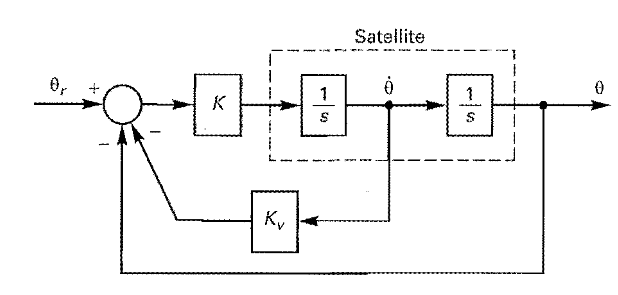
The discussion focuses on deriving the transfer function for a rigid satellite control system utilizing rate feedback, specifically with parameters K=1 and K_v=0. The closed-loop transfer function is identified as θ(s)/θ_r(s) = K/(s^2 + s*K*K_v + K), which simplifies to 1/s^2 in a unity feedback configuration. Participants emphasize the importance of applying block simplification rules to achieve the complete transfer function and provide resources for MATLAB implementation using the Control System Toolbox.

PREREQUISITES
  • Understanding of control system dynamics and transfer functions
  • Familiarity with block diagram representation and simplification rules
  • Knowledge of MATLAB and its Control System Toolbox
  • Experience with feedback loop analysis in control systems
NEXT STEPS
  • Research block diagram simplification techniques in control systems
  • Learn how to implement transfer functions in MATLAB using the tf command
  • Explore the use of the bode command for frequency response analysis in MATLAB
  • Study the root locus method using the rlocus function in MATLAB
USEFUL FOR

Control engineers, students studying control systems, and MATLAB users interested in analyzing and designing feedback control systems.

jj007
Messages
8
Reaction score
0
I'm trying to get the transfer function of this rigid control system that uses rate feedback to stabilize it. Using k=1 and kv=0
Capture_zps6fbe8d62.png


Attempt at a solution.
When kv=0, the rate feedback is removed.
In the block diagram, I moved the pickoff point and used the cascade rule to get 1/s^2
and the transfer function for the top portion is H(s)=\frac{(1/s^2)k}{1+(1/s^2)k}=\frac{k}{s^2((k/s^2)+1)}
With the pickoff point moved you get \frac{1}{1/s} at the bottom next to kv.
This is where I'm stuck. How do I get the complete transfer function? I would like to put it in matlab.

Thanks
 
Physics news on Phys.org
This looks like something you probably should have posted in the Homework section, just FYI.

What transfer function is it you want? Is it θ(s)/θ_r(s)?
 
milesyoung said:
This looks like something you probably should have posted in the Homework section, just FYI.

What transfer function is it you want? Is it θ(s)/θ_r(s)?

Yes please.
 
(thread moved to HH)
 
For K = 1, K_v = 0, you have a double integrator, 1/s^2, in a unity feedback configuration and the transfer function you posted, H(s), is the closed-loop transfer function θ(s)/θ_r(s) for this system.

In case you're looking for θ(s)/θ_r(s) with K, K_v only known to be real, you could apply block simplification for the inner loop first, then the outer one using the rule for negative feedback loops. You already used this rule once in finding H(s).
 
That's the only thing I'm not sure of...the block simplification. There's so many rules and I don't know which ones to apply here.
 
This was the first link on Google for 'block simplification':
http://www.msubbu.in/sp/ctrl/BD-Rules.htm

Have a look at rule 1, 2 and 6. Try simplifying your block diagram to a single system using those rules and post here if you get stuck.
 
Split up the summing junction and simplify the series inside the inner loop, rule 1 & 2:

sys1.jpg


Simplify the inner negative feedback loop, rule 6:

sys2.jpg


Do you understand those steps? How would you proceed?
 
  • #10
milesyoung said:
Split up the summing junction and simplify the series inside the inner loop, rule 1 & 2:

sys1.jpg


Simplify the inner negative feedback loop, rule 6:

sys2.jpg


Do you understand those steps? How would you proceed?

Understood. Proceed by using rule 2 again and that's it? Looks like I was over complicating things.

Thanks
 
  • #11
Rule 2 to simplify the series inside the loop, but what about the loop itself?
 
  • #12
milesyoung said:
Rule 2 to simplify the series inside the loop, but what about the loop itself?

The output \theta goes back into junction, which gives a transfer function of 1?
We're looking for \frac{θ(s)}{θ_r(s)} right?
 
  • #13
We want to simplify the block diagram so it looks like:

θ_r -> box -> θ

and nothing else. No loops!

Have a look at the step I did using rule 6. Doesn't that look like something you could do again?
 
  • #14
Y=\frac{G1}{1+G1(1)}= \frac{K}{s^2+s*K*K_v+K}?
 
  • #15
Yes :smile:
 
  • #16
Ok. Last Question. For K=1 and K_v=0, how do I use this transfer function in MATLAB to get the Root Locus or Bode plot?
 
  • #17
jj007 said:
Ok. Last Question. For K=1 and K_v=0, how do I use this transfer function in MATLAB to get the Root Locus or Bode plot?

If you have the Control System Toolbox you could use its suite of commands, e.g.:
tf
bode
rlocus

and so on. Have a look at their help pages and that of the toolbox itself.

If you don't have it, you could make your own functions to evaluate the transfer function for whatever range of parameters you're interested in and plot the results.
 
  • #18
There is an rlocus function in MATLAB that will plot the root locus plot of a given transfer function.
 

Similar threads

  • · Replies 8 ·
Replies
8
Views
2K
Replies
2
Views
1K
  • · Replies 1 ·
Replies
1
Views
2K
  • · Replies 2 ·
Replies
2
Views
2K
Replies
24
Views
5K
  • · Replies 1 ·
Replies
1
Views
2K
  • · Replies 3 ·
Replies
3
Views
3K
  • · Replies 5 ·
Replies
5
Views
3K
  • · Replies 6 ·
Replies
6
Views
2K
Replies
1
Views
3K