Saturation line for a given substance

3 replies · 6K views · last reply
mech-eng
Messages
826
Reaction score
13
"The saturation line for a given substance is the combination of temperature and pressure where 100% vapor exists. At any point below this line, there will be a mixture of vapor and liquid, until a point is reached when only the liquid phase exists."

I don't understand above passage from @SteamKing's post. Is saturation line= saturated liquid line + saturated vapor line, as in the picture?

If you have a mixture, can you use a saturated liquid table?
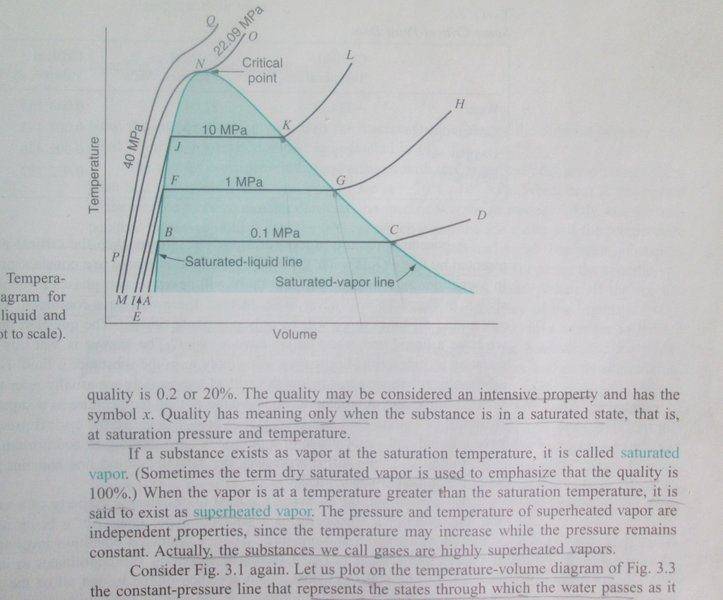
Temperature versus volume diagram for water with a dome-shaped region bounded by the saturated-liquid line on the left and saturated-vapor line on the right, meeting at the critical point N; horizontal constant-pressure lines at 0.1, 1 and 10 MPa and isobars at 22.09 and 40 MPa are labelled.


Source: Introduction to Engineering Thermodynamics by Sonntag/Borgnakke.

Thank you.
 
Here is a "translation":
mech-eng said:
"The saturation line [= saturated-vapor line] for a given substance is the combination of temperature and pressure where 100% vapor exists. At any point below this line, there will be a mixture of vapor and liquid, until a point [= saturated-liquid line] is reached when only the liquid phase exists."
Edit: Note also that @SteamKing was talking about T and P, while the picture you posted is T vs V.
 
DrClaude said:
Here is a "translation":

But thermodynamics is an relatively old science but in the thread there is confussion on the names of concepts. Would you please share the common terms. Of course they cannot be only one for the same concept.

Saturation Line or Saturated Vapor Line.

Saturation line might be confused with if it is for liquid or vapor.
Thank you.
 
mech-eng said:
But thermodynamics is an relatively old science but in the thread there is confussion on the names of concepts.
SteamKing may have been talking colloquially. In any case, the terminology is often far from fixed, especially between physics and engineering. I stopped counting the number of times confusion arises at PF due to the different definitions of an ideal gas!