Schrodinger equation in terms of complex conjugate

Click For Summary
SUMMARY

The discussion focuses on the application of the complex conjugate in the Schrödinger equation (S.E) and the implications of conjugating the wave function ψ. It clarifies that the derivative with respect to time, when expressed in terms of the complex conjugate ψ*, remains valid as long as the original equation is valid. Key c-number conjugation rules are highlighted, including the conjugation of products and sums, as well as the derivative of the wave function. The importance of the product rule in this context is emphasized, aiding in the understanding of the equation's transformation.

PREREQUISITES
  • Understanding of the Schrödinger equation in quantum mechanics
  • Familiarity with complex numbers and their properties
  • Knowledge of calculus, specifically derivatives and the product rule
  • Basic grasp of wave functions in quantum physics
NEXT STEPS
  • Study the derivation and implications of the Schrödinger equation in quantum mechanics
  • Learn about complex conjugates and their role in quantum mechanics
  • Explore the product rule in calculus and its applications in physics
  • Investigate the significance of wave functions and their transformations in quantum theory
USEFUL FOR

Students of quantum mechanics, physicists, and anyone interested in the mathematical foundations of the Schrödinger equation and its applications in quantum theory.

QuantumDuality
Messages
10
Reaction score
0
I know there's a similar post, but i didn't understand it. Why the derivative respect to t in terms of the complex conjugate of ψ is:
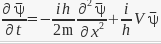
m8KfDe.png

instead of being the original S.E in terms of ψ*
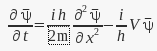
6wKeBq.png

or the equation in terms of ψ with the signs swapped
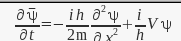
7sovFI.png
 
Physics news on Phys.org
One is simply applying conjugation to the equation as a whole. This yields an equation which is valid provided the original is valid. Some c-number conjugation rules that may be helpful are,

  1. ##(a b)^\ast = a^\ast b^\ast##
  2. ##(a + b)^\ast = a^\ast + b^\ast##
  3. ##(i)^\ast = -i##
  4. ##(\frac{\partial \psi}{\partial t})^\ast = \frac{\partial \bar\psi}{\partial t}##
 
I got it!. I always forget to use the product rule, Thanks
 

Similar threads

  • · Replies 14 ·
Replies
14
Views
4K
  • · Replies 1 ·
Replies
1
Views
2K
  • · Replies 2 ·
Replies
2
Views
1K
  • · Replies 6 ·
Replies
6
Views
2K
  • · Replies 17 ·
Replies
17
Views
3K
  • · Replies 39 ·
2
Replies
39
Views
2K
  • · Replies 7 ·
Replies
7
Views
2K
  • · Replies 3 ·
Replies
3
Views
2K
  • · Replies 8 ·
Replies
8
Views
2K
  • · Replies 6 ·
Replies
6
Views
15K