Scintillator to generate electricity?

Join the discussion
Ask a follow-up here, or get your own question answered by working scientists, mathematicians and engineers — people, not an autocomplete.
Real named experts · corrections over time · the nuance an AI answer skips
4 replies · 2K views
ryanuser
Messages
74
Reaction score
0
Hi, I am doing a high school project based on physics and I wondered if my idea works or not.
So I was thinking to use gamma rays as a source of energy to produce enough current to charge my phone.
My question is that would it be possible to use scintillators (used in photomultipliers in astronomy to decrease the frequency of gamma rays to visible light) so then the visible light can be directed at a solar panel to knock the electrons off the silicon surface so then a current could flow?

The image below might clarify.
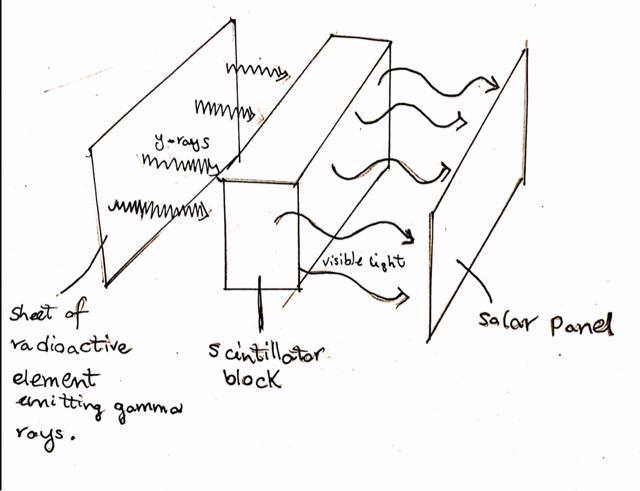
ImageUploadedByPhysics Forums1416342249.343575.jpg
 
Physics news on Phys.org
In general, any source of gamma rays of such quantity and intensity as what you are looking for would be tightly regulated by national and international laws. Without proper handling of these sources by trained personnel, fatal exposure to gamma rays could result. Radiation of any kind is not something you want to handle casually.
 
Hypothetically would it be possible if this was going to be done under high health and safety conditions (wearing lead gloves and clothing) and in a more equipped lab?
 
ryanuser said:
Hypothetically would it be possible if this was going to be done under high health and safety conditions (wearing lead gloves and clothing) and in a more equipped lab?
possibly, but what's the point ? ... it isn't anything that could be made for common usage
and even in a lab it would be easier, safer and cheaper to use a normal wall charger or other USB source

Dave
 
What Davenn and SteamKing said in regards to safety is very true.

But to entertain the question, even if you had a gamma source of sufficient intensity, you still wouldn't be able to do this. The only reason scintillator detectors are useful is because they have photomultiplier tubes to amplify the incredibly weak signal (on the order of a few hundred photons) to an electrical signal that may be measured. Only a very small fraction of the energy lost by the gamma rays in the scintillator are converted to fluorescence. Most is dissipated through lattice vibrations and heat. Further, a typical photomultiplier tube runs at about 1000 V. So you'd never get net energy out.

ETA: Radiation Detection and Measurement by Glenn F. Knoll has an excellent chapter on scintillator detectors and one on photomultiplier tubes.
 
  • Like
Likes   Reactions: Nugatory and davenn