Seeking formal derivation for common thermo equation

  • Context: Graduate 
  • Thread starter Thread starter saybrook1
  • Start date Start date
  • Tags Tags
    Derivation Thermo
Click For Summary

Discussion Overview

The discussion revolves around the formal derivation of a thermodynamic equation related to the change in entropy during an isothermal change of state. Participants explore various approaches to derive this equation and reference different textbooks and methods in statistical physics and thermodynamics.

Discussion Character

  • Exploratory
  • Technical explanation
  • Debate/contested
  • Mathematical reasoning

Main Points Raised

  • One participant seeks help for a formal derivation of an entropy change equation during an isothermal process, suggesting it may relate to the first law of thermodynamics and heat.
  • Another participant recommends F. Reif's book for its treatment of statistical physics and thermodynamics, mentioning the derivation of the Helmholtz free energy and its relation to entropy.
  • A different participant notes that the text by Pathria implies the derivation can be done without using the partition function, which has not yet been introduced in their study.
  • One participant proposes taking the difference between two states' entropy as a potential method for deriving the equation.
  • A later reply mentions finding a solution in publicly available lecture notes and questions whether the derived equation applies generally to adiabatic processes, not just isothermal ones.

Areas of Agreement / Disagreement

Participants express various approaches and methods for deriving the equation, but there is no consensus on a single method or the necessity of the isothermal condition for the derived equation.

Contextual Notes

Participants reference different textbooks and methods, indicating a variety of assumptions and approaches. The discussion includes unresolved questions about the applicability of the derived equation to different types of processes.

Who May Find This Useful

Readers interested in thermodynamics, statistical physics, and the derivation of thermodynamic equations may find this discussion relevant.

saybrook1
Messages
101
Reaction score
4
Hi guys,

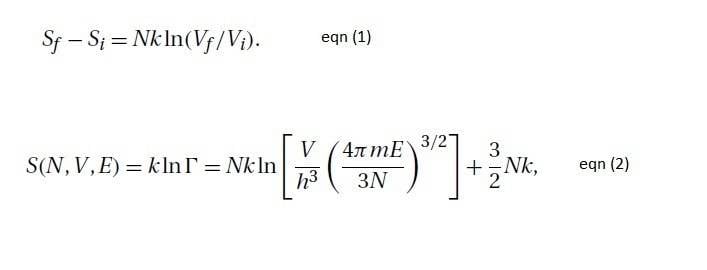
I was hoping that someone might be able to help me out with a formal derivation of this common thermodynamic equation regarding the change in entropy during an isothermal change of state.

The first equation is what I would like to derive, and the second is where the book tells me to derive it from once we acknowledge that there is no energy change in an isothermal process. I've tried a few different ways but haven't had success yet. I'm thinking it has to do with the first law and then somehow relating heat to entropy.
entropy change.jpg


Anyway, thanks for any help. Even a link would rock!

Best regards

Here's a link to the image in case it won't load for you here:
http://imgur.com/a/s9qoP
 
Science news on Phys.org
Hello again. The best book I know of for Statistical Physics/Thermodynamics is F.Reif's book. He derives the case ## F=-kT ln Z ## and gives an extensive treatment of ## Z ## for ## N ## atoms using the Maxwell-Boltzmann Statistics with the ## N! ## Boltzmann factor in the denominator. ## Z=\zeta^N/N! ## where ## \zeta ## is the partition function for a single atom (of the gas). The derivation of ## \zeta ## is somewhat lengthy but not difficult. Once you get Z and F, the minus partial of F w.r.t. T at constant V I think is the entropy ## S ##.
 
  • Like
Likes   Reactions: saybrook1
Hello my friend! I've just returned from getting some late night tacos; I appreciate you responding to my post again. So, the text that I'm going through is Pathria and I also have the Schroeder undergrad text "Thermal Physics". The problem is that I think Pathria implies that you can derive eqn (1) without use of the partition function. This is at the end of chapter 1 of his book and the partition function has not been introduced in any form yet. I'm just banging my head on a way to derive eqn (1) from eqn (2) under an isothermal change of state(fixed N,T). I will however attempt your method. Thanks again!
 
  • Like
Likes   Reactions: Charles Link
Wooo I think I figured it out. I think you need to take eqn (2) and just take the difference like so: $$S_2(N,V_2,E) - S_1(N,V_1,E)$$
I'll report back and let you know how it goes!
 
Alright, so here it is. I actually found this solution while looking through the publicly available lectures notes of Alejandro L. Garcia of San Jose State University.
If anyone has anything to add, please do. A question that I still have about this, is that it doesn't seem like we needed to invoke an isothermal condition, so is this a general entropy change equation for adiabatic processes?
Entropy change solution.jpg
 

Similar threads

  • · Replies 1 ·
Replies
1
Views
2K
Replies
5
Views
1K
  • · Replies 1 ·
Replies
1
Views
2K
  • · Replies 11 ·
Replies
11
Views
10K
  • · Replies 6 ·
Replies
6
Views
3K
  • · Replies 4 ·
Replies
4
Views
1K
  • · Replies 15 ·
Replies
15
Views
2K
  • · Replies 1 ·
Replies
1
Views
1K
  • · Replies 2 ·
Replies
2
Views
2K
  • · Replies 4 ·
Replies
4
Views
6K