Selecting electron shells for nuclear decay with binding energies

1 reply · 2K views · last reply
Graham87
Messages
72
Reaction score
16
Homework Statement
See pic
Relevant Equations
See pic
How do you know which binding energy shell to use? In the solution it uses K and L2. Why specifically L2 and not L3 or L1 for example?

And what should I do with the information to omit electrons lower than 20kev? I initially thought that meant to omit the electron binding energies lower than 20kev. But L2 which is lower than 20kev is included, so which expression represents electron energy? If it is ΔE - B(L) then shouldn’t L3 be included since it also has a higher energy than 20kev?
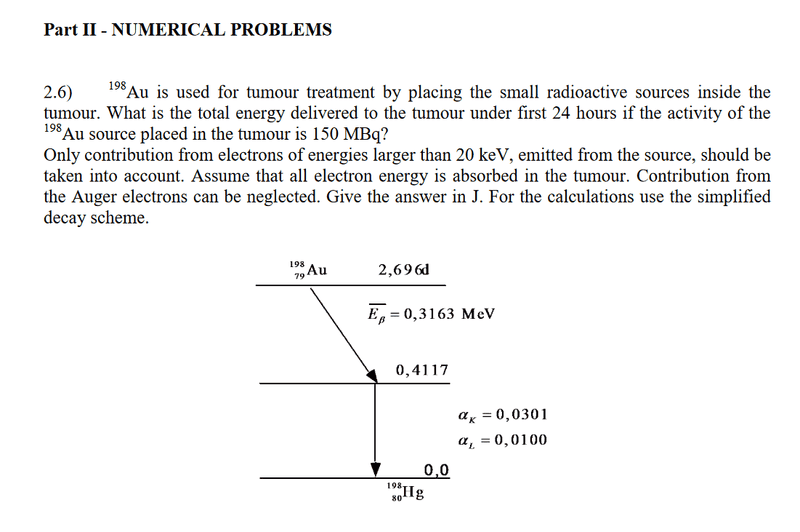
Part of a nuclear decay scheme: Au-198 (Z=79) decays with a half-life of 2.696 d and mean beta energy 0.3163 MeV to a level at 0.4117 MeV, which then drops to the Hg-198 ground state at 0.0; conversion coefficients alpha_K = 0.0301 and alpha_L = 0.0100 are listed beside the gamma transition.
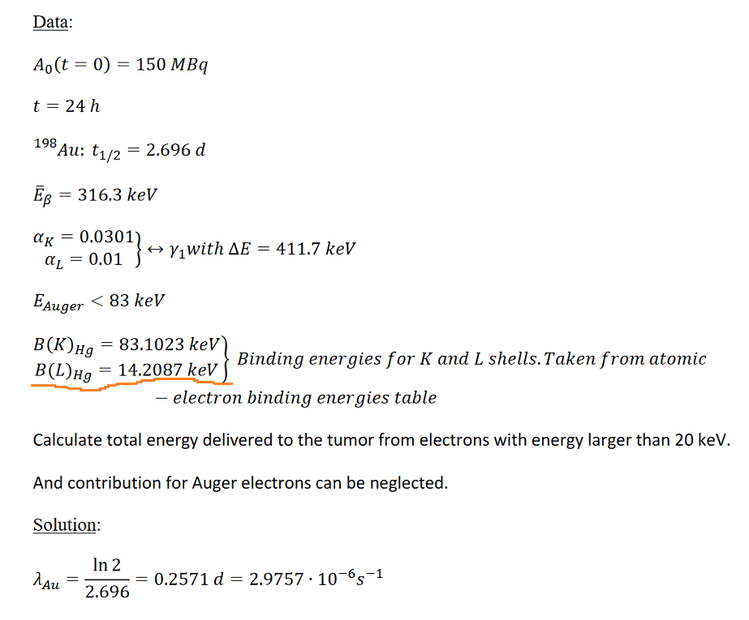
Typed worksheet listing data for Au-198 decay: A0 = 150 MBq, t = 24 h, half-life 2.696 d, mean beta energy 316.3 keV, K and L conversion coefficients, Auger energy below 83 keV, and binding energies B(K)Hg = 83.1023 keV and B(L)Hg = 14.2087 keV, followed by the decay constant calculation.
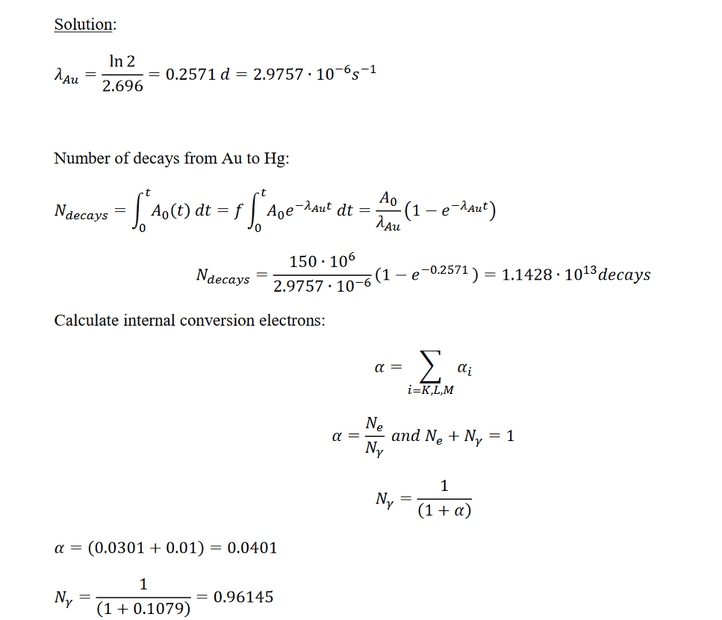
Handwritten-style typeset solution showing λAu = ln2/2.696 = 0.2571 d = 2.9757·10^-6 s^-1, the integral for number of decays, Ndecays = 1.1428·10^13, and internal conversion relations α = Σ αi, Ne/Ny, Ny = 1/(1+α), with α = 0.0401 and Ny = 0.96145.
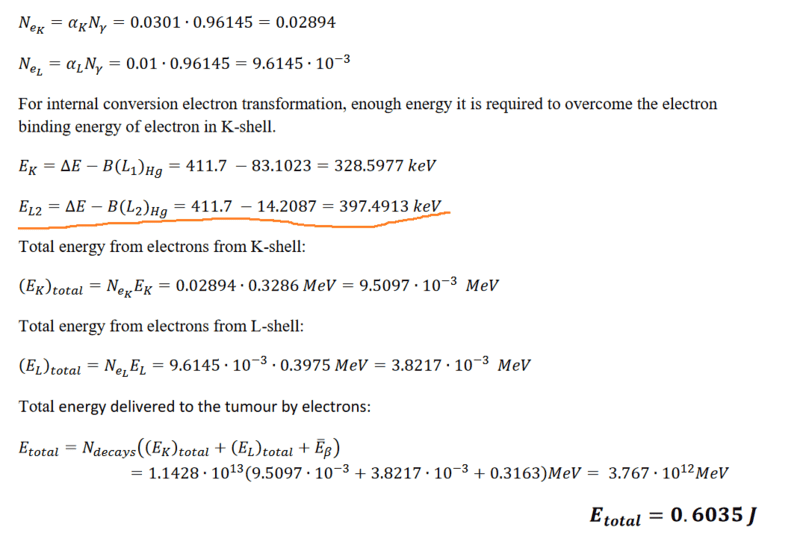
Handwritten-style worked solution computing electron energies from K-shell and L2-shell conversion electrons, with the L2 energy line underlined in orange, ending in a total energy of 0.6035 J.
 
My guess is that there are some typos as indicated below:
Handwritten derivation of electron energies: E_K = ΔE − B(L1)Hg = 411.7 − 83.1023 = 328.5977 keV, and E_L2 = ΔE − B(L2)Hg = 411.7 − 14.2087 = 397.4913 keV, with circled labels and arrows pointing to K and L.

The ##L_1## should be ##K## and the ##L_2##'s should just be ##L##. This corresponds with the given binding energies:

Two lines of notation: B(K) for Hg = 83.1023 keV and B(L) for Hg = 14.2087 keV, with a brace labelled Binding energies for K and L shells.


Perhaps the value ##B(L)_{Hg} = 14.2087## keV is a weighted average over the ##L_1##, ##L_2##, and ##L_3## levels.

I'm not sure about the 20 keV restriction. Since ##\overline E_\beta##, ##B(K)_{Hg}## and ##B(L)_{Hg}## are all in the hundreds of keV, there doesn't appear to be any need to worry about requiring the electrons to have an energy greater than 20 keV.