Semi-Circles Within a Circle

  • Context: Undergrad 
  • Thread starter Thread starter bob012345
  • Start date Start date
bob012345
Gold Member
Messages
2,359
Reaction score
1,084
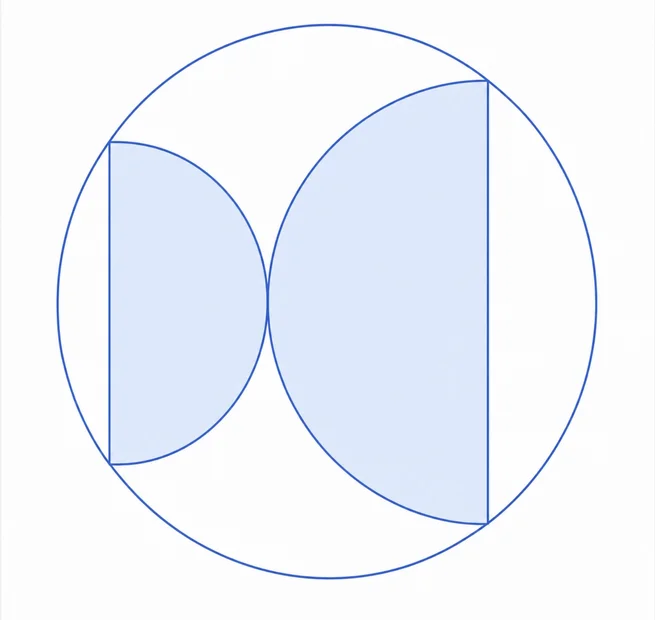
Here is a puzzle from Catriona Shearer. Find the area ratio of the shaded semi-circles to the circle which they fit in. The bases of the semi-circles are parallel.
IMG_5707.webp

Hint: consider the extreme cases to figure what the answer might be then prove the general case.
 
Mathematics news on Phys.org
NOT ELEGANT solution
The eqation of the circles
$$x^2+y^2=R^2$$
$$(x-x_1)^2+y^2=R^2-x_1^2$$
$$(x-x_2)^2+y^2=R^2-x_2^2$$
By subtraction of the two smaller circles equatins, we see they touch at ##x=x_1+x_2,y=0##. Thus
$$x_1^2=R^2-x_2^2$$
$$x_1^2+x_2^2=R^2$$
Area of the sum of small circles divided by ##\pi##
$$2R^2-x_1^2-x_2^2=R^2$$
equals the area of the large circle divided by ##\pi##. So the solution is 1/2.
 
Last edited:
  • Like
Likes   Reactions: bob012345
The extreme cases I mentioned are when the radius of the smaller semi-circle goes to zero, the larger semi-circle fills exactly half the circle and also when the radii of the semi-circles are the same length.
 
  • Like
Likes   Reactions: anuttarasammyak
bob012345 said:
The extreme cases I mentioned are when the radius of the smaller semi-circle goes to zero, the larger semi-circle fills exactly half the circle and also when the radii of the semi-circles are the same length.
Is this your proof? If so, don't you still have to show that the ratio of areas is independent of the radii of the semicircles?
 
kuruman said:
Is this your proof? If so, don't you still have to show that the ratio of areas is independent of the radii of the semicircles?
No, that is not my proof, just an observation.
 
IMG_5722.webp
Here is my proof.


$$r_1^2+(r_1+d)^2=R^2=r_2^2+(r_2-d)^2$$
Solving for ##d##$$d=\frac{r_2^2-r_1^2}{r_2+r_1}=r_2-r_1$$
Therefore $$r_1^2+r_2^2=R^2$$
And area ratio is $$\frac{\frac{1}{2}\pi r_1^2+\frac{1}{2}\pi r_2^2}{\pi R^2}=\frac{1}{2}$$
 
Another more elegant solution than post#2.
1780153010536.webp

F is on AC.
##\angle ACD = \pi/4##
##\angle AOD=\pi/2##
##\triangle AEO \equiv \triangle OGD##
##EO=GD##
Thus ##r_1^2+r_2^2=R^2## where ##r_1## and ##r_2## are radii of two smaller circles.
 
  • Like
Likes   Reactions: bob012345

Similar threads

Replies
1
Views
4K
  • · Replies 11 ·
Replies
11
Views
2K
  • · Replies 11 ·
Replies
11
Views
2K
Replies
11
Views
3K
  • · Replies 2 ·
Replies
2
Views
2K
  • · Replies 1 ·
Replies
1
Views
3K
  • · Replies 6 ·
Replies
6
Views
2K
  • · Replies 2 ·
Replies
2
Views
2K
Replies
43
Views
5K
  • · Replies 4 ·
Replies
4
Views
1K