Semi-snorkel stove heat transfer

  • Context: HVAC 
  • Thread starter Thread starter AlwaysDan
  • Start date Start date
  • Tags Tags
    Heat Heat transfer
Click For Summary

Discussion Overview

The discussion centers around the design and heat transfer mechanisms of a hot tub utilizing a 55-gallon steel drum wood stove as a heat source. Participants explore various methods for optimizing heat transfer and circulation, while also addressing safety concerns related to carbon monoxide production.

Discussion Character

  • Exploratory
  • Technical explanation
  • Debate/contested

Main Points Raised

  • One participant describes their project involving a wood stove integrated into a hot tub and seeks suggestions for effective heat transfer and circulation methods.
  • Another participant suggests organizing circulation through natural convection and mentions the possibility of using an external coil over the fire for heat exchange.
  • A warning is raised about the risks of overutilizing heat from the stove, which could lead to low exhaust temperatures and carbon monoxide production.
  • The original poster acknowledges the warning and discusses their plans to adjust water flow over the stove while addressing issues with water-tight seals where the tank meets the chimney.
  • Concerns are reiterated about carbon monoxide risks, emphasizing the need for careful monitoring of the stove's operation and burn quality.
  • The original poster confirms that the stove is located outdoors and mentions strategies for ensuring a clean burn.

Areas of Agreement / Disagreement

Participants express a mix of suggestions and warnings, with no consensus on the best approach to optimize heat transfer while ensuring safety. The discussion remains unresolved regarding the most effective methods and safety measures.

Contextual Notes

Participants have not fully explored the implications of their proposed methods, and there are unresolved concerns about the water-tightness of the chimney connection and its impact on stove performance.

AlwaysDan
Messages
3
Reaction score
2
TL;DR
How to catch heat from top of stove using circulating water.
Hi! Came across this forum while researching my project, and this seems like a good place to ask. Thanks in advance!

I'm building a hot tub that will use a 55 gallon steel drum wood stove as a heat source. The drum is built into one of the sides so that the majority of the stove is surrounded by water, with a small opening on the outside of the tub to load firewood/cleanout. The top of the drum is about 4 inches above water level, with a chimney coming from the top. I have an old pool pump that draws water from the side farthest from the drum, and plan to have that water run over the top of the stove down into the tub as a water feature/means to collect some heat from the top of the stove and bring it back into the tub.

I'm looking for suggestions of the best way to accomplish this, or if there are other ways of achieving the same result that I haven't thought of.
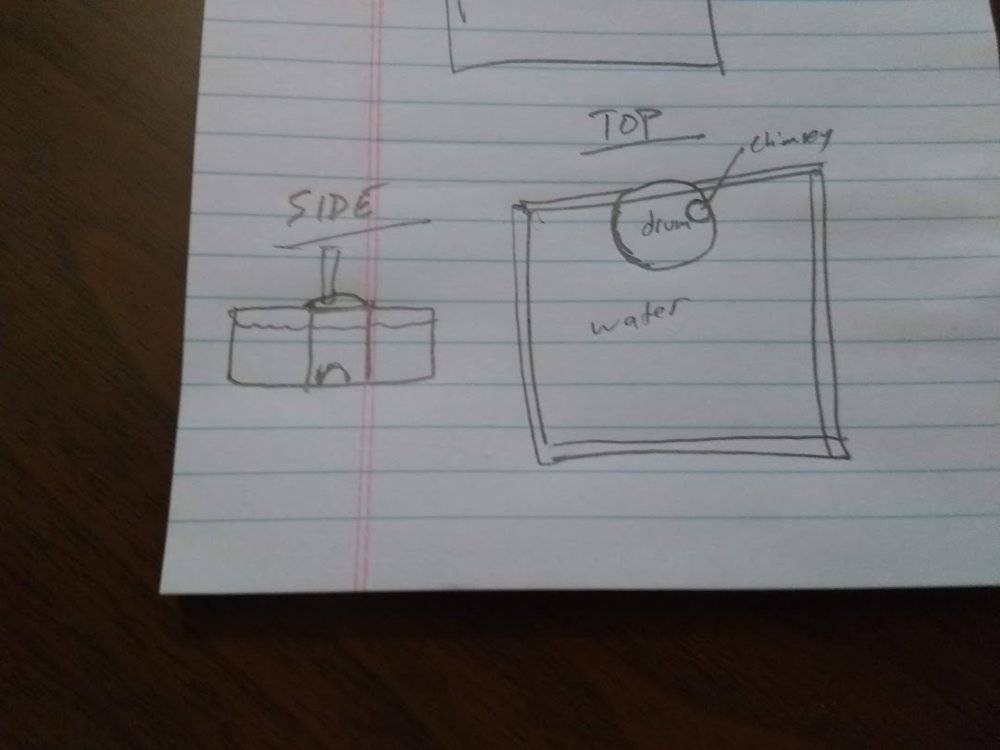
sketch.jpg
 
Physics news on Phys.org
Hello Dan, :welcome: !

Pleasant project :smile: !

You might want to organize some circulation, perferably natural convection.
Or else have some screen separating you from the hot drum.
I google 'hot tub with external coil' and get lots of links and images 😉
 
AlwaysDan said:
I'm looking for suggestion...
Just one small warning: if you overdo the utilization of the heat from the stove you can end with the exhaust having too low temperature and the stove choked (danger of having CO produced). Your idea with the pump (in some configuration) is fundamentally OK as enforced circulation, but make sure that you can hold back when that's what needed.
 
Thank you both.

BVU - The external coil over the fire was one option that I looked at, and I might still be able to incorporate that into the flue. And there will definitely be a screen of some sort around the stove. (Although the stove below the water line stays cool)

Rive - I haven't had that problem yet, but while I can't control the flow rate of the water, I'll be able to adjust the amount that flows over the stove.

Right now, my problem is creating water tight seals where tank meets chimney; water has been leaking down and suppressing the fire. I might just place a metal pot on top of the drum for now to run the water through
 
Rive said:
Just one small warning: if you overdo the utilization of the heat from the stove you can end with the exhaust having too low temperature and the stove choked (danger of having CO produced). Your idea with the pump (in some configuration) is fundamentally OK as enforced circulation, but make sure that you can hold back when that's what needed.
AlwaysDan said:
Rive - I haven't had that problem yet, but while I can't control the flow rate of the water, I'll be able to adjust the amount that flows over the stove.

Slow down. CO is a flaw that can kill people. You can't just wave your hands.

How will you know when it is adjusted correctly?
Is the stove outdoors or indoors?
 
It's outside. Any fire will produce CO if it's overloaded or choked, so I'll look for a clean burn from the flue. Or if that doesn't work I can just wave my hands by the air intake.
 
  • Like
Likes   Reactions: anorlunda

Similar threads

  • · Replies 49 ·
2
Replies
49
Views
15K
  • · Replies 40 ·
2
Replies
40
Views
7K
  • · Replies 11 ·
Replies
11
Views
4K
  • · Replies 8 ·
Replies
8
Views
3K
  • · Replies 7 ·
Replies
7
Views
2K
Replies
7
Views
2K
  • · Replies 24 ·
Replies
24
Views
13K
  • · Replies 26 ·
Replies
26
Views
12K
  • · Replies 2 ·
Replies
2
Views
1K
Replies
6
Views
4K
