Discussion Overview
The discussion revolves around the characteristics and calculations related to a separately excited DC motor, specifically addressing the interpretation of its power rating, losses under no-load conditions, and the relevance of various losses in the context of the problem presented.
Discussion Character
- Technical explanation
- Debate/contested
Main Points Raised
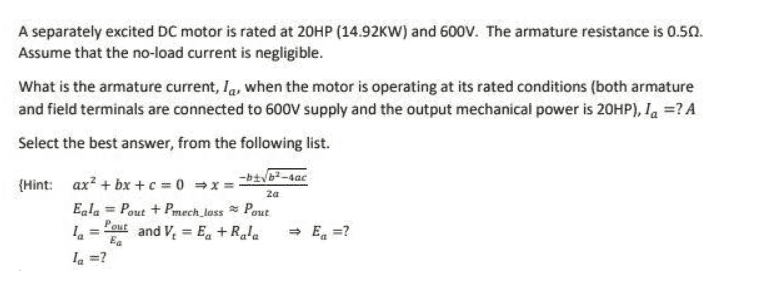
- Some participants clarify that the 20 HP rating refers to the output mechanical power (Pout) and the source voltage is indeed 600 V.
- It is noted that under no-load conditions, the armature current is assumed to be zero, leading to the neglect of rotational losses (Prot) and armature copper losses.
- One participant questions the relevance of field losses in the context of the problem, suggesting that they are not significant unless calculating efficiency.
- Another participant challenges the notion of the motor being "ideal," stating that while no-load conditions may lead to zero rotational and armature losses, copper losses will occur under load conditions due to armature resistance.
- It is proposed that while rotational losses may be zero at no-load, copper losses will be present when the motor is under load.
Areas of Agreement / Disagreement
Participants generally agree on the definitions of power ratings and the conditions under which certain losses are neglected. However, there is disagreement regarding the characterization of the motor as "ideal" and the implications of losses under different loading conditions.
Contextual Notes
Participants express varying assumptions about the conditions under which losses are considered, particularly regarding the ideality of the motor and the implications of no-load versus loaded conditions.