Separation of variables - rocket equation

Join the discussion
Registration is free. Ask a follow-up in this thread, or start your own.
9 replies · 4K views
Januz Johansen
Messages
34
Reaction score
1
hello there
Im trying to do a derivation of tsiolkovsky's rocket equation, but i got stuck at the step when i have to use separation of variables (marked with red in the pic), i used maple to solve it, so i could get on with it, but i want to understand what is happening to solve this, so can anyone explain how to solve this step with separation of variables?
Thanks :)
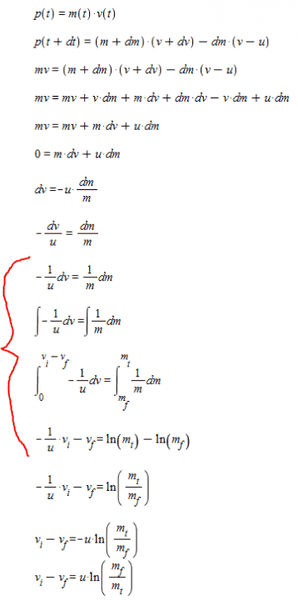
upload_2016-11-27_15-19-15.png
 
Physics news on Phys.org
It is exactly what they have done. What step in particular do you have problems with?
 
Orodruin said:
It is exactly what they have done. What step in particular do you have problems with?

ok thanks so i have done some right ;)

im having trouble explaining what is happening, or i think i do.
I can explain the first steps, just isolate the variables on each side of the equation.
But what rules are used/how is this integrated (the bordered step)
Thanks :D
upload_2016-11-27_15-59-54.png
 
You integrate both sides between the same points. It is essentially making an integration and then making a change of variables.
 
  • Like
Likes   Reactions: Januz Johansen
Orodruin said:
You integrate both sides between the same points. It is essentially making an integration and then making a change of variables.
Thanks i see now :D
 
Oh, and the integration boundaries on the LHS should be ##v_f## to ##v_i##. In this particular example it does not matter for the result because the integrand is constant. You then make a change of variables to ##m(v)## and use ##m_f = m(v_f)## and ##m_i = m(v_i)##.
 
Hello
Do you mean like this?
upload_2016-11-27_16-20-29.png

im not 100% sure what you mean with the change of variables
Again thank you for helping
 

Attachments

  • upload_2016-11-27_16-20-25.png
    upload_2016-11-27_16-20-25.png
    1.5 KB · Views: 692
Yes. Consider the integral
$$
\int_{v_f}^{v_i} dv.
$$
Now, you know that ##m## is a function of ##v## so change variables to ##m##. The integral changes to
$$
\int_{m(v_f)}^{m(v_i)} \frac{dv}{dm} dm.
$$
Insert the known differential equation and perform the new integral.
 
so i have it like so:
upload_2016-11-27_16-46-29.png

or do i get -1/u*m(vi)-m(vf)?
thank you for your patience and help
 
No, you have the wrong integration boundaries in the first integral. They are what I said in my post.