Seriously? Moment of Force about a specified Axis

Click For Summary

Homework Help Overview

The discussion revolves around calculating the moment of force about a specified axis, specifically focusing on the method of using Cartesian vectors and cross products to determine the resultant moment. The original poster expresses frustration over consistently arriving at an incorrect answer despite following a structured approach.

Discussion Character

  • Exploratory, Assumption checking, Problem interpretation

Approaches and Questions Raised

  • The original poster outlines a method involving Cartesian vectors and cross products but questions the validity of their approach after receiving an unexpected result. Some participants suggest re-evaluating specific components of the calculations, particularly regarding the terms involved in the moments.

Discussion Status

Participants are actively engaging with the original poster's method, offering suggestions to reconsider specific aspects of the calculations. There is an acknowledgment of the challenges faced, and while no consensus has been reached, the discussion is providing supportive feedback and potential avenues for further exploration.

Contextual Notes

The original poster expresses concern over recurring errors in their calculations, indicating a possible pattern of mistakes that may be affecting their understanding of the problem. There is an emphasis on the importance of careful evaluation of each step in the process.

Saladsamurai
Messages
3,009
Reaction score
7
[SOLVED] Seriously? Moment of Force about a specified Axis

So I really thought I understood this. I have attached the problem and attempt at solution. It should be easy to follow. Problem
Picture1-3.png

Attempt at Solution
This was my process:

1. Write each F and each r as cartesian vectors
2. Find each moment by cross product.
3. Add the moments to get resultant moment M_R. Find unit vector along Oa axis=U_oa
4. Use resultant Moment and Unit vector along Oa to find
M_R dot U_oa=|M_oa|
5. Write as Cartesian vector-->|M_oa|*U_oa
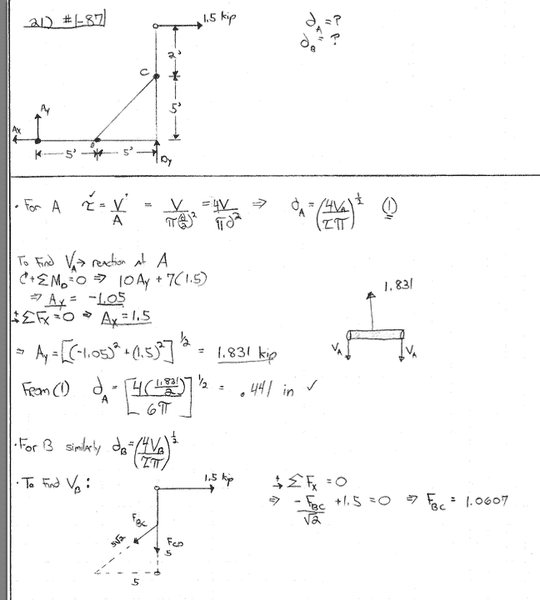
Picture2-2.png

The answer is supposed to be 26.1i-15.1j lb*ft. As you can see, my answer isn't close (WTF else is new!)

What is wrong with my method?
Thanks,
Casey
 
Physics news on Phys.org
I can't believe I keep getting the same wrong answer!
 
I think for Moment 2 you suppose to only have (i) term
 
Look at your second cross product again. Don't get discouraged, :-).

Imagine attaching a flexible pipe from the origin to the a point on the line of action of F2 and pulling on it with a rope in the direction of f2, the pipe would begin to trace out a disk and the direction of the moment caused by F2 about the origin would be defined as being perpendicular to this disk and hence must only have an i component.
 
Last edited:
tongpu said:
I think for Moment 2 you suppose to only have (i) term

dontdisturbmycircles said:
Look at your second cross product again. Don't get discouraged, :-).

Thanks guys! I was worried that my method was wrong. I wonder if I will EVER stop making tiny stupid errors. I just can't seem to stop...no matter how careful and aware I think I am being.

Oh well...siggghhh.
Thanks again!
 

Similar threads

  • · Replies 105 ·
4
Replies
105
Views
6K
  • · Replies 1 ·
Replies
1
Views
1K
  • · Replies 23 ·
Replies
23
Views
3K
  • · Replies 4 ·
Replies
4
Views
2K
  • · Replies 4 ·
Replies
4
Views
2K
  • · Replies 12 ·
Replies
12
Views
2K
  • · Replies 6 ·
Replies
6
Views
3K
  • · Replies 1 ·
Replies
1
Views
3K
Replies
5
Views
4K
  • · Replies 1 ·
Replies
1
Views
2K