Shaded Pole Motors: Old Electrical & Measuring Things

  • Thread starter Thread starter dlgoff
  • Start date Start date
  • Tags Tags
    Motors Pole
Join the discussion
Registration is free. Ask a follow-up in this thread, or start your own.
10 replies · 4K views
Messages
4,458
Reaction score
3,265
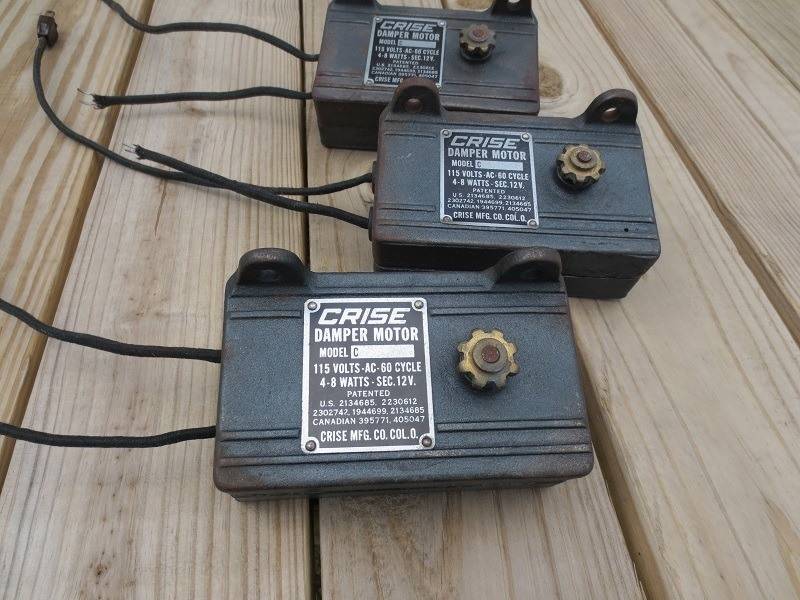
I'm wanting to add some small motors to my Beauty of old electrical and measuring things etc. thread and was curious if anyone here is familiar with Shaded Pole Motors?

DamperMotors.jpg
 
  • Like
Likes   Reactions: davenn
Engineering news on Phys.org
hey Don

They are something I have never heard of before ... had to google them to find out more :wink:Dave
 
I knew about shaded pole motors for small fans and record players,
A shorted turn around part of the core gives an out of phase flux which when added to main flux makes a rotating flux.
Another piece of sinewave magic. Euler was sure one heavy dude.

but i never saw a reversible one like described in that patent.
 
jim hardy said:
I knew about shaded pole motors for small fans and record players,
Thanks for this piece of information. Motors certainly aren't my forte. I'll need to look into record players.
 
They're easy to spot by the heavy copper shorted turn.

upload_2015-4-7_13-49-58.png


Prevalent in blower fans and small appliances.
Current in the shorted turn lags, making an out of phase flux.
imageevf.jpg


http://avstop.com/ac/apgeneral/typesofacmotors.html
The first effort in the development of a self-starting, single phase motor was the shaded pole induction motor (figure 9-85). This motor has salient poles, a portion of each pole being encircled by a heavy copper ring. The presence of the ring causes the magnetic field through the ringed portion of the pole face to lag appreciably behind that through the other part of the pole face. The net effect is the production of a slight component of rotation of the field, sufficient to cause the rotor to revolve. As the rotor accelerates, the torque increases until the rated speed is obtained. Such motors have low starting torque and find their greatest application in small fan motors where the initial torque required is low.
Shaded_pole_detail.jpg
 
  • Like
Likes   Reactions: davenn
jim hardy said:
A shorted turn around part of the core gives an out of phase flux which when added to main flux makes a rotating flux.

That's a mouthful ... too much flux in there :wink:

jim hardy said:
They're easy to spot by the heavy copper shorted turn.

View attachment 81645

Prevalent in blower fans and small appliances.
Current in the shorted turn lags, making an out of phase flux.

That's outstanding, Jim !

Have seen those copper links so often over the years and never knew their purpose

As with Don's comment ... motors are also not my fortedave
 
jim hardy said:
They're easy to spot by the heavy copper shorted turn.
Yes...they...are. Thanks for educating me. I pulled this out of one of my piles. It WILL become beautiful. :oldtongue:
tobebeautiful.jpg
From your link (bold by me)
... Such motors have low starting torque and find their greatest application in small fan motors where the initial torque required is low.

Which explains the damper motors gear train.

lowtorque.jpg
 
jim hardy said:
That'd look cool with an old wood model airplane propeller . Engineer's fan...
Good call. :bow: Any design experience as to getting "good" airflow? You know, working well is one of my design task. :oldbiggrin: