dsurfer21
- 6
- 0
Hi,
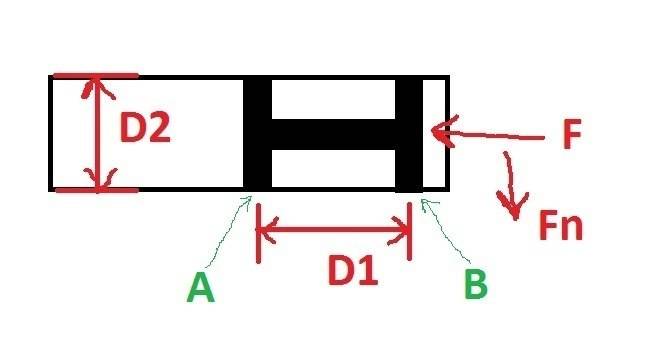
Another fellow engineer told me that for a dual connected piston guided inside a tube (as shown in the diagram below), the distance D1 has to be chosen correctly in order to avoid binding (I'm guessing from friction only) since there may be a side force present. This is ignoring gravity for now. In the example discussed there is a force F applied with some side force component Fn. I couldn't make sense as to why D1 is relevant. Can anyone explain it easily?
The only thing that comes to mind is that I see a normal force at point A and point B as a result of Fn. I can see how maybe there is a moment created at point B by the normal force at point A times the distance D1 and then a moment at point B from the force F times D2/2. Would the balance of those moments result in the value for D1?
Another fellow engineer told me that for a dual connected piston guided inside a tube (as shown in the diagram below), the distance D1 has to be chosen correctly in order to avoid binding (I'm guessing from friction only) since there may be a side force present. This is ignoring gravity for now. In the example discussed there is a force F applied with some side force component Fn. I couldn't make sense as to why D1 is relevant. Can anyone explain it easily?
The only thing that comes to mind is that I see a normal force at point A and point B as a result of Fn. I can see how maybe there is a moment created at point B by the normal force at point A times the distance D1 and then a moment at point B from the force F times D2/2. Would the balance of those moments result in the value for D1?