Simple/Basic Example on Wedge Products

  • Level: Graduate 
  • Thread starter Math Amateur
  • Start date
  • Tags Tags
    Example Wedge
5 replies · 8K views · last reply
Math Amateur
Gold Member
MHB
Messages
3,920
Reaction score
48
I am reading Barrett O'Neil's book: Elementary Differential Geometry ...

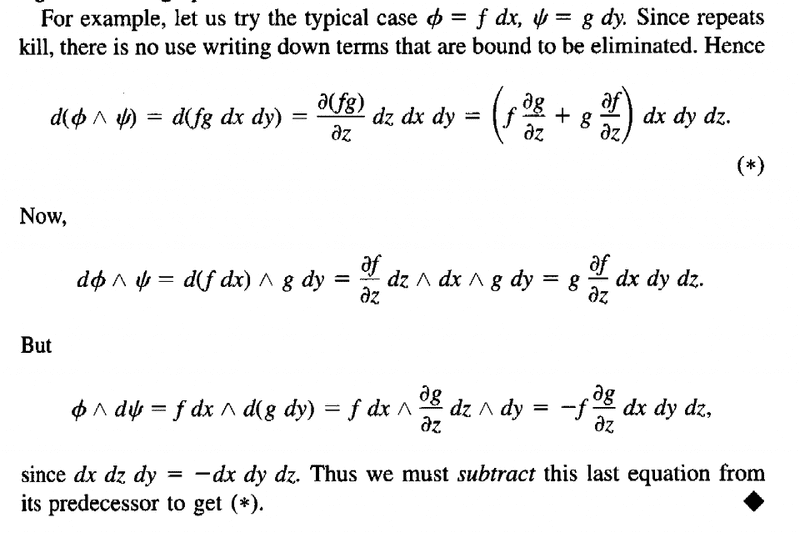
I need help with fully understanding the example on wedge products of differential forms in O'Neill's text on page 31 in Section 1.6 ..The example reads as follows:
?temp_hash=61bf9d43e782a3c8ffa0ec43c4bd722e.png
I do not follow the computations in this example ... can someone please explain (in very simple terms) how the example "works" ... essentially how do we justify each step in the reasoning ...Particularly puzzling for me is the following ... ...... in the first equation (equation *) we find

[itex]d(fg \ dx \ dy ) = \partial (fg) / \partial z \ dz \ dx \ dy[/itex]

How is this step justified?... then I find all the steps in the second and third equations puzzling as well ...

Can someone explain and justify the steps in the example in terms of O'Neill's Definitions, Theorems and Lemma's ... ...To give readers of this post the context, notation and necessary Definitions, Theorems and Lemma's, I am providing the text of Section 1.6: Differential Forms ... ... as follows ... ...
Printed textbook page titled 1.6 Differential Forms, with text on 1-forms and 2-forms, the alternation rule dx_i dx_j = -dx_j dx_i, and an equation summing f_i dx_i and g_i dx_i.

Page from a differential geometry text showing Example 6.1 computing wedge products of 1-forms, followed by Lemma 6.2 stating that wedge of 1-forms is anticommutative, with its proof.

Printed textbook page showing Definition 6.3 of the exterior derivative of 1-forms, the expanded formula for dφ in R^3, a worked example with d(xy dx + x^2 dz), and Theorem 6.4 with product rules for d.

Printed textbook page on differential forms: a worked calculation of d(fg dx dy) using the exterior derivative, followed by a remark on the minus sign from the alternation rule.
 
Attachments
  • Typeset page from a differential geometry text working through a wedge product example with f dx, g dy and exterior derivatives, ending in equation (*) and a subtraction of the last equation from its predecessor.
    O'Neill - EXAMPLE on page 31 - Wedge Products of Differential Forms.png
    28.7 KB · Views: 1,119
  • Printed textbook page titled 1.6 Differential Forms, covering 1-forms and 2-forms on R^3, the alternation rule dx_i dx_j = -dx_j dx_i, and the wedge product notation.
    O'Neill - 1 - Section 1.6 - page 28 - Differential Forms - PART 1 .png
    41.9 KB · Views: 1,017
  • Printed textbook page titled 6.1 Example, computing wedge products of differential forms, with worked steps for phi and psi, then Lemma 6.2 stating phi wedge psi equals minus psi wedge phi, with its proof.
    O'Neill - 2 - Section 1.6 - page 29 - Differential Forms - PART 2 .png
    49.1 KB · Views: 1,012
  • Printed textbook page showing Definition 6.3 of the exterior derivative of 1-forms, with the coordinate formula for d(phi) in R^3, an example computing d(xy dx + x^2 dz), and Theorem 6.4 with product rules for exterior derivatives.
    O'Neill - 3 - Section 1.6 - page 30 - Differential Forms - PART 3 .png
    33 KB · Views: 894
  • Printed textbook page on differential forms: proof of the minus sign in a wedge product formula, with worked equations for d(f dx ∧ g dy) and a remark on treating d as a 1-form.
    O'Neill - 4 - Section 1.6 - page 31 - Differential Forms - PART 4 .png
    42.7 KB · Views: 1,055
Thanks for the interesting post. I have never worked with wedge products before, but I think I can help you tear this one apart.
Using the definition of the exterior derivative see 6.3 and definition 5.2 (not included):
##d(fg \partial x \partial y ) = d(fg) \wedge \partial x \partial y##
and
##d(fg) = \frac{\partial (fg)}{\partial x } \partial x + \frac{\partial (fg)}{\partial y } \partial y+ \frac{\partial (fg)}{\partial z} \partial z.##
Using the rule about repeats being zero, you can drop the ##\partial x## and ## \partial y## terms.
This gives you:
##d(fg \partial x \partial y ) = \frac{\partial (fg)}{\partial z} \partial z \wedge \partial x \partial y.##

For the second equation:
##d(f \partial x ) =df \wedge \partial x\\
\quad = \frac{\partial (f)}{\partial x } \partial x + \frac{\partial (f)}{\partial y } \partial y+ \frac{\partial (f)}{\partial z} \partial z \wedge \partial x \\
\quad =\frac{\partial (f)}{\partial y } \partial y \partial x+ \frac{\partial (f)}{\partial z} \partial z \partial x ##
Then looking at
##d(f \partial x )\wedge g\partial y ##
gives you:
##d(f \partial x )\wedge g\partial y = \frac{\partial (f)}{\partial y } \partial y \partial x+ \frac{\partial (f)}{\partial z} \partial z \partial x \wedge g\partial y\\
\quad = \frac{\partial (f)}{\partial y } g \partial y \partial x \partial y + \frac{\partial (f)}{\partial z} g \partial z \partial x \partial y ##
Eliminating the duplicate partial y, you get:
##d(f \partial x )\wedge g\partial y= \frac{\partial (f)}{\partial z} g \partial z \partial x \partial y\\
\quad = - \frac{\partial (f)}{\partial z} g \partial x \partial z \partial y\\
\quad = \frac{\partial (f)}{\partial z} g \partial x \partial y\partial z##

For the third equation, the process is about the same.
 
Hi RUber ... thanks for the help ... appreciate it ...

Just a question about the justification for

[itex]d(fg \ \partial x \partial y ) = d(fg) \ \wedge \ \partial x \partial y[/itex]

or, in the notation of O'Neil ... ...

[itex]d(fg \ dx dy ) = d(fg) \ \wedge \ dx dy[/itex]

Now you quote Definition 6.3 ( I cannot see the relevance of Definition 5.2 ? maybe you can help ...)

Definition 6.3 says that if we have a 1-form [itex]\phi = \sum f_i \ dx_i[/itex] then [itex]d \phi = \sum df_i \ \wedge dx_i[/itex]

Now how do we get 6.3 about 1-forms to apply to a situation about 1-forms ... I'm not sure ...

It does not solve my problem ... but to get closer to apply 6.3 we can put [itex]fg = F[/itex] and then try to apply 6.3 ...but how do we deal with the fact that we are dealing with [itex]dx \ dy[/itex] and not just [itex]dx[/itex] ... I guess we could write [itex]dX = dx \ dy[/itex] ... but could we then legitimately use 6.3 ...

Can you help?

Peter
 
The general definition of the exterior derivative of a wedge product of two differential forms is

##d(α∧β) = dα∧β =
+ (-1)^{p}α∧dβ## where ##α## is a ##p##-form.

For a zero form - i.e. a function - the wedge is omitted since it is just scalar multiplication for zero forms.

##dxdy## is really ##dx∧dy## so

##d(fdxdy) = d(f∧(dx∧dy)) = df∧(dx∧dy) + (-1)^{0}f∧d(dx∧dy) =df∧(dx∧dy) + f(d^{2}x∧dy - x∧d^{2}y)##
## = df∧(dx∧dy) = df∧dxdy##

since ##d^2## is zero always.
 
  • Like
Likes   Reactions: RUber and Math Amateur
Thanks for you help, Lavinia ... most helpful ...

... BUT ... just a clarification ... (perhaps just a detail. but anyway ...)

How exactly do you get [itex]d(f \ dx \ dy ) = d ( f \ \wedge \ (dx \ \wedge \ dy )[/itex] ... ... ?

I can see that if [itex]dx \ dy = dx \ \wedge \ dy[/itex] that we would have

[itex]d ( f \ dx \ dy ) = d ( f \ dx \ \wedge \ dy )[/itex] ... ...
 
Wedge product with a zero form is just scalar multiplication - by definition. The wedge is usually left out for zero forms but this is just a notational convenience.
 
  • Like
Likes   Reactions: Math Amateur