Calculating Torque on a Rod: Net Torque, Mass & Distance

Click For Summary

Discussion Overview

The discussion revolves around calculating torque on a rod, specifically addressing how to balance a rod with an added weight by considering the net torque and the mass distribution. Participants explore the concepts of torque, center of gravity, and the forces acting on the rod.

Discussion Character

  • Exploratory
  • Technical explanation
  • Conceptual clarification
  • Debate/contested

Main Points Raised

  • One participant states that torque is calculated as the product of perpendicular force and radius, but questions how to account for the torque of the rod itself.
  • Another participant suggests calculating the torque from the weight of the rod by integrating the torques of small segments from the fulcrum to the end of the rod.
  • A third participant advises understanding the concept of the center of gravity to aid in solving such problems.
  • One participant challenges the notion of the "torque of the object itself," arguing that the rod does not generate torque independently; rather, it is the gravitational force acting on the mass that creates torque.

Areas of Agreement / Disagreement

Participants express differing views on the concept of torque related to the rod itself, with some emphasizing the role of gravitational force while others question the initial framing of the problem. The discussion remains unresolved regarding the interpretation of torque in this context.

Contextual Notes

There are limitations in the assumptions made about the distribution of mass and the definition of torque in relation to the rod. The discussion does not resolve how these factors influence the calculations.

Who May Find This Useful

This discussion may be useful for students or individuals interested in understanding torque, balance, and the effects of mass distribution in physics problems.

tummbacoco
Messages
9
Reaction score
0
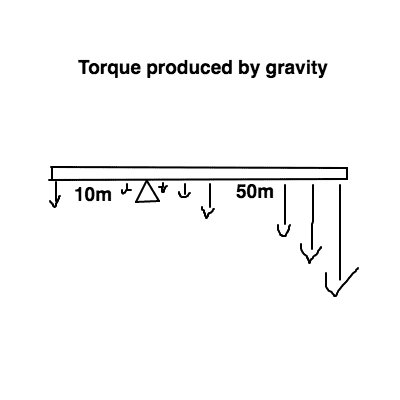
So I've learned that the torque on an object is just: (perpendicular force)(radius) and that has worked well for things like seesaws but it doesn't take into account the torque of the object itself!
7pqSg.png

In the picture the rod has a total mass of 5kg, and by definition the torque on the right is greater than that on the left. T=Fr

Now my question is a what distance to the left of the fulcrum (triangle supporting the rod) would I have to put a 3kg weight to balance the rod?? I've tried calculating the net torque Tnet= Iα but have yet to solve this problem. Since the problem is just practice I'm looking for an explanation more so than an answer. Thanks!
 
Physics news on Phys.org
Assuming the rod is horizontal, you can calculate the torque from the weight of the part of the rod each side of the fulcrum, as an integral of the torques of small segments, from the fulcrum to the end of the rod on that side.

Torque from weight of a side of length ##L = \int_0^L m g l\,\frac{dl}L##
 
Find out what the 'Centre of Gravity' of a body is . This will help you a lot when doing this sort of problem .
 
Your phrase "torque of the object itself" really does not make any sense. The object, presumably the rod, does not cause any torque; it is just a chunk of mass. The force of gravity on this mass causes a torque, but that is due to gravity, not due to the rod.
 
  • Like
Likes   Reactions: russ_watters

Similar threads

  • · Replies 2 ·
Replies
2
Views
3K
  • · Replies 8 ·
Replies
8
Views
2K
  • · Replies 14 ·
Replies
14
Views
2K
  • · Replies 21 ·
Replies
21
Views
3K
  • · Replies 3 ·
Replies
3
Views
3K
  • · Replies 6 ·
Replies
6
Views
2K
  • · Replies 4 ·
Replies
4
Views
4K
  • · Replies 4 ·
Replies
4
Views
2K
  • · Replies 138 ·
5
Replies
138
Views
9K
  • · Replies 2 ·
Replies
2
Views
3K