Simple Integrated Circuit Question

Click For Summary

Discussion Overview

The discussion revolves around a conceptual question related to an integrated circuit, specifically focusing on the voltages at various nodes in the circuit and the relationships between them. Participants explore equations related to overdrive voltage and the implications of certain voltage values in the context of NMOS transistors.

Discussion Character

  • Exploratory
  • Technical explanation
  • Debate/contested

Main Points Raised

  • One participant questions the values assigned to VD4 and VS4, seeking clarification on why VD4 is -1.5 V and VS4 is -1.3 V, noting that -1.3 V is the voltage at the drain of Q5.
  • Another participant asserts that the drain of Q4 must be more positive than its source, suggesting that the drain could be as low as -1.3 V but not lower, while the source is at -1.5 V.
  • A later reply indicates that the solution manual had an error regarding the overdrive voltage equation, suggesting it should be VOV4 = -1.3 - (-1.5).
  • New questions arise regarding the equation R = (VS2 + VGS2)/IREF, with one participant asserting that both forms of the equation seem correct.
  • Another participant elaborates that due to symmetry, VD1 equals VD2, leading to the conclusion that R can be expressed in multiple equivalent forms.
  • Questions are raised about the relationship between VDS2max and VOV2, with participants debating whether VDS2 should equal VGS2 given their connection.
  • Further discussion clarifies that VOV generally refers to overvoltage and can apply to any two transistor terminals, not strictly tied to threshold voltage (Vth).
  • One participant confuses overvoltage with overdrive voltage, leading to a clarification that overvoltage is the maximum voltage applicable between terminals, independent of other parameters.

Areas of Agreement / Disagreement

Participants express differing views on the relationships between voltages in the circuit, particularly regarding the definitions and implications of overvoltage and overdrive voltage. There is no consensus on the correct interpretation of certain voltage values and equations.

Contextual Notes

Participants reference specific voltage values and relationships without providing complete context or definitions, leading to potential misunderstandings. The discussion includes assumptions about the operation modes of NMOS transistors and the implications of circuit design choices.

Quincy
Messages
228
Reaction score
0
I have a simple conceptual question rather than an actual problem so pardon me for not using the provided template.

There's a question in my Microelectronic Circuits book involving this circuit:
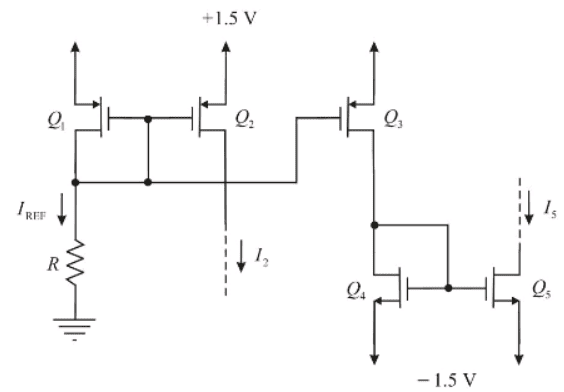
SS figure p7.51.png


where it states that
voltages at the drain of Q2 can be as high as +1.3 V and voltages at the drain of Q5 can be as low as -1.3 V.

Part of the solution involves this equation:

VOV4 = VD4 - VS4 (equation for overdrive voltage of Q4)

VOV4 = -1.5 - (-1.3)

My question is: Why is VD4 equal to -1.5 V and why is VS4 equal to -1.3 V? -1.3 V is the voltage at the drain of Q5, how did it become the voltage at the source of Q4?
 
Physics news on Phys.org
Quincy said:
My question is: Why is VD4 equal to -1.5 V and why is VS4 equal to -1.3 V? -1.3 V is the voltage at the drain of Q5, how did it become the voltage at the source of Q4?
Unfortunately, what you state is incorrect. The drain of D4 will be more positive than the source.
The drain of Q4 is > -1.5V. Perhaps as low as -1.3V but certainly no lower.
The source of Q4 is at -1.5V.
The drain of Q5 can be as low as -1.3V.
For an NMOS. the drain is more positive than the source unless it's operated in the "inverse" mode in which case the labels "drain" and "source" become a matter of semantics. I have never encountered a circuit using the inverse mode, except once which turned out to be a design error. So forget the inverse mode.
 
rude man said:
Unfortunately, what you state is incorrect. The drain of D4 will be more positive than the source.
The drain of Q4 is > -1.5V. Perhaps as low as -1.3V but certainly no lower.
The source of Q4 is at -1.5V.
The drain of Q5 can be as low as -1.3V.
For an NMOS. the drain is more positive than the source unless it's operated in the "inverse" mode in which case the labels "drain" and "source" become a matter of semantics. I have never encountered a circuit using the inverse mode, except once which turned out to be a design error. So forget the inverse mode.

Turns out the solution manual had it wrong... it should be VOV4 = -1.3 - (-1.5)
 
New question concerning same circuit: Why is R = (VS2 + VGS2)/IREF? Shouldn't it be VD1/IREF?
 
Both seem correct.
 
Quincy said:
New question concerning same circuit: Why is R = (VS2 + VGS2)/IREF? Shouldn't it be VD1/IREF?

VGS2=VG2-VS2
VS2+VGS2=VG2

VD1=VG2

due to symmetry VD1=VD2
therefore R=(VS2+VGS2)/Iref=VD1/IREF=VD2/IREF
 
New question related to same circuit in the initial post: the solution manual states that VDS2max = VOV2 = VGS2 - Vth. My question is why is VDS2max = VOV2? Shouldn't VDS2 = VGS2 since the drain and gate of Q2 are connected?
 
Quincy said:
New question related to same circuit in the initial post: the solution manual states that VDS2max = VOV2 = VGS2 - Vth. My question is why is VDS2max = VOV2? Shouldn't VDS2 = VGS2 since the drain and gate of Q2 are connected?
VDS2max is the max allowed D-S voltage. Yes, obviously, VDS2 = VGS2 so therefore you can also say that VOV2 = VGS2max.
 
Isn't VOV = VGS - Vth, so shouldn't VOV2 = VGS2max - Vth? (or VOV2 = VDS2max - Vth) rather than VOV2 = VGS2max?
 
  • #10
Quincy said:
Isn't VOV = VGS - Vth, so shouldn't VOV2 = VGS2max - Vth? (or VOV2 = VDS2max - Vth) rather than VOV2 = VGS2max?
VOV in general just means "overvoltage". It could apply to any two transistor terminals.
 
  • #11
rude man said:
VOV in general just means "overvoltage". It could apply to any two transistor terminals.
I get that but what about the threshold voltage (Vth)? The overvoltage is the voltage across two transistor terminals minus the threshold voltage. Why don't we include it in the equation for VOV = VDS2max?
 
  • #12
Quincy said:
I get that but what about the threshold voltage (Vth)? The overvoltage is the voltage across two transistor terminals minus the threshold voltage.
No. The overvoltage is the maximum voltage you can apply between any two terminals. It has nothing to do with Vth or any other transistor parameter.
 
  • #13
rude man said:
No. The overvoltage is the maximum voltage you can apply between any two terminals. It has nothing to do with Vth or any other transistor parameter.

Ah ok. I was confusing it with the overdrive voltage; I thought they were the same thing.
 

Similar threads

  • · Replies 4 ·
Replies
4
Views
5K
  • · Replies 2 ·
Replies
2
Views
3K
  • · Replies 3 ·
Replies
3
Views
2K
Replies
0
Views
2K
  • · Replies 2 ·
Replies
2
Views
2K
  • · Replies 1 ·
Replies
1
Views
4K
  • · Replies 6 ·
Replies
6
Views
2K
Replies
4
Views
1K
  • · Replies 3 ·
Replies
3
Views
2K
Replies
9
Views
2K