Understanding T^2 x L Graphing for Simple Pendulum Experiment

Click For Summary
SUMMARY

The discussion centers on graphing a T^2 x L graph for a simple pendulum experiment, specifically how to calculate T^2 from the period (T). Participants confirm that T^2 is derived by squaring the period values recorded during the experiment. For example, if T = 1.10 seconds, then T^2 = 1.21 seconds². The correct approach is to plot Length (L) in meters on the x-axis and T^2 in seconds² on the y-axis, emphasizing the linear relationship expected between T^2 and L.

PREREQUISITES
  • Understanding of simple pendulum mechanics
  • Basic knowledge of graphing techniques
  • Familiarity with units of measurement (meters and seconds)
  • Ability to perform basic mathematical operations (squaring numbers)
NEXT STEPS
  • Learn how to conduct a simple pendulum experiment effectively
  • Explore the relationship between period and length in pendulum motion
  • Research linear regression techniques for analyzing experimental data
  • Study the principles of graphing and interpreting scientific data
USEFUL FOR

Physics students, educators conducting experiments, and anyone interested in understanding the dynamics of pendulum motion and data visualization techniques.

shivam28
Messages
5
Reaction score
0
Summary: Question regarding graphing a T^2 x L graph for a simple pendulum

I did a Simple Pendulum experiment in my college physics class the other day. We were asked to graph a T^2 x L graph based off our results. I plan on using the Length on the x-axis and the T^2 on the Y-axis.

This may seem like a simple question but how would I find my T^2? Is it just simply the Period (T) that we timed but squared? For example: T = 1.10s is 1.21 T^2. Or, is there some kind of formula I need to find T^2? Here is a picture of my table that will hopefully clarify:
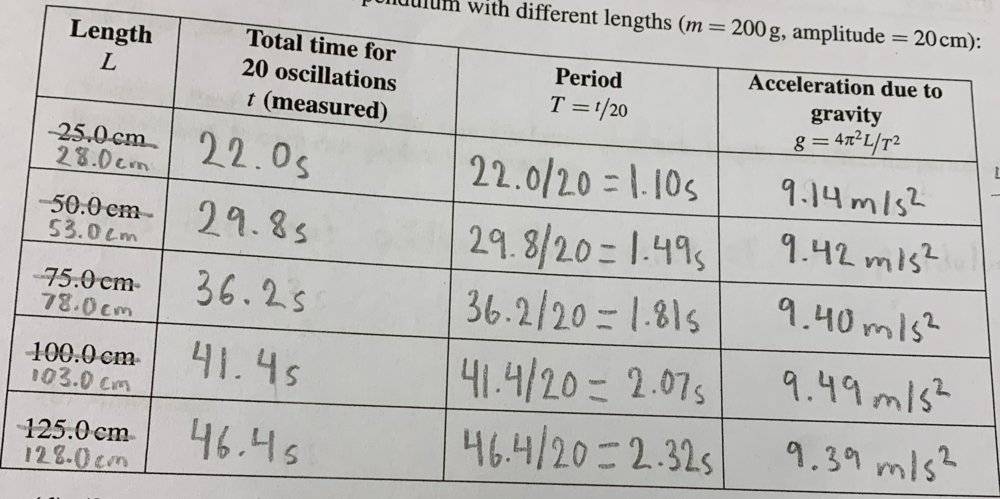
404F9E2F-6DFD-4BA0-8644-DE0A40AA76B0.jpeg


Based off my picture above, should I plot my first coordinate at (28, 1.10) or (28, 1.21)?
 
Physics news on Phys.org
You need T2 as the ordinate: you expect a linear dependency on T2, not on T.
 
BvU said:
You need T2 as the ordinate: you expect a linear dependency on T2, not on T.

Sorry, I don't believe I understand.
 
BvU said:
You need T2 as the ordinate: you expect a linear dependency on T2, not on T.

So Should I be squaring my T values to get T^2 and use those as the values on my Y-axis?
 
I would plot L (meters) on the x-axis and T^2 (seconds^2) on the y-axis.
 
gmax137 said:
I would plot L (meters) on the x-axis and T^2 (seconds^2) on the y-axis.

Yup, that's what I said I was going to do. I'm only confused on how to get my T^2. Is it just squaring the T value that I already have written down (1.10 to 1.21), or is there an equation for it (I've seen people do it both ways on different forums, with different answers).
 
shivam28 said:
Is it just squaring the T value that I already have written down (1.10 to 1.21)
Yes.
shivam28 said:
I've seen people do it both ways on different forums
Please post an example or link for the 'other' way.
 
shivam28 said:
So Should I be squaring my T values to get T^2 and use those as the values on my Y-axis?
Just DO IT and see what happens. Make y = T2 and plot x against y. :smile:
 

Similar threads

  • · Replies 9 ·
Replies
9
Views
2K
Replies
9
Views
2K
  • · Replies 5 ·
Replies
5
Views
2K
  • · Replies 3 ·
Replies
3
Views
8K
  • · Replies 26 ·
Replies
26
Views
3K
  • · Replies 3 ·
Replies
3
Views
2K
Replies
2
Views
2K
  • · Replies 5 ·
Replies
5
Views
2K
  • · Replies 8 ·
Replies
8
Views
2K