Simple pendulum with moving support

4 replies · 2K views · last reply
member 731016
Homework Statement
I am trying to find the coordinates of a simple pendulum on a rotating support.
Relevant Equations
Please see below.
For this problem,
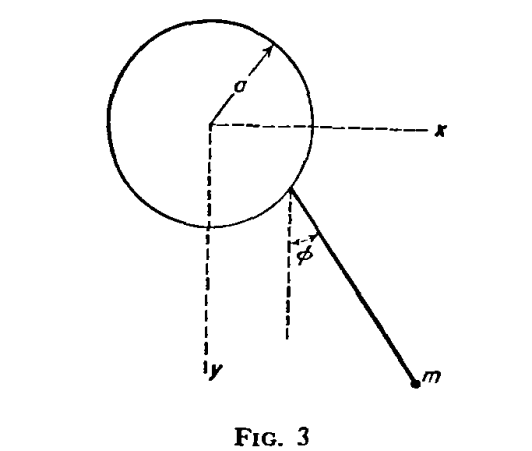
Printed text of Problem 3: a simple pendulum of mass m whose support (a) moves uniformly on a vertical circle with constant frequency gamma (Fig. 3), (b) oscillates horizontally in the plane of motion according to x = a cos gamma t, (c) oscillates vertically according to y = a cos gamma t.

Diagram of a circle of radius a centred at the origin, with x axis to the right and y axis pointing downward, and a simple pendulum of mass m hanging from the circle's edge at angle phi from the vertical.

The correct coordinates are,
Printed solution text giving the coordinates of mass m as x = a cos γt + l sin φ and y = -a sin γt + l cos φ, followed by the Lagrangian L = ½ml²φ̇² + mlaγ² sin(φ - γt) + mgl cos φ.

However, I am confused how they got them.

So here is my initial diagram. I assume that the point on the vertical circle is rotating counterclockwise, that is, it is rotating from the x-axis to the y-axis.
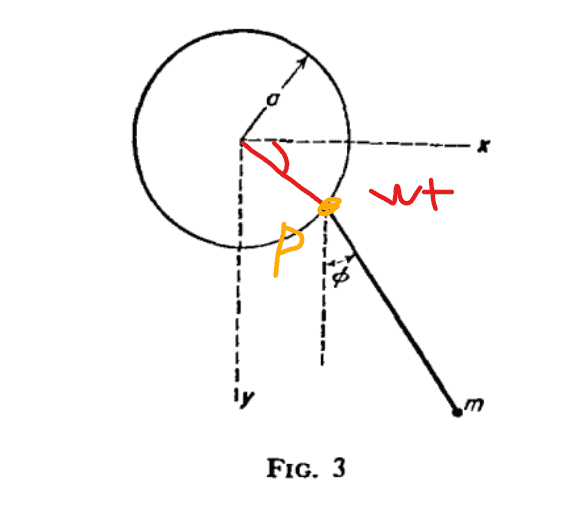
Diagram of a circle of radius a centred at the origin with x axis to the right and y axis pointing down, a point on the rim at angle wt below the x axis, and a pendulum of mass m hanging from it at angle phi.


Thus ## \omega t > 0## for the point. i.e angle subtended from positive x-axis to positive y-axis is positive. However, this does not give the correct relations for the point.

To get the correct relations, you must make the diagram,
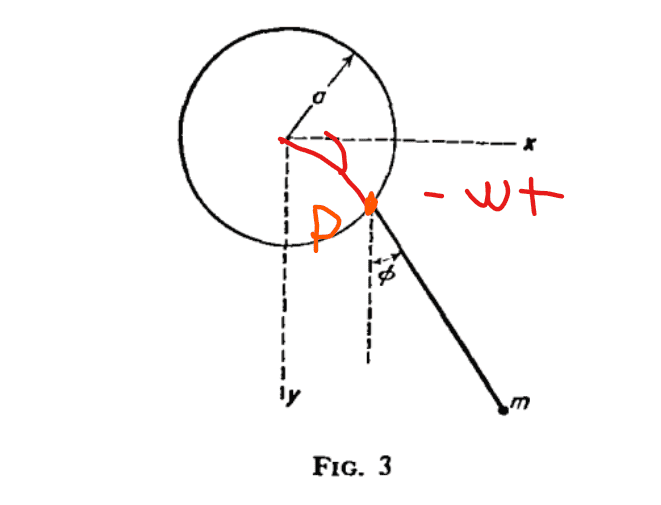
Diagram of a circle of radius a centred at the origin with x to the right and y downward, a point on its rim at angle phi, and a rod of mass m hanging from that point.

Due to the odd and even function properties of sine and cosine, this gives the desired solution since $$-\omega t < 0$$. However, does anybody please know what convention this is called, i.e. angle $$\omega t$$ rotated from the positive x-axis to the negative y-axis is positive?

Thanks for any help!
 
Attachments
  • Diagram of a simple pendulum on a circular support: a circle of radius a centred at the origin, with x-axis to the right and y-axis pointing downward. A rod at angle phi from the vertical hangs from the rim to a mass m. A red hand-drawn arc and the label wt mark an angle from the x-axis.
    1712977561129.png
    8.9 KB · Views: 126
The question does not specify whether the rotation is clockwise or anticlockwise. If it is anticlockwise then the diagrammed position can be thought of as being with t negative.
 
  • Love
Likes   Reactions: member 731016
haruspex said:
The question does not specify whether the rotation is clockwise or anticlockwise. If it is anticlockwise then the diagrammed position can be thought of as being with t negative.
Thank you for your reply @haruspex!

If the question does not specify the direction of rotation, is it in general safe to assume that is it anticlockwise, from the positive x-axis to the positive y-axis?

This question is from landau mechanics 3rd edition page 11, problem 3.

Thanks!
 
ChiralSuperfields said:
Thank you for your reply @haruspex!

If the question does not specify the direction of rotation, is it in general safe to assume that is it anticlockwise, from the positive x-axis to the positive y-axis?
If x is to the right and y is up then yes, but here the positive y axis is down, so all bets are off.
 
  • Like
  • Love
Likes   Reactions: member 731016 and MatinSAR
ChiralSuperfields said:
If the question does not specify the direction of rotation, is it in general safe to assume that is it anticlockwise, from the positive x-axis to the positive y-axis?
The question indeed does not specify the sense of the rotation. However, in order to write equations and solve the problem, one is free to choose but must choose a sense of rotation. The author of the solution has chosen
##x(t)=a\cos\!\gamma t~\implies \dot x(t)=-\gamma a \sin\!\gamma t##
##y(t)=-a\sin\!\gamma t~\implies \dot y(t)=-\gamma a \cos\!\gamma t##
It follows that
##x(0)=a~;~~ \dot x(0)=0##
##y(0)=0~;~~ \dot y(0)=-\gamma a ##
Conventionally assuming that ##\gamma## represents an angular speed not an angular velocity, we see that at ##t=0## the point of support is on the positive x-axis moving in the negative y-direction, i.e. "up" in the original Figure 3. Thus, the author of the solution implicitly chose the rotation to be counterclockwise by specifying ##x(t)## and ##y(t)##.

We can interpret the original Figure 3 as showing the point of support at time ##t## such that ##~\frac{3}{2}\pi < \gamma t < 2\pi##. Your first modified Figure 3 would be correct if you labeled the "larger angle" as ##\gamma t.##
 
Last edited:
  • Like
  • Love
Likes   Reactions: member 731016 and MatinSAR